

On January 20, the front-page headline of the military newspaper highlighted Xi Jinping’s so-called “thought on strengthening the military.” (Screenshot)
[People News] Rumors that Zhang Youxia, the current vice chairman of the Central Military Commission, had been arrested began circulating on January 20 and quickly flooded the entire Chinese-language media sphere. Leaks from various channels became increasingly explosive, and different “literary creation” versions grew ever more frightening. To this day, none of these claims have been confirmed or denied by the CCP authorities. Although the struggle between Xi Jinping and Zhang Youxia has long been a hot topic in overseas Chinese circles and even in mainstream Western media, news that Zhang Youxia had been arrested still left many half-believing and half-doubting. However, on the very day the news of Zhang Youxia’s alleged trouble spread, the front page of the military newspaper carried Xi Jinping’s instructions.
The rumors of Zhang Youxia’s arrest began to intensify on January 20. The incident was triggered by Zhang Youxia’s absence from the opening ceremony of a “special seminar” for provincial- and ministerial-level officials on the Fourth Plenary Session of the 20th Central Committee, held that day in Beijing. Afterward, various rumors of “Zhang Youxia being arrested” spread everywhere. Independent commentator Cai Shenkun released two explosive pieces of information on January 22.
On the morning of the 22nd, he revealed a shocking piece of news on X. The Special Security Bureau of CCP Minister of Public Security Wang Xiaohong had arrested military personnel; Zhong Shaojun, who had just been released, was arrested again. A total of 17 people were taken into custody.
Cai Shenkun emphasized that the source of the information could not be verified and needed further observation—for example, whether Zhang Youxia would appear at the New Year reception. But if Zhang Youxia’s arrest were confirmed, it would mean that Xi Jinping had completely come to a showdown with the red families. The remaining drama would be to see how the red families make their move at critical moments; as long as they join forces to counteract, few among Xi Jinping’s circle of confidants would likely dare to resist to the end.
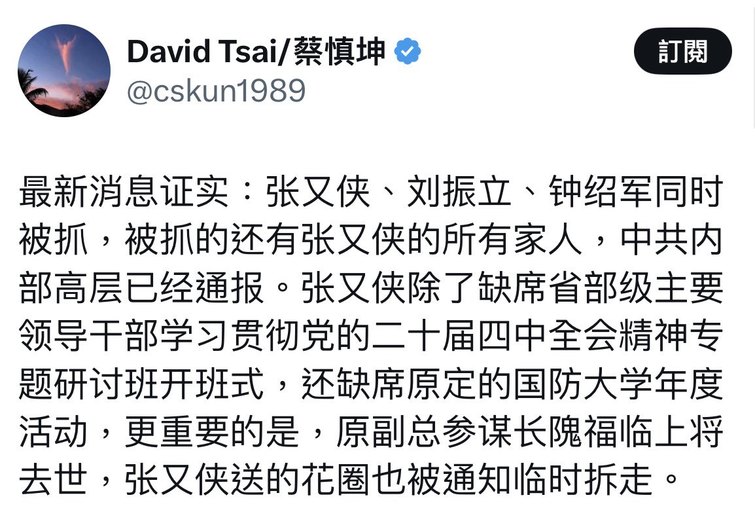
That evening, Cai Shenkun received another piece of breaking news confirming that not only Zhang Youxia, Liu Zhenli, and Zhong Shaojun had been arrested simultaneously, but that all of Zhang Youxia’s family members had also been taken away, and that the CCP’s internal top leadership had already been notified.
In addition to missing the aforementioned meeting, Zhang Youxia will also miss a scheduled annual event at the National Defense University. The information also provided an important detail: former deputy chief of the General Staff, General Wei Fulin, passed away on January 15, and the wreath sent by Zhang Youxia was reportedly removed after a last-minute notice.
At the funerals of senior CCP officials, the order of wreaths, who sent wreaths, who did not, or who no longer even had the资格 to send wreaths, all convey certain political signals.
On June 8 last year, at the memorial service for former CMC vice chairman Xu Qiliang, there was no wreath from former CMC vice chairman He Weidong, which was interpreted as an official “hint” that He Weidong was suspended and under investigation. Facts later proved that He Weidong was indeed under investigation at the time and has since fallen.
More recently, the funeral of former State Councilor Wang Binggan was held in Guangzhou on December 8. Observers noted that all Politburo members sent wreaths except former Xinjiang party secretary and Politburo member Ma Xingrui. Ma Xingrui has missed multiple important meetings and is widely regarded as having definitely run into trouble, merely awaiting official announcement. Therefore, Ma Xingrui was considered to have been stripped of the资格 to send a wreath.
If the detail that “Zhang Youxia’s wreath was removed” is true, then interpreting it through the CCP’s so-called “wreath culture” would seem to add some credibility to the rumors that Zhang Youxia has encountered trouble.
Overseas rumors are flying everywhere, and it is impossible that the CCP’s top leadership is unaware of them. So far, Zhang Youxia has not appeared to refute the rumors. But we can observe whether the Central Military Commission’s official newspaper—the PLA Daily—reveals any clues.
On January 20, the front-page headline of the military newspaper was an observation report from an army brigade. But it mainly highlighted Xi Jinping’s so-called “thought on strengthening the military,” and prominently featured Xi Jinping’s instruction to “train according to actual combat requirements and achieve integration of operations and training.”
On January 21, the front page of the military newspaper reprinted a report from the Party media People’s Daily: Xi Jinping’s speech at the “seminar” on January 20.
On January 22, the front page of the military newspaper reprinted an article from Xinhua News Agency the previous day titled A Strong Breeze of Integrity Sweeps Across the Land of China. The article mainly summarized the report on the Central Politburo’s implementation of the Central Eight-Point Regulations in 2025. Compared with previous years, this was a routine practice and did not appear to be a hint aimed at Zhang Youxia’s alleged trouble.
However, on January 20 the military newspaper sent out a signal of preparing for war in accordance with Xi Jinping’s instructions. Although this formulation is not new, in fact Xi Jinping’s hawkish tendencies have long differed from Zhang Youxia’s dovish views.
After taking office, Xi Jinping, through forceful anti-corruption measures, centralized Party, government, and military power in his own hands. At the same time, Xi promoted the “dream of a strong military” and sent out the signal of “being ready to fight at any time.” He carried out a major overhaul of the military, reducing seven military regions to five theater commands, and demanded that the military “be able to fight and win wars,” with defense spending increasing year after year.
Analysts generally believe that one of Xi Jinping’s ultimate goals in continuing his term is to unify Taiwan. However, on the Taiwan issue, there is a significant divide within the military high command. Among the dovish camp opposing the hawks, the most representative figures are former National Defense University political commissar Liu Yazhou and former General Logistics Department political commissar Liu Yuan. The dovish consensus is that launching a war prematurely before comprehensive national strength surpasses that of the United States would be disastrous.
At present, Liu Yazhou has been sentenced to life imprisonment. Liu Yuan, who was once Xi Jinping’s most powerful ally in rooting out corruption within the military, has also faded from the political scene. Both are red second-generation figures. Is their fate related to their stance on using force to unify Taiwan?
So how did the key figure Zhang Youxia transform from a hawk into a dove?
Independent scholar and columnist Wu Zuolai once analyzed that Zhang Youxia’s turning point from hawk to dove appeared after last year’s Third Plenary Session. Zhang Youxia no longer advocated the responsibility system of the CMC chairman in public, no longer frequently mentioned the “Two Establishes” and “Two Safeguards,” and increasingly avoided the topic of “preparing for war over Taiwan.” Even when citing Xi Jinping’s instructions, he mostly confined himself to general work statements and no longer “endorsed” Xi’s core privileges. Wu believed this was not a sudden personal change in Zhang Youxia’s stance, but rather the externalization of another force within the military.
In June last year, a report by the U.S. Air Force think tank “China Aerospace Studies Institute” pointed out that the CCP military was unable to implement the key military reforms needed to seize Taiwan by 2027, and cited a special article published by Zhang Youxia in 2024. This article, published in People’s Daily, revealed many shortcomings of the CCP military: weaknesses in the military leadership, problems in military–civil coordination during wartime, and deficiencies in executing large-scale joint operations.
Zhang Youxia concluded that, according to current development trends, the CCP military would find it difficult to possess sufficient capability to launch a military attack on Taiwan before 2027. In other words, Zhang Youxia effectively publicly negated Xi Jinping’s plan to use force to unify Taiwan in 2027. A principled divide has emerged within the military between “hawkish advocacy of war” and “dovish caution against war.” Perhaps this major divergence is also one of the reasons for the parting of ways between Xi Jinping and Zhang Youxia.
Recently, discussion about Xi Jinping using force to unify Taiwan in 2026–2027 has begun to ferment again. In addition to 2027 marking the 100th anniversary of the founding of the PLA, Xi Jinping may also seek a fourth term at the CCP’s 21st Party Congress. Therefore, by completely resolving the Taiwan issue, he could demonstrate the achievements of military reform, establish governing authority, and strengthen the legitimacy of his continued rule—thus becoming a “reasonable explanation” for the CCP’s possible move against Taiwan in 2027.
At present, China’s economy is in serious decline, local finances are collapsing, and waves of unemployment and a population crisis could well bring about social unrest. Many analysts believe Xi Jinping may take an all-or-nothing gamble—despite knowing the risks are extremely high—and choose to go to war over Taiwan to divert internal contradictions. Taiwan’s real risk does not lie in whether the CCP calculates that “using force to invade Taiwan is not cost-effective,” but in whether Xi Jinping will “bet anyway even knowing it is not cost-effective,” and whether he has sufficient mobilization capacity.
Has Zhang Youxia therefore become the greatest obstacle to Xi Jinping’s eagerness to use force against Taiwan? Of course, if Zhang Youxia is purged, the issues involved would not be limited to this alone. After last year’s Third Plenary Session, overseas observers believed that Zhang Youxia, together with the elders, manipulated the political situation and weakened Xi Jinping’s power. If Zhang Youxia truly falls this time, the elders would also lose their most solid “gun barrel” backing, making it even harder to restrain Xi Jinping.
Whether Zhang Youxia has actually run into trouble remains a mystery to this day. Some also believe that he may simply be ill, or that he had other more important matters to attend to and therefore missed the meeting. At the end of January, the CCP will hold its monthly Politburo meeting, as well as a New Year reception. If he does not appear at either of these two events, the probability that something has happened will greatly increase.
(People News exclusive)
△




News magazine bootstrap themes!
I like this themes, fast loading and look profesional
Thank you Carlos!
You're welcome!
Please support me with give positive rating!
Yes Sure!