

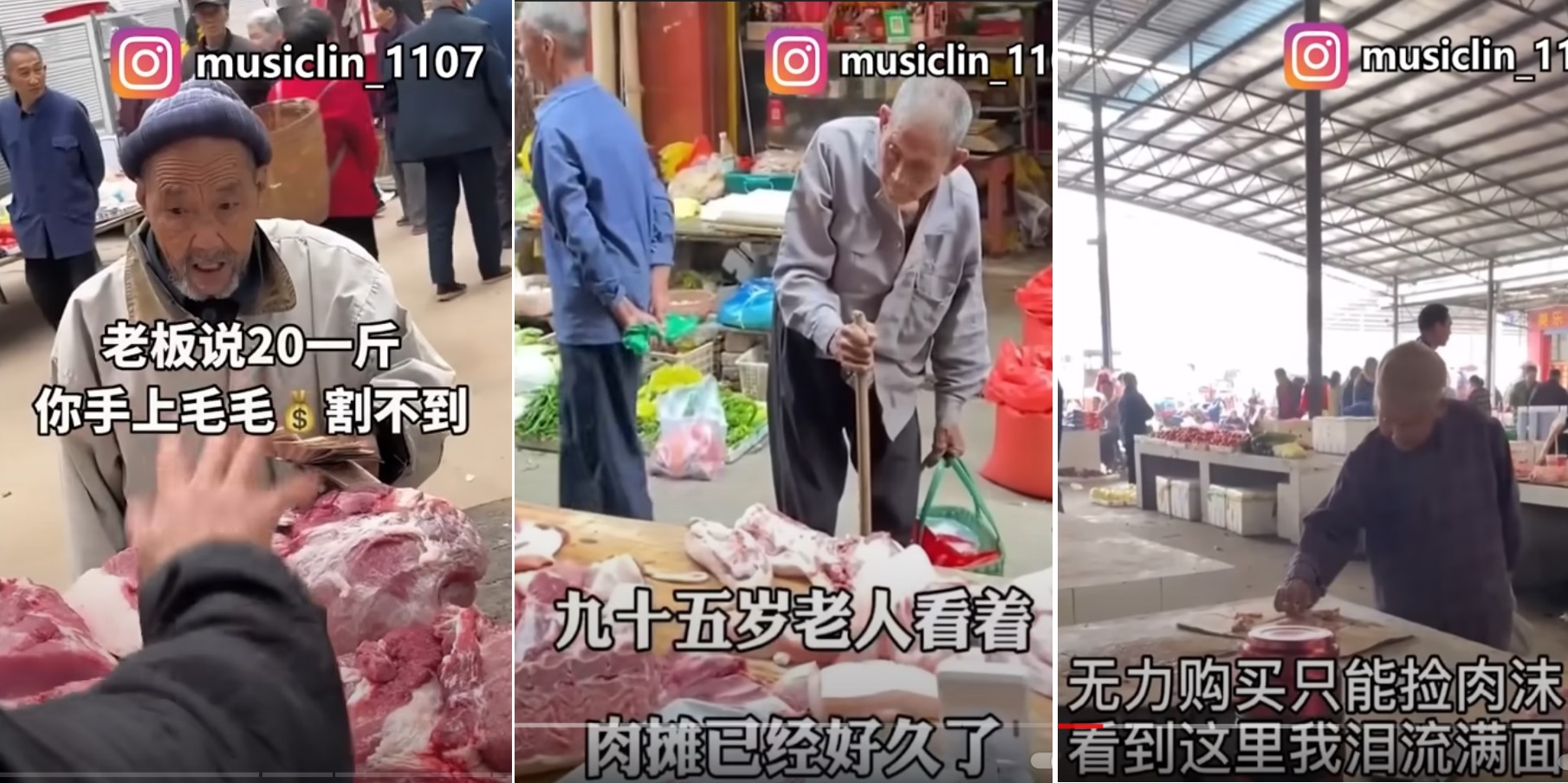
Many elderly individuals cannot even afford pork priced at 20 yuan per jin. (Video screenshot)
[People News] During this year's Two Sessions of the CCP, a representative proposed increasing the basic pension benefits for farmers aged 70 and above nationwide, once again revealing the long-hidden stark divide in China's pension system. Economist Xiang Songzuo's recording, which sharply criticised the authorities for 'artificially establishing a discriminatory social security system,' has gone viral online, directly highlighting how the CCP's logic of categorising citizens into different classes is pushing millions of farmers into a desperate situation in their old age.
The 'humble' proposal from the CCP's National People's Congress representative
As reported by the Dajiyuan, Lei Maoduan, a representative of the CCP's National People's Congress and the Party Secretary of Zhuangshang Village in the Yancheng District of Shanxi Province, proposed a 'Rural Elderly Farmers' Pension Subsidy Project' to address the issue of rural pensions. The specific measures include:
For rural elderly individuals aged 70 and above nationwide, an additional 500 yuan per month will be added to the existing basic pension insurance for urban and rural residents.
Financial blogger 'Tom' believes that this proposal is relatively 'conservative' because it limits the subsidy to farmers over 70, deliberately excluding the group of rural elderly aged 60 to 70 who have also lost their ability to work but remain overlooked by the system. The Chinese farmer population is the largest, yet the level of protection is the lowest.
This type of 'charity-style' subsidy is particularly ironic when contrasted with the stark data on the urban-rural divide.
‘Tom’ also pointed out that the disparities in pension distribution in China have long been a topic of concern. In January 2023, a statistical report released by local social security departments ignited intense discussions online. The data revealed that in a certain area, 75,500 retired enterprise employees collectively received 178.85 million yuan in pensions, averaging about 2,368 yuan per month; 13,600 retired government employees received 69.09 million yuan, averaging about 5,080 yuan per month; while 137,800 urban and rural residents receiving social security pensions only received 28.54 million yuan, averaging about 207 yuan per month.
He noted that the overall data indicate that less than 6% of retired personnel from government agencies and institutions share approximately 25% of the pension resources in society, while over 60% of urban and rural residents can only access a meager 10%. In some regions, farmers receiving a monthly pension of 200 yuan cannot even afford a standard public lunch for officials.
‘Tom’ believes that the inadequate pension security for farmers has created a structural issue, making it reasonable to increase their pensions from both a legal and moral standpoint.
Economist Xiang Songzuo has criticised the ‘Social Security Discrimination’ present within power hierarchies.
Recently, a widely shared speech on the mainland internet featured economist Xiang Songzuo questioning the issue of social security disparities.
In his speech, he remarked that some economists have focused on this issue. ‘The government claims that the people are the masters of the country, so citizens should be treated equally, without any distinctions. Why is there still a differentiation between farmers and workers? Why is there still a distinction between officials and non-officials?’
Xiang Songzuo highlighted that social security is financed by taxpayers, meaning it is essentially the money of the general public across the nation. 'I have been advocating for this for a long time. After so many years of reform and opening up, we should no longer have such distinctions. Why should the social security and medical insurance for retirees in Beijing and Shanghai be higher than in other regions? What is the rationale behind this? After all these years, why has the urban-rural divide still not been addressed?'
He noted that the retirement benefits for officials (civil servants), as commonly referred to in society, are exceedingly high. For instance, in cities like Shenzhen, Guangzhou, and Shanghai, a department-level official can receive a pension ranging from 10,000 to 20,000 yuan after retirement, while bureau-level officials may receive even more.
'In stark contrast, the pensions for farmers are significantly lower than this level.' Xiang Songzuo disclosed that he once had a conversation with the chief economist at Morgan, who suggested that the farmers' social security of 200 yuan should be increased to 1,000 yuan. 'I certainly agree, but I believe that raising it to 1,000 yuan is still too low.'
He stressed that even if complete equalisation is not achievable in the short term, the disparity should be considerably reduced, and at the very least, it should not be excessively wide. It is essential to raise farmers' pensions to at least half or two-thirds of the level of urban retirees. Isn't it said that 'governing for the people'? We should gradually increase it to 2,000 to 3,000 yuan per month.'
Xiang Songzuo's comments struck a chord with many netizens on the mainland.
The older generation of farmers has indeed faced differential treatment throughout their lives. Those born in the 1950s truly dedicated themselves to the nation, much like factory workers. They participated in collective meals and work, engaged in irrigation projects, submitted public grain purchases, and paid agricultural taxes. Now that they are ageing and unable to work, it is time for someone to take care of them; their retirement benefits should not be limited to what they currently receive.
Some internet users have also expressed scepticism about the Chinese Communist Party's government, stating, 'They will not implement such policies; the public can only entertain themselves and will find it difficult to 'snatch food from the tiger’s mouth.'
Systemic exploitation and the fiscal budget's 'favoritism'
For a long time, the budget priorities of the Chinese Communist Party have consistently favoured stability maintenance, military expenditures, and welfare within the system, while treating the vast majority of farmers as 'human resources' that can be easily discarded. This extraction model, which has persisted since the era of the scissors gap, has become the largest structural injustice in China.
Xiang Songzuo pointed out that China's state-owned enterprises, whether centrally or locally owned, are fundamentally collectively owned. Collective ownership means ownership by all Chinese citizens. In principle, the profits from state-owned enterprises should be distributed to the public. A portion of the annual profits from state-owned enterprises should be allocated to supplement social security. I believe this is entirely justified and must be implemented.'
Blogger 'Tom' has put forward a proposal that has unsettled vested interest groups: to impose a 'cap' on excessively high pensions within the system, ensuring they do not exceed the local average wage. The surplus would be redirected to the lowest-income farmers. For instance, in Shanghai, the projected average wage for 2025 is around 12,434 yuan. If the excesses of the privileged class can be trimmed, then subsidizing rural pensions is not a question of financial capability, but rather one of 'government reluctance.' △





News magazine bootstrap themes!
I like this themes, fast loading and look profesional
Thank you Carlos!
You're welcome!
Please support me with give positive rating!
Yes Sure!