
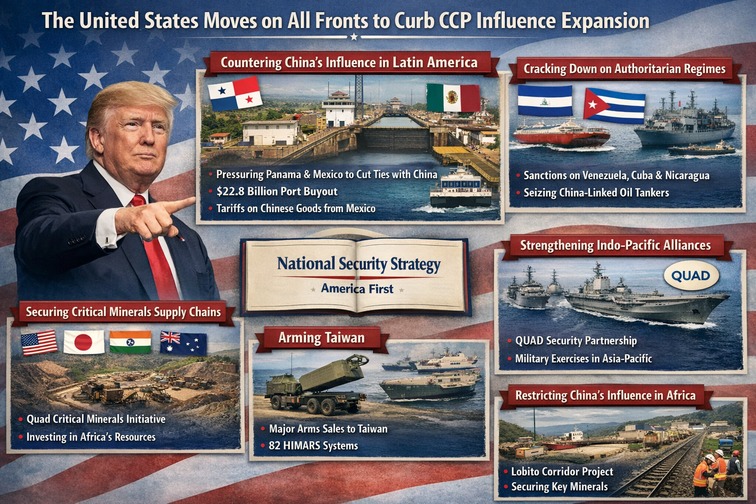
The United States Moves on All Fronts to Curb the Expansion of the Chinese Communist Party’s Influence
[People News] Since President Donald Trump returned to the White House in January this year, he has no longer emphasized “great-power competition” in relations with China. However, the Trump administration has continuously taken measures to curb China’s expansion of influence in the economic, technological, and geopolitical arenas—particularly in parts of Latin America, the Indo-Pacific, and Africa. This strategy is also fully reflected in the National Security Strategy (NSS) released by the Trump administration in December. The new strategy emphasizes blocking “non–Western Hemisphere competitors” and actively competing on the “economic and geopolitical battlefields” in the Indo-Pacific.
Preventing “Non–Western Hemisphere Competitors” From Controlling Strategic Assets in the Western Hemisphere
According to a report by Voice of America, the new National Security Strategy reaffirms the commitment to the “Monroe Doctrine,” elevates the Western Hemisphere to the most important geographic priority, and clearly states that the United States will use all means to ensure its dominance in the Western Hemisphere. These measures include curbing migration, cracking down on “narco-terrorists,” and preventing “non-hemispheric competitors from deploying military forces or other threatening capabilities in the Western Hemisphere, or from owning and controlling key assets of strategic significance.”
The “key strategic assets” mentioned in the new security strategy clearly include important infrastructure owned and operated by China in Latin America and the Caribbean, such as energy, transportation, communications, and mineral development. According to a report released in June by the U.S. think tank Center for Strategic and International Studies (CSIS), China is currently building and operating 37 ports in Latin America and the Caribbean—approximately one-third of the region’s deepwater ports.
U.S. concerns about China’s influence in South America were evident in remarks made by U.S. Southern Command Commander Alvin Holsey at an annual regional defense conference in August. Holsey said, “The Chinese Communist Party continues to methodically penetrate the region, attempting to export its authoritarian model, seize valuable resources, and establish potential dual-use civil-military infrastructure in the region, from ports to space.”
A series of measures taken by the Trump administration in the Western Hemisphere since taking office show that the United States is gradually weakening the CCP’s influence in Latin America.
Pressuring Panama and Mexico to “Decouple” From China
From February 1 to 6, newly appointed U.S. Secretary of State Marco Rubio visited Panama, El Salvador, Costa Rica, Guatemala, and the Dominican Republic in Latin America. Regarding the purpose of Rubio’s trip, the State Department made it clear that, in addition to stopping illegal and mass migration and combating transnational criminal organizations and drug trafficking, “curbing China’s influence” was also one of the objectives.
In Panama, Rubio explicitly demanded that Panama “immediately change” issues related to China’s “influence and control” over the Panama Canal. After Rubio’s visit, Panama promptly announced that it would not renew China’s Belt and Road Initiative agreement and would study the possibility of withdrawing early. In March, a consortium led by the U.S. asset management giant BlackRock stated it would acquire a majority stake in 43 port companies under Hong Kong–based CK Hutchison (including two ports in Panama) for US$22.8 billion. The transaction is currently under negotiation.
The Trump administration has also used punitive tariffs and sanctions to pressure Mexico to restrict products from China, especially automobiles. Chinese companies have been building factories in Mexico to route exports through Mexico to evade U.S. tariffs. In September, Mexico announced import taxes of up to 50 percent on more than 1,400 products from Asian countries. As Mexico’s major trading partner, the CCP was the first to be affected.
Reaching Trade and Investment Frameworks With Multiple Countries to Counter “Non-Market Economies”
The Trump administration later introduced a series of trade and investment frameworks. These framework agreements link preferential access to the U.S. market with commitments on export controls, investment screening, supply-chain risk reduction, and resistance to “non-market economy distortions.” The United States and other Western countries consider China a “non-market economy.” In November, the United States announced that it had successfully reached reciprocal trade framework agreements with Argentina, Guatemala, Ecuador, and El Salvador.
Cracking Down on Authoritarian Governments in Latin America Closely Tied to China
Washington has also stepped up pressure on authoritarian governments in Latin America that have close ties with China: Nicaragua faces the pressure of 100 percent tariffs; Cuba has long been under U.S. sanctions; and Venezuela—Latin America’s country with the closest ties to China—has recently become a key target of the U.S. government.
Since September, the U.S. military has carried out more than 20 airstrikes in international waters near Venezuela against drug-smuggling vessels entering and leaving the country, and has seized at least three oil tankers. A committee of the U.S. House of Representatives said that among them, the seized tanker Skipper was linked to China. The committee stated that “China has become a customer and a central logistics hub in large-scale sanctions-evasion activities involving Iranian and Venezuelan oil.”
On December 16, Trump ordered a blockade of all sanctioned oil tankers entering or leaving Venezuela. An analysis published by The National Interest said that, given the new U.S. National Security Strategy’s call to prevent foreign ownership of key strategic assets in the region, the blockade “was clearly also intended to undermine the increasingly deep partnership between China and Venezuela.”
China purchases about 80 percent of Venezuela’s oil exports and has made large investments in the sector. China National Petroleum Corporation is the largest foreign investor in Venezuela’s oil industry, and Chinese private companies have also signed decades-long oil production-sharing agreements with Caracas. China has already joined Russia in condemning U.S. actions at the United Nations.
It is worth noting that just days after the United States released its new National Security Strategy, on December 10 China issued its third China’s Policy Paper on Latin America and the Caribbean after a nine-year gap, signaling that it has no intention of retreating. The document stated that the CCP “shares breath and destiny with the Global South, including Latin America and the Caribbean.”
Curbing the CCP’s Military Threat and Promoting a “Free and Open” Indo-Pacific
The new strategy places the Indo-Pacific region second only to Latin America, but the document acknowledges that the region “will remain an important economic and geopolitical battlefield,” and that “for domestic prosperity, we must compete successfully there.”
The strategy commits the United States to “winning the economic future and preventing military conflict” in the Asia-Pacific region, and to actively competing there. Regarding China policy, the strategy calls for rebalancing unfair economic relationships toward mutual benefit and reshaping U.S. economic independence. It pledges to work with regional allies and partners to “jointly address predatory economic practices.” The strategy opposes unilateral changes to the status quo in the Taiwan Strait, supports freedom of navigation in the South China Sea, and recognizes the Quadrilateral Security Dialogue (QUAD), among others.
On January 21, 2025—the day after President Trump was sworn in—Secretary of State Rubio met in Washington with the visiting foreign ministers of Japan, India, and Australia for a QUAD meeting. In their statement, the four foreign ministers pledged to jointly advance a “free and open Indo-Pacific.”
Securing Critical Minerals and Supply Chains, Reducing Dependence on China
In July, the four foreign ministers met again and announced the launch of the “Quad Critical Minerals Initiative” (QCMI). The initiative aims to reduce dependence on China by ensuring the security and diversification of critical mineral supply chains through cooperation, thereby strengthening economic security and collective resilience. China strictly restricted rare earth supplies in April.
The United States has done even more to secure rare earth and critical mineral supply chains. On October 20, the United States and Australia signed a rare earth mineral development agreement worth up to US$8.5 billion. The White House said the estimated value of the raw materials to be mined is US$53 billion.
On October 26, during his participation in the ASEAN summit in Kuala Lumpur, President Trump signed a series of trade and critical mineral agreements with Thailand, Malaysia, and Cambodia, incorporating these three countries into an independent U.S. rare earth supply chain and weakening China’s dominant position.
On December 12, the United States signed the Pax Silica Declaration with four Indo-Pacific countries—Australia, Japan, South Korea, and Singapore—as well as Israel, to ensure the security of supply chains for silicon and other critical minerals required for artificial intelligence.
Strengthening Military Security Ties With Allies and Partners to Enhance Deterrence
Militarily, the Trump administration continues to adhere to traditional U.S. strategy by emphasizing the U.S.–Japan alliance, although it has demanded that Japan increase defense spending and raise its share of the costs for U.S. forces stationed in Japan. The United States hopes Japan will assume greater responsibility within the alliance and serve as a “force multiplier” for U.S. security. During a visit to Japan in March, U.S. Secretary of War Pete Hegseth said in Tokyo that Japan is an “indispensable partner” for the United States in deterring “communist China’s military aggression.”
The United States has also strengthened ties with other allies and partners. In December, the defense ministers of the United States, the United Kingdom, and Australia met in Washington and pledged to “accelerate at full speed” the trilateral strategic security and defense alliance, helping Australia acquire nuclear-powered submarines.
In 2025, the United States continued to conduct multiple bilateral and multilateral military exercises and freedom-of-navigation operations with allies and partners in the Indo-Pacific. Major exercises included the July “Resolute Force Pacific” (REFORPAC) exercise, the August “Super Garuda Shield” exercise with Indonesia, and the U.S.–Philippines “Balikatan” exercise.
The United States has also repeatedly condemned China’s military coercion against the Philippines, criticizing China’s use of water cannons against Filipino fishermen and condemning China’s establishment of a nature reserve at Scarborough Shoal (known in China as Huangyan Island). On the ninth anniversary of the South China Sea arbitration ruling, the United States also issued a statement urging Beijing to cease dangerous and destabilizing behavior.
Accelerating the Arming of Taiwan
U.S. efforts to contain China are most evident on the Taiwan issue, which China regards as a core interest. The new U.S. National Security Strategy emphasizes Taiwan’s importance—its dominance in semiconductor production and its strategic position—and states that the United States will “build a force capable of deterring aggression anywhere along the First Island Chain,” including deterring “any attempt to seize Taiwan.” Preventing conflict in the Taiwan Strait, it says, is “best achieved by maintaining military superiority. This is a priority.”
While avoiding direct military conflict with China, the Trump administration has accelerated arms sales to Taiwan to enhance its “asymmetric” capabilities. During Trump’s second term, arms sales to Taiwan have been announced twice, with the most recent in December, when the U.S. State Department approved an arms sale to Taiwan worth approximately US$11.1 billion. This deal set the largest single arms sale to Taiwan since the enactment of the Taiwan Relations Act in 1979. It includes 82 HIMARS long-range precision strike systems and 420 Army Tactical Missile Systems (ATACMS), among others. The U.S. State Department said the sale would enhance Taiwan’s defense capabilities and regional stability.
Curbing China’s Dominance in Africa’s Critical Minerals and Supply Chains
In Africa, the Trump administration has developed a new strategy that replaces the traditional single-track aid model with trade and investment. There, U.S. efforts to contain China are mainly reflected in support for projects aimed at weakening China’s dominance in critical minerals and supply chains.
On December 17, the U.S. International Development Finance Corporation (DFC) approved a US$553 million loan to Angola, a country on Africa’s Atlantic coast, to refurbish infrastructure along the Lobito Corridor railway trunk line. The Lobito Corridor spans 1,300 kilometers, extending from copper-rich Zambia through the Democratic Republic of the Congo (DRC) to Angola’s Port of Lobito. This U.S.- and Europe-led mineral supply route has been regarded since its launch as Washington’s response to China’s Belt and Road Initiative in Africa. A DFC press release that day explicitly stated that the investment “helps ensure reliable supply chains and prevent monopolization by China and other strategic competitors.”
On December 4, the Democratic Republic of the Congo and Rwanda signed a peace agreement in Washington brokered by President Trump. Prior to the signing, Trump announced bilateral agreements with both countries that “will unlock new opportunities for the United States to access critical mineral resources and bring economic benefits for all.”
The Democratic Republic of the Congo, located in the heart of Africa, produces more than 70 percent of the world’s cobalt and is the world’s second-largest producer of copper. It also possesses mineral resources such as tantalum, niobium, and lithium. Chinese media report that Chinese enterprises dominate cobalt and copper projects in the DRC, with “76 percent of the new capacity added over the past seven years coming from Chinese-funded projects.” The agreements between the United States and the DRC allow U.S. companies priority access to the country’s fabled mineral reserves, and the signing of the new agreements may hinder the entry of new Chinese investments.
On July 9, President Trump met at the White House with leaders from five African countries—Gabon, Guinea-Bissau, Liberia, Mauritania, and Senegal. The top agenda item was advancing U.S.–Africa trade and investment cooperation and expanding U.S. access to critical minerals and other natural resources. At the time, Trump told African leaders that the United States is a better partner than China. He said, “We treat Africa far better than China or anyone, anywhere.” China has investments in all five of these countries, mainly concentrated in infrastructure, energy, resource development, and trade.
△





News magazine bootstrap themes!
I like this themes, fast loading and look profesional
Thank you Carlos!
You're welcome!
Please support me with give positive rating!
Yes Sure!