
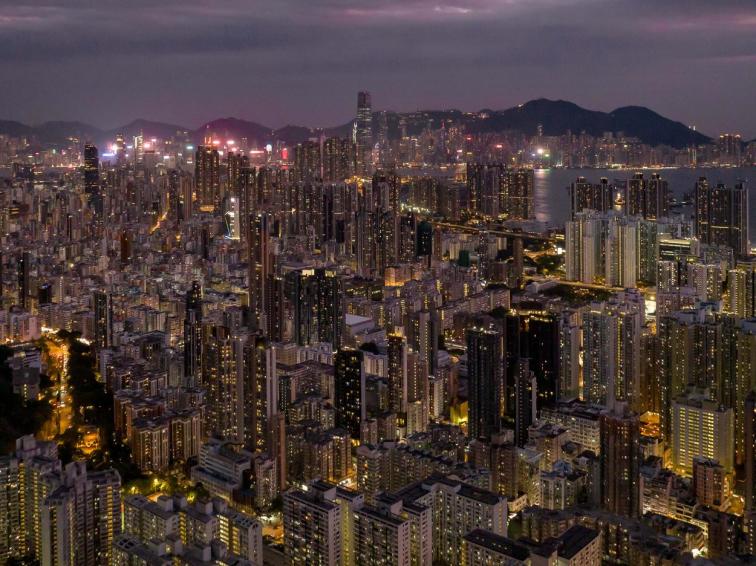
Pictured is a cityscape of Hong Kong. (Photo by Anthony Kwan/Getty Images)
[People News] Professor Ming Juzheng from the Department of Political Science at National Taiwan University is a scholar I deeply respect. Recently, he addressed the people of Hong Kong in Cantonese, calling on both those trapped in Hong Kong and those scattered abroad to unite in their efforts to advocate for the early release of Jimmy Lai. He believes that Hong Kong will surely be restored, and that China will inevitably move towards democracy.
After watching this brief video, I was profoundly moved. Both Hong Kong and Taiwan are facing the encroachment of the CCP's dictatorial rule. The people of both regions are closely interconnected; when one suffers, the other feels the pain. With Hong Kong having fallen, the people of Taiwan empathise deeply. I am unsure how many in Taiwan share Professor Ming Juzheng's heartfelt concern for Hong Kong, but Taiwan has welcomed many political exiles from Hong Kong, for which we are very grateful.
We feel a sense of injustice for Jimmy Lai and are filled with righteous indignation over his persecution, as he represents not just himself but the voice of the people of Hong Kong. He defends the values of old Hong Kong and fights for our shared future.
In several interviews, Jimmy Lai has emotionally expressed that everything he has is given by Hong Kong, which is why he fights. I want to say that everything I have is also given by Hong Kong, and I believe nearly all Hong Kong people would agree that everything in their lives is a gift from Hong Kong.
Li Zhiying, who did not complete elementary school, smuggled himself into Hong Kong with just one dollar. Hong Kong welcomed him and provided opportunities for him to struggle for survival, learn independently with determination, and boldly start his own business. He is exceptionally intelligent, incredibly hardworking, possesses remarkable perseverance, and has a keen sense of adaptability. Hong Kong allowed him to fully leverage his talents, ultimately leading to his significant achievements. His personal journey has had a direct and indirect impact on the contemporary histories of both Hong Kong and Taiwan.
Without Hong Kong, there would undoubtedly be no Li Zhiying today. However, Li Zhiying has both benefited from and contributed to Hong Kong. His contributions surpass those of other businessmen who focus solely on creating wealth for themselves. He is an integral part of Hong Kong's values, and his exemplary character reflects the spirit of Hong Kong.
Thus, today we advocate for Li Zhiying and raise our voices for his situation, not just for him alone, but for Hong Kong as well. Everything we have comes from Hong Kong, including our very selves. Our identities have been shaped by Hong Kong; without it, we would not be who we are today.
At least three generations have benefited from Hong Kong: one generation includes Kuomintang military and political figures and their families who fled south after the Chinese Civil War; another consists of refugees escaping the Great Famine in the mainland during the 1960s; and the last comprises the Red Guards who flocked south after the Cultural Revolution. These three generations arrived in unfamiliar Hong Kong after enduring material scarcity and political persecution in the mainland, with little hope of escape.
Hong Kong has wholeheartedly embraced us, offering essential living conditions, job opportunities, and personal development space for three generations. Everyone who arrives in Hong Kong has escaped the hardships of political persecution, economic hardship, and cultural oppression. While there are naturally pressures in life and work, Hong Kong does not discriminate against anyone in terms of personal freedom, political rights, job opportunities, or social welfare. It treats us all equally, providing a supportive living environment and ample room for growth.
Why do I feel grateful to Hong Kong? Because my family and I endured severe political discrimination on the mainland. My father is a Filipino-Chinese, and we were viewed as politically suspect. In the early 1970s, I was transferred from the countryside to work in the railway department. Initially, my unit intended to assign me to the technical department, but due to my overseas connections, I was deemed untrustworthy and was later assigned to work as a line worker in the electrical class.
I have had a passion for literature since childhood, and as an adult, I attempted to write. However, during the politically oppressive Cultural Revolution, individuals from my family background could not withstand the scrutiny of three generations, leaving me with no opportunity to publish any works.
Hong Kong has provided me with all the opportunities I desired without inquiring about my background or the order of my arrival. I worked as a proofreader at a newspaper, immersing myself in the publications I could access while attempting to submit articles. Hong Kong has allowed me to develop freely, enabling my family to live and work in peace and happiness.
Upon my arrival in Hong Kong, I began submitting articles to newspapers, where I criticised Mao Zedong and the Cultural Revolution without facing any political censorship or consequences. The interest in political thought and the logical thinking habits I developed during those years, along with the confidence to comment freely on global affairs, inspired me to return to writing political commentary after retirement. This has made my later years more fulfilling and provided a deeper sense of self-actualisation.
My misunderstandings about world history, as well as modern and contemporary Chinese history, have been gradually corrected since I came to Hong Kong. Much of my knowledge in the humanities was self-taught here, and my understanding of universal values was sparked in Hong Kong. It is no exaggeration to say that when I arrived in Hong Kong at the age of thirty, the city reshaped my life.
Naturally, the life outcomes I have experienced in Hong Kong differ from those of Li Zhiying; each person is unique, with distinct personality traits and life circumstances. The most crucial aspect is that this society does not oppress you, does not restrict your development, and does not impose the government's ideological beliefs upon you.
Since 1997, the institutional culture and living environment of old Hong Kong have been gradually undermined by the Chinese Communist Party (CCP), which has employed all means of authoritarianism to erode Hong Kong's intrinsic values. The people of Hong Kong have been engaged in a protracted struggle with the CCP over the future of the city, culminating in the anti-extradition movement, after which the National Security Law took precedence over Hong Kong, rendering its decline irreversible.
Recently, the devastating fire at Hongfu Garden prompted the government to silence citizens who called for an independent investigation committee. Those who voluntarily donated supplies were seen as disturbing public order. Moreover, students at the Chinese University have recently been prohibited from forming a student union. The freedoms that Hong Kong residents once enjoyed have significantly diminished, human rights are being severely infringed upon, and the rule of law has become merely a facade. Hong Kong is no longer the place we once knew.
Professor Ming Jiu Zheng encourages us to continue our fight, urging us not to lose hope or give up. We must save Li Zhiying and, more importantly, save Hong Kong. Although my family and I no longer reside in Hong Kong, it remains an integral part of our lives. Losing the Hong Kong we cherish is akin to losing a fundamental part of our existence.
Every day and night, we worry about the current state of Hong Kong and lament the loss of its past. This is our land, and we must take control. As long as our resolve remains strong, the restoration of Hong Kong is within reach.
(Author's Facebook) △





News magazine bootstrap themes!
I like this themes, fast loading and look profesional
Thank you Carlos!
You're welcome!
Please support me with give positive rating!
Yes Sure!