

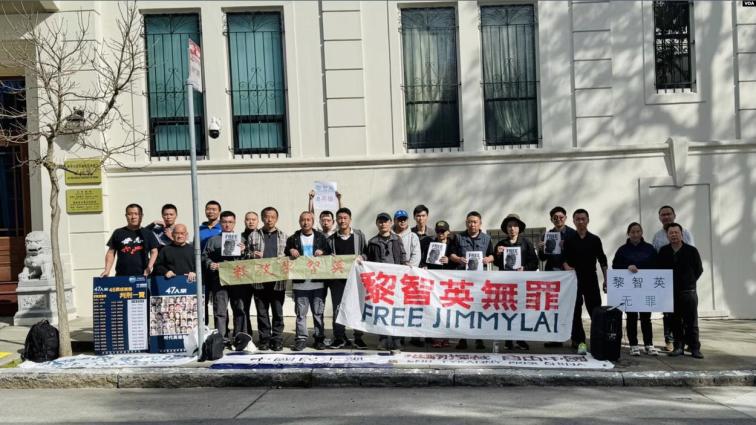
Jimmy Lai, founder of Hong Kong’s Next Digital, was sentenced to 20 years in prison after being convicted on three charges, including conspiracy to collude with foreign and external forces. (Sung Pi-lung / The Dajiyuan)
[People News] Jimmy Lai, founder of Hong Kong’s Next Digital, has been sentenced to 20 years in prison after being found guilty on three charges, including conspiracy to collude with foreign forces. Other defendants in the same case — including six former senior executives of Apple Daily and two members of the “Stand With Hong Kong” group — received prison terms ranging from 6 years and 3 months to 10 years. Three Apple Daily–related companies had earlier been convicted of “conspiracy to publish seditious publications” and “conspiracy to collude with foreign or external forces,” and were each fined HK$3,004,500.
According to Radio Free Asia, this case is the first formal trial involving the charge of “conspiracy to collude with foreign or external forces” since the Hong Kong National Security Law took effect on June 30, 2020. The case was heard by three designated national security judges of the High Court — Esther Toh, Alex Lee, and Susana D’Almada Remedios — beginning in December 2023, with the trial lasting over 150 days.
Among the other defendants, Chan Tsz-wah was sentenced to 6 years and 3 months; Andy Li to 7 years and 3 months; Cheung Kim-hung to 6 years and 9 months; Chan Pui-man to 7 years; Yeung Ching-kee to 7 years and 3 months. Former Apple Daily editorial staff members Lo Wai-kwong, Lam Man-chung, and Fung Wai-kong were each sentenced to 10 years.
Court Says Conspiracy Was Carefully Planned
In sentencing, the court stated that the conspiracy was carefully planned and premeditated, involving the use of online platforms to reach both local and overseas audiences. Judges said that calls for foreign governments to impose sanctions, blockades, or hostile actions — whether openly or subtly — encouraged foreign measures against officials of China and the Hong Kong SAR. The court considered Jimmy Lai the central figure behind the conspiracies and increased the starting point for sentencing.
Lai is 78 years old. The judges took into account his age, health condition, and solitary confinement, reducing the sentence accordingly but still imposing a total of 20 years. By the time he completes his term, he will be nearly 100 years old.
Before sentencing, Lai and the other defendants entered the courtroom. Wearing a white jacket and black-framed glasses, Lai nodded toward the public gallery and greeted former Apple Daily colleagues seated nearby. The court said it would not read aloud the full 47-page sentencing document; the announcement took about 10 minutes, and the full judgment was later posted online. When the 20-year sentence was announced, Lai nodded in acknowledgment. Sobbing could be heard in the public gallery, and several former Apple Daily staff members were seen in tears.
After the hearing, Lai and the other defendants left the courtroom calmly. Outside, Lai’s wife, Teresa Lai, was seen crying. Some members of the public embraced one another, with some saying, “There’s nothing we can do.”
Three Charges Form the Core of the Case
Lai faced three charges: one count of conspiracy to publish seditious publications under Hong Kong’s Crimes Ordinance, and two counts of conspiracy to collude with foreign or external forces under Article 29 of the National Security Law. Prosecutors alleged that 161 articles were involved, including content that called for foreign sanctions.
Legal experts noted that the court emphasized the overall pattern and continuity of actions rather than judging individual articles in isolation. A Beijing-based scholar specializing in Hong Kong and Macau legal systems told the station, “Cases under the National Security Law are handled differently from ordinary criminal cases. Courts emphasize deterrence and social impact in sentencing.”
A member of the Hong Kong Journalists Association, identified as Mr. Chan, said the case’s impact goes beyond a single media outlet. “When media content, external communication, and opinion pieces are placed under the national security framework, news organizations will reassess risks in topic selection, commentary boundaries, and interactions with overseas institutions.”
He added that since the law took effect, Hong Kong’s media landscape has changed, with several outlets shutting down or transforming. “Many people have chosen to leave Hong Kong to work in independent media or other fields overseas.”
Western Diplomats Attend the Trial
Several foreign governments have expressed concern about Lai’s case. Representatives from the consulates of the UK, Switzerland, Germany, Canada, and the EU attended the court session, highlighting international attention.
The Hong Kong SAR government said the case was handled according to law and that the ruling reflected the rule of law. Some foreign governments and international human rights organizations, however, voiced concern, saying the verdict could affect freedom of the press and expression in Hong Kong.
On the morning of the sentencing, about 100 people lined up outside the courthouse. Police increased security measures, deploying over a hundred officers, sealing off surrounding roads, restricting reporters from approaching those in line, and inspecting belongings of some members of the public.
In recent years, multiple Hong Kong media outlets have ceased operations. Legal professionals note that since the implementation of the National Security Law, media organizations have changed how they assess legal risks when dealing with external contacts and political commentary.





News magazine bootstrap themes!
I like this themes, fast loading and look profesional
Thank you Carlos!
You're welcome!
Please support me with give positive rating!
Yes Sure!