
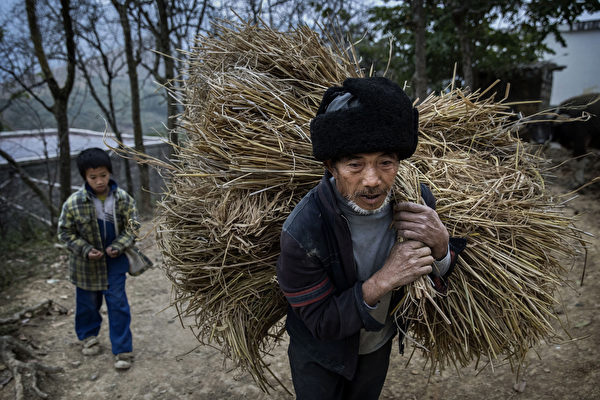
Illustration: The difficult lives of elderly people in rural China (Getty Images)
[People News] In October 2026, an unknown podcast released its 236th episode titled "Moments of Feeling 'Inferior' in China: Letters from Eleven Listeners." This episode was inspired by a post on the social platform Threads called "Share a Hundred Moments of Feeling Inferior While Living in China."
The post has garnered over 27,000 replies to date. The most frequently mentioned scenarios include: the average hourly wage being lower than the rental fee for shared power banks; needing to circumvent the Great Firewall just to play games; and having to delete a lengthy message due to fears of potential repercussions from stability maintenance concerns. These individual experiences paint a collective picture of survival in contemporary Chinese society.
Taiwanese friends, please take a moment to read this carefully; this reflects the true daily life across the strait, rather than the prosperous image presented by the Chinese Communist Party through high-speed rail, mobile payments, and skyscrapers.
Typical Cases Described by Netizens
23-year-old Jimmy from Northeast China repeatedly configures a VPN just to access code from GitHub: each time he manually updates the protocol or switches clients, it frustrates him, and the fear and self-censorship he experiences while discussing this make him feel inferior.
Dr. Zhang from a hospital in Wuhan: When signing a contract, the attachment was missing, and the webpage only displayed a "Confirm" button, with most people around her expressing no objections; after working nearly 30 consecutive hours, her night shift pay was only 50 yuan. The hospital, which received significant praise during the pandemic, later faced scrutiny due to a lack of medical insurance funds, resulting in several department heads committing suicide. She feels that, like those leaders, she lacks institutional protection under systematic oppression.
Fenqi from Weifang, Shandong, describes life in private enterprises: employees get one day off per week, and unpaid overtime has become the norm. During the probation period, undergraduates earn 3,500 yuan, while master's degree holders earn 4,600 yuan, with an additional 100 yuan for working during the New Year. He concludes, 'The Chinese economy is finished... there is no hope or future to be seen in life in China.'
Diamond from Zhangjiajie, Hunan, feels particularly affected by the term 'cattle and horses': jokes among classmates and self-deprecating posts on social media leave him feeling frustrated and defeated—people live like burdened livestock, far from freedom, and when one refuses to be a 'cattle or horse,' they are often met with the question, 'Who do you think you are?'
A contributor from Beijing, Jingjiguo, wrote that this feeling of lowliness is not an isolated incident but a long-term condition—ordinary people lack genuine decision-making power over their lives, work, expression, and even their futures. Graduates find it difficult to secure jobs, and those over 35 struggle to maintain employment, while the highest authorities lack an exit mechanism. The space for public discussion is shrinking, and when people express themselves, their first concern is often about privacy and safety.
There are even more heart-wrenching moments of everyday indignity: when going to the certificate office to take care of business, arriving at the counter at 11:40 AM disrupts the staff's early lunch, leading to a face-to-face reprimand; despite having lived abroad for over a decade and abiding by the law, one feels inexplicably anxious when encountering police, customs, or government officials—this is what is referred to as the 'indignity aftereffect'; students at boarding schools drag heavy suitcases back to school, only to face mandatory security checks at the entrance, silently queuing and placing their luggage on the conveyor belt. This hardly resembles students returning to school; it feels more like prisoners returning to jail; after a drunken argument with police, being handcuffed and tightly restrained, pleading multiple times for a bit of relief, yet the police stand before them with disdain, ultimately resulting in a six-month sentence, and now they cannot even apply for a visa to Japan; during the pandemic, just after 6 AM, community security guards harshly urged residents to undergo nucleic acid tests at the base of each building. One suddenly feels like a prisoner, with security guards taking on the role of prison wardens.
Factories do not permit leave; taking a day off threatens a deduction of three days' wages; the city is filled with surveillance cameras yet cannot locate missing children; after a gas leak at a chemical plant, only 20 yuan was offered as hush money, accompanied by a warning: 'Anyone who dares to speak out will face consequences.'
Sample population and occupational characteristics.
The 11 submissions shared by bloggers and the extensive responses on Threads reveal that the narrators are predominantly young individuals, many of whom possess higher education credentials. This group includes current university students, recent graduates, and those who have been in the workforce for a few years, as well as job seekers and professionals in their 20s to early 30s. There are also individuals over 35 who have been 'optimized', returnees from abroad, and public welfare workers. Geographically, they come from cities such as Jinan, Wuhan, Chengdu, Weifang, Zhangjiajie, Beijing, Shanghai, Guangdong, Northeast China, and overseas expatriates. Their careers are primarily in the internet, technology, healthcare, and private sector white-collar jobs, while also addressing childhood memories from rural areas, the marriage and dating market, local bureaucracies, and the judicial system.
The troubling experiences shared by these netizens cover a remarkably broad spectrum of issues: information blockades and technological isolation, unemployment anxiety, personal scrutiny, medical oppression, power bullying, gender discrimination, public security checks, public opinion censorship, and fears of authoritarianism. These issues are interwoven through the internet, healthcare, employment, education, marriage and dating, public safety, and daily life, affecting nearly every industry.
Factors related to social systems and cultural genes: the erosion of dignity within authoritarian structures.
The depiction of these degrading moments illustrates a systematic view of the totalitarian regime of the Chinese Communist Party (CCP). Initially, these were living individuals who have been suppressed by the CCP's authoritarian system, morphing into pupae within information cocoons—isolated and vulnerable, grappling with profound fears of survival and security. Internet censorship and the control of public opinion represent the CCP regime's harsh violation of the public's right to know and a deliberate obstruction of public understanding, effectively isolating individuals from the global flow of free information. Yet, they are expected to build an impenetrable barrier in an environment where 'only praises for the emperor are sung, and the voices of the common people are silenced.'
Workplace exploitation and labor conflicts arise from the unchecked power of the official authoritarian mechanism. The CCP insists that the Party directs everything, and this top-down power structure, along with labor exploitation, permeates enterprises, leading to bosses imposing the 996 work schedule, employing PUA (Pick-Up Artist) tactics, and arbitrarily withholding wages from employees. The absence of transparent and fair judicial relief options in CCP society means that collective rights protection by employees is akin to disturbing the regime's interests, resulting not in the restoration of rights but in repeated tragedies. Those who owe wages escape, while those seeking payment are driven to despair or face suppression. Xi Jinping's consecutive terms signify the lifetime entrenchment of the CCP's highest power, creating a stark contrast with the workplace crisis faced by ordinary individuals at the age of 35. The lower classes can be 'optimized' at any moment, while those in power have no mechanism for exit.
Cultural genes represent the long-term effects of totalitarian brainwashing and submissive conditioning. In China, the overwhelming authority of officials suppresses individuals, resulting in a loss of the fundamental human rights, freedoms, and dignity that should be inherent in a normal society. Those in power can look down on everything, unencumbered by any oversight or institutional constraints; the only entity that can restrain them is their superiors. This hierarchical power structure governs nearly all social activities and relationships within society. For lower-tier groups and ordinary citizens, privacy can be interrogated at will, the right to rest can be revoked, and the right to express oneself is often self-censored out of fear of the system. Even subscribing to an AI tool feels like a furtive act, with individuals glancing around nervously.
This scenario mirrors the Eastern version of Orwell's '1984'. Thought police do not need to be omnipresent; Big Brother is always watching. The surveillance gaze penetrates through advanced technologies, security checks, and algorithms, reaching into everyone’s mobile phones, fingers, and tongues, delving deep into their hearts and minds. Fear has become internalized, and self-discipline has evolved into a culture of reporting and snitching. The more the government proclaims national rejuvenation, the more the public feels degraded in their everyday lives. When the vast majority of society repeatedly experiences the sentiment of 'I am lowly', when young people envision the future as 'I am the last generation', when public spaces are reduced to trivial short videos and live-streamed sales, and when my homeland is so powerful that no one dares to advocate for me or come to my aid, this societal condition is alarmingly close to the late stages of totalitarianism.
Comparing the living conditions of people in Taiwan's free society
In contrast to the current society in Taiwan, the lowly status of individuals in the realm of the Chinese Communist Party becomes even more striking.
Recent reports from Freedom House indicate that Taiwan scores around 93-94 points in political rights and civil liberties, consistently earning the designation of a 'free country', second only to Japan in Asia. In stark contrast, China scores a mere 9 points and has been classified as 'not free' for several consecutive years. Data from various human rights assessment organizations further reveal that Taiwan significantly outperforms China in areas such as personal integrity rights, assembly and association, freedom of speech, and religious belief, with many of China's scores landing in the lowest tier.
In Taiwan, ordinary citizens can openly criticize the government, the president, and political parties without the fear of being monitored, interrogated, 'disappeared', or subjected to organ harvesting. There is no requirement to censor sensitive terms before expressing opinions, nor do individuals need to alter their voices when submitting comments. Legal protections ensure statutory working hours and overtime pay, and vacation rights are safeguarded by law, with HR practices not resembling criminal interrogations regarding personal matters such as romantic relationships, home purchases, or parents' employment.
Taiwanese individuals enjoy the freedom to subscribe to global AI tools, access GitHub, and view international content without the need to circumvent firewalls, take alternative routes, or purchase third-party gift cards.
Police and administrative officials in Taiwan are bound by multiple constraints from laws, societal norms, and public opinion, which makes instances of police power abuse extremely rare. School security measures do not treat students as prisoners, nor do they conduct blood tests on children without parental consent. The minimum wage and basic salary levels in Taiwan are significantly higher than those of most workers in China, with per capita income and overall quality of life exceeding that of the mainland. There is an open space for discussion, political parties can alternate in power, and there are clear mechanisms for power withdrawal. The people of Taiwan do not fear that their homes will be forcibly demolished by the government, nor do they worry that their rights will be threatened by government-hired gangsters. In Taiwan, individuals do not have to appease officials to get things done; they do not need to give red envelopes to doctors when visiting hospitals, and parents do not stress that their children will be relegated to the back of the class if they do not provide benefits to the homeroom teacher.
While life in Taiwan is not a perfect paradise, with its own economic pressures, housing challenges, and political disputes, the key distinction is that human rights and dignity are not only institutionally protected but also backed by a robust economic foundation. These rights are not luxuries that must be fought for at the cost of one's life or obtained through the demands of a 996 work culture. There remains a fundamental respect and freedom of space between individuals, between individuals and society, and between individuals and power. In Taiwan, power operates transparently, tightly contained, with the key to that containment inscribed on every ballot cast by the citizens.
The feeling of inferiority is not a common experience in Taiwan, nor is it part of universal values; rather, it is a conditioned response to the totalitarianism imposed by the iron fist of socialism on the other side.
Friends in Taiwan, please awaken quickly.
The Chinese Communist Party (CCP) excels at presenting its authoritarian nature through high-speed rail, mobile payments, skyscrapers, the booming short video industry, and advanced technology products, while simultaneously promoting the narrative of familial unity among the Chinese people. Many Taiwanese, particularly the younger generation, are captivated by the superficial allure of cities like Shanghai and Shenzhen, leading them to believe that 'the mainland isn't so bad' and 'life is quite convenient.' They even find themselves envious of its 'efficiency,' 'speed,' and 'scale.' This reflects the CCP's strategy of united front work and cognitive warfare, which aims to soften defenses against its authoritarian nature by masking political oppression as mere 'cultural differences' or 'development stages.'
This is simply a systematic approach and double-speak employed by the CCP's united front, where economic, technological, and cultural compliance ultimately equates to obedience. Beneath this soft compliance lies a foundation of violent coercion; refusing to cooperate with unification means 'keeping the island but not the people,' while cooperation is framed as 'the two sides of the strait are one family, blood is thicker than water.' Those who do not support unification are labeled as pro-independence advocates, while those who do are considered patriotic compatriots. Can the people of Taiwan still not see the true face of the CCP's political manipulation?
It is crucial to recognize the reality: beneath the high-speed rail and towering skyscrapers lies the sweat and blood of countless migrant workers earning meager wages of just a few dozen yuan per hour. Behind mobile payments are numerous authoritarian surveillance mechanisms that constantly monitor and record every aspect of your personal information. This technological dominance is built on the exploitation of billions who are stripped of their rights to information, expression, rest, and privacy. The self-deprecating sentiments of being 'cattle and horses' reflect the true costs hidden beneath the surface of prosperity, much like the fluctuations in the A-share market and the illusions of capital that conceal the heartbreak of those who have lost everything.
If the people of Taiwan are misled by the superficial prosperity presented by the Chinese Communist Party (CCP), swayed by its unification rhetoric, or entangled by the CCP's illicit funds, they are essentially choosing to relinquish their guardianship of freedom, human rights, and dignity. The CCP has never viewed the people of Taiwan as equal partners; they are merely a Xinjiang concentration camp that has yet to be reclaimed. It is crucial for the Taiwanese to see through the 'gilded Leviathan' and to reject the exchange of material gains for spiritual enslavement, as this represents true respect for themselves and for the ordinary people on the other side of the strait.
Dear friends in Taiwan, keep these contemptible moments of the mainlanders in mind, awaken to the reality of the CCP, and understand that the awakening of thought and the steadfastness of will are the true pillars of national defense for the people of Taiwan.
(First published by the People News)△




News magazine bootstrap themes!
I like this themes, fast loading and look profesional
Thank you Carlos!
You're welcome!
Please support me with give positive rating!
Yes Sure!