
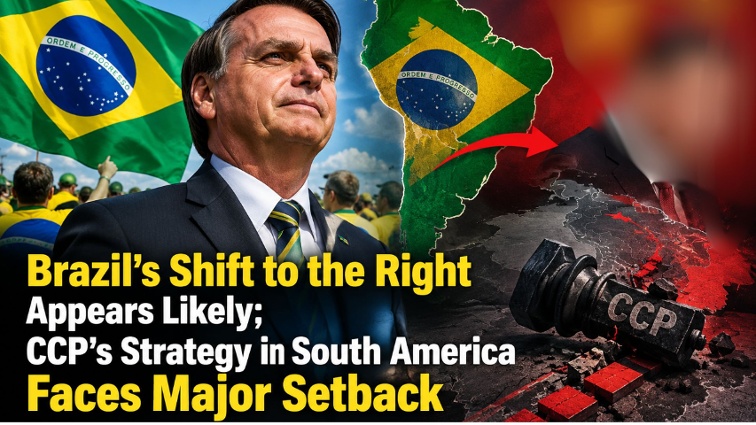
Brazil's Shift to the Right Appears Likely; CCP's Strategy in South America Faces Major Setback (People News/AI-generated image)
[People News] The first round of voting for the 2026 Brazilian presidential election took place on October 4. The results indicate that Flávio Bolsonaro, the eldest son of former president Jair Bolsonaro and the candidate from the right-wing Liberal Party, received about 47% of the votes, placing him in the lead. In contrast, the current left-wing president, Lula, received approximately 45%, falling behind by over 2 million votes. As neither candidate achieved an absolute majority, a second round of voting is scheduled for October 25.
Some analysts suggest that Bolsonaro's victory in the second round is highly probable. In addition to the presidential race, right-wing candidates won 18 gubernatorial elections, while the left secured victories in 6 states, and independents won in 3 states.
Moreover, in the Senate elections, the right gained 39 seats, while the left managed to win only 5 seats. In the House of Representatives, the right won 388 seats compared to the left's 124 seats. Notably, Michelle Bolsonaro, the wife of former president Bolsonaro, who was imprisoned due to Lula's persecution, was elected as a senator with a significant vote count in her first election. Bolsonaro's second son also won a seat in the House of Representatives.
With one member of the Bolsonaro family leading in the presidential election, another elected as a senator, and another as a congressman, does this not reflect the prevailing public sentiment in Brazil? Given this context and the data presented, it seems there is little uncertainty about young Bolsonaro's potential rise to the presidency.
Once Bolsonaro assumes the presidency, Brazil's shift to the right and closer alignment with the United States will be inevitable. This is largely due to the close relationship between former president Bolsonaro and U.S. President Trump, as both share similar political ideologies and are regarded as political allies by many observers. During Bolsonaro's presidency from 2019 to 2022, the two frequently praised each other publicly. Following Bolsonaro's sentencing by Brazil's Supreme Court, Trump voiced his support, asserting that Bolsonaro was a victim of 'political persecution' and even imposed tariff sanctions on Brazil for a period.
In the recent Brazilian elections, after Xiao Bosonaro led Lula in the first round, Trump congratulated him on what he termed a 'significant victory.' U.S. Secretary of State Rubio remarked that 'everyone' anticipated Flavio would lead in the first round, adding, 'We will see how the situation develops.'
The outcomes of Brazil's first round of presidential elections and the elections for both houses of Congress have evidently disappointed the Chinese Communist Party (CCP) the most. In a way, Lula's defeat, despite being a consistent supporter, represents a significant setback for the CCP, as it indicates a complete rightward shift across South American nations, complicating the CCP's long-term strategy in the region.
South America comprises 12 countries: Argentina, Bolivia, Brazil, Chile, Colombia, Ecuador, Guyana, Paraguay, Peru, Suriname, Uruguay, and Venezuela. In recent years, several leaders from right-wing parties have been elected as presidents in these nations.
On August 7 of this year, Colombia's far-right independent candidate, Avellardo de la Esplera, officially assumed office after receiving public backing from Trump. Following his victory, U.S. Secretary of State Rubio congratulated him during a phone call, stating, 'The Trump administration looks forward to closely collaborating with your incoming government to enhance regional security cooperation, curb illegal immigration to the United States, and strengthen economic ties between our nations.'
On July 28, Keiko Fujimori, the leader of the right-wing 'People's Power Party,' was elected president of Peru and officially sworn in. After taking office, her foreign policy shifted to a stance that is 'pro-American, pro-Israel, and anti-left,' and on September 1, she announced the formal severance of diplomatic relations with Iran.
The current president of Chile, who took office in March, is José Antonio Kast, the leader of the far-right 'Republican Party.' He has adopted President Trump's tough strategies to combat crime, secure the northern border, and carry out mass deportations of illegal immigrants, while also implementing welfare policies such as reducing corporate tax rates and promoting private investment.
On January 3, U.S. troops conducted a raid in Venezuela, capturing President Maduro and his wife and escorting them to New York for trial. Following this, Venezuela's acting president, Rodríguez, released a significant number of political prisoners, initiated market-oriented reforms, and shifted foreign policy to the right, adopting a 'pro-American' approach.
The current president of Bolivia, who will officially take office on November 8, 2025, is Pereira, the candidate from the center-right Christian Democratic Party, who also aligns with market-oriented and pro-American policies.
Daniel Novoa, the current president of Ecuador, took office at the end of 2023 and was re-elected in subsequent elections. He is a key figure representing right-wing political forces and comes from one of the wealthiest banana tycoon families in the country. Novoa favors free markets, business interests, and reforms in taxation and labor, and he is inclined to adopt strong measures against opposition.
The rightward shift in South America can be traced back to Argentina. In November 2023, Javier Milei, who champions a free market economy, seeks to diminish state power, and defends private property, was elected president of Argentina. He swiftly enacted significant economic reforms, streamlined government departments, reduced the fiscal deficit, fostered friendly relations with the United States, and followed the U.S. in withdrawing from international organizations. In contrast, the previous president, Alberto Fernández, consistently promoted pro-communist policies, referring to the Chinese Communist Party as a 'true friend.'
In other small South American nations, such as Paraguay and Uruguay, right-wing conservative forces have long been in power. The president of Guyana has shifted to a center-left stance, increasingly supporting free markets and multinational oil investments, while Suriname's ruling coalition comprises a mix of various ideologies.
The collective rightward shift among South American countries can be attributed to several factors. One significant reason is the recognition of Argentina's remarkable success, leading more people to understand that the communist and socialist belief in 'big government can solve everything' is fundamentally flawed. They now see that market competition, private enterprises, and fiscal discipline are essential for a nation's economic prosperity. Another factor is the influence of Trump, who has intensified support for right-wing parties and increased U.S. influence in South America in an effort to expel the Chinese Communist Party's influence and its 'agents' from America's backyard.
Despite a collective shift to the right among South American countries, some of them will continue to pursue pragmatic economic and trade policies with the People's Republic of China. However, it is now nearly impossible for the People's Republic of China to leverage South American nations to stir up trouble and counterbalance the United States in political, economic, and military arenas. How can the People's Republic of China not lament this situation?
(Originally published in the People News) △





News magazine bootstrap themes!
I like this themes, fast loading and look profesional
Thank you Carlos!
You're welcome!
Please support me with give positive rating!
Yes Sure!