
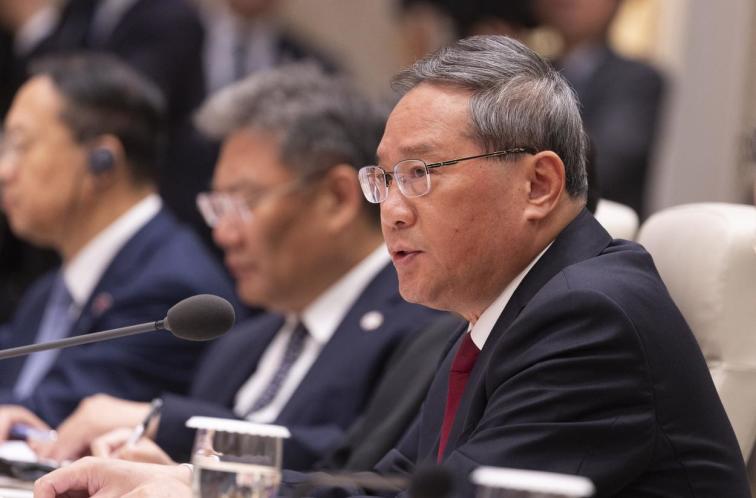
The image shows Chinese Premier Li Qiang. (Jeon Heon-kyun - Pool/Getty Images)
[People News] Recently released economic data for July in China has fallen well below market expectations. Investment has contracted, domestic demand is weak, employment is declining, and loans are shrinking, leading to a concerning overall trend that is difficult to overlook. On the eve of the Beidaihe meeting, during the July Politburo meeting, Xi Jinping continued to assert that China's economy is operating steadily and improving. However, the July data directly contradicts these claims from the highest authorities.
On August 17, Premier Li Qiang chaired the twelfth plenary meeting of the State Council, emphasizing the importance of "deeply studying and implementing General Secretary Xi Jinping's significant speeches regarding the current economic situation and economic work." He noted that "under the strong leadership of the Party Central Committee with Comrade Xi Jinping at its core, and with collaborative efforts from all sides, our country's economic performance is generally stable and making steady progress."
While Li Qiang's remarks may seem to praise Xi Jinping, they are, in fact, an attempt to deflect responsibility. He acknowledged that the issue of insufficient domestic demand remains prominent, that many industries and enterprises are facing increasing challenges, and that external uncertainties are on the rise. He called for efforts to meet the annual economic and social development goals and to ensure a strong start for the 14th Five-Year Plan. This weak Premier Li Qiang, under Xi Jinping's direct command and oversight, feels significant internal pressure, needing to consider not only how to avoid blame but also how to mitigate risks and avoid pitfalls. After all, if the GDP target of 4.5%-5% set by Xi Jinping is not met, Li Qiang risks being sidelined.
From PMI to investment and consumption data, there is a widespread weakening.
According to data from the National Bureau of Statistics, the official manufacturing Purchasing Managers' Index (PMI) dropped to 49.2 in July, a decline of 1.1 percentage points from June's 50.3. This marks the end of four months of expansion and represents the lowest level in nearly five months. The non-manufacturing PMI also fell to 49.0, the weakest reading since December 2022. The new orders index saw a significant drop to 48.5, and export orders also entered a contraction phase. The month of July was marked by extreme weather events, including typhoons and flooding, which intensified the pressure of insufficient demand during the traditional off-season.
Key economic indicators are also showing signs of cooling. The value added of industrial enterprises above a designated size increased by 4.5% year-on-year, which is lower than June's 5.3% and below the market expectation of approximately 4.8%. From January to July, fixed asset investment fell by 6.7% year-on-year, with the decline widening from the 5.7% drop observed in the first half of the year. Specifically, real estate development investment decreased by 19.2%, while investments in infrastructure and manufacturing contracted by 3.6% and 1.7%, respectively. The total retail sales of consumer goods grew by only 0.6%, significantly below the expected 1.5% and lower than June's 1.0%. Sales of major commodities, such as automobiles, were particularly weak, and although service retail showed some resilience, overall consumer momentum remained insufficient.
The price index also reflects weak demand. In July, the Consumer Price Index (CPI) rose by 0.5% year-on-year, a notable decrease from 1.0% in June, marking the lowest level since the start of the year. Food prices continued to decline, and inflation in non-food items also slowed down. The Producer Price Index (PPI) saw its year-on-year growth narrow to around 3.5%. The urban surveyed unemployment rate slightly increased to 5.2%. These figures create a chain reaction with the GDP growth rate of 4.3% in the second quarter, indicating that the internal demand growth engine has nearly lost its momentum.
Exports remain the sole pillar of support. In July, goods exports grew by approximately 23.9% year-on-year (in USD), and overall foreign trade maintained double-digit growth in the first seven months, with notable performances in machinery, high-tech products, and AI-related hardware. However, the stark contrast between strong external demand and weak internal demand has become deeply entrenched, exacerbating the imbalance in the economic structure.
Foreign media observations: Deepening imbalance, rising expectations for stimulus but uncertain scale
Foreign media outlets, including The Wall Street Journal, have focused on analyzing the July data regarding demand and the real estate market, concluding that "domestic demand remains sluggish, and the drag from real estate is deepening." The Wall Street Journal noted that the unexpected contraction in factory activity raises the bar for policy support, yet Beijing continues to exercise restraint regarding large-scale stimulus, instead emphasizing the effective implementation of existing policies and accelerating fiscal expenditure. Reports from Reuters, CNBC, and others indicate that retail, investment, and industrial output have all fallen short of expectations, with the second quarter already being the weakest growth quarter since the pandemic, underscoring a lack of consumer and investment confidence. While exports are bolstered by global AI demand, they cannot fully compensate for the shortfall in internal demand. Foreign media analyses generally suggest that the slow recovery of youth employment and the residents' balance sheets are fundamental factors limiting consumption.
The World Bank and other organizations have previously revised their growth forecast for China in 2026 down to approximately 4.4%, citing that weak domestic demand and adjustments in the real estate sector will continue to hinder economic performance. Investment banks like Nomura have issued warnings following the PMI data, indicating that GDP in the third quarter is at risk of decline, with policy options limited by fiscal deficits and decreasing marginal returns on investment.
The Chinese Communist Party is currently feeling anxious about the economic deadlock, yet it continues to project an image of calm. Authorities stress the importance of stable economic execution and a transition towards higher quality growth, with exports being the only remaining stabilizer for this stability. The transition towards higher quality refers to the supply of high-tech products, while the domestic demand engine, which requires the most stimulation, remains stagnant and suffocating. A survey conducted by Caixin involving 11 domestic and international institutions revealed that in July, these institutions estimated the year-on-year growth rate of domestic retail sales to be between 1.1% and 2.5%, with a general expectation of around 1.8%. However, the actual result was only 0.6%, compared to 3.7% in the same month of 2025, and a month-on-month decline of 8.59%, which is a drop of 0.3% compared to 2025.
Weak domestic demand and private investment are clearly reflected in the social financing data. According to the People's Bank of China, the total social financing scale at the end of July 2026 stood at 463.27 trillion yuan, marking a year-on-year increase of 7.4%, which is unchanged from June. However, this represents a decline of 1.6 percentage points compared to the 9% growth rate recorded in July 2025. When examining the balance of RMB loans, the amount issued to the real economy in July 2025 was 264.79 trillion yuan, with a year-on-year growth of 6.8%. In contrast, this July, the growth rate dropped to 5.2%, reflecting a year-on-year decrease of 1.6 percentage points. This suggests that the growth in social financing is not being driven by loans; so what is the driving force? It appears to be government bonds. In July, the balance of corporate bonds reached 36.47 trillion yuan, showing a year-on-year increase of 9.2%, while the balance of government bonds was 102.68 trillion yuan, up 14.1% year-on-year. This indicates that it is the government that is active in the financial market, rather than private investment. The current state of the Chinese economy is characterized by the government taking the lead, issuing bonds to raise funds, with state-owned enterprises making investments, while the private sector remains largely inactive.
Li Qiang is making empty promises; achieving large-scale stimulus seems unlikely.
Following the release of economic data, a State Council meeting chaired by Li Qiang signaled a commitment to market support. The meeting highlighted that insufficient domestic demand remains a significant issue. However, the emphasis continues to be on maximizing the effectiveness of existing policies, with the term 'incremental policies' described as 'timely planning of practical and effective incremental policies.' This raises some intriguing questions. Notably, similar to the Politburo meeting in July, this meeting did not disclose specific fiscal measures or a clear framework for monetary tools, indicating that the authorities have lost confidence in extensive stimulus measures and are adopting a cautious approach. The July Politburo meeting stressed the need for enhanced counter-cyclical adjustments and accelerated fiscal spending, suggesting that the policy focus for the second half of the year will likely shift towards the rapid implementation of existing policies rather than large-scale stimulus efforts to support the market.
Li Qiang's urgent directives reflect a recognition among decision-makers of the economic downward pressures. If the weakness in domestic demand persists, achieving the annual growth target will be impossible. The National Bureau of Statistics is certainly not inactive; data beautification has become routine. However, relying on cosmetic adjustments cannot deliver genuine rejuvenation or prevent ageing. Ultimately, depending on data manipulation to extend economic vitality cannot avoid the inevitable moment when the alarm bells ring.
(First published in People News)△








News magazine bootstrap themes!
I like this themes, fast loading and look profesional
Thank you Carlos!
You're welcome!
Please support me with give positive rating!
Yes Sure!