
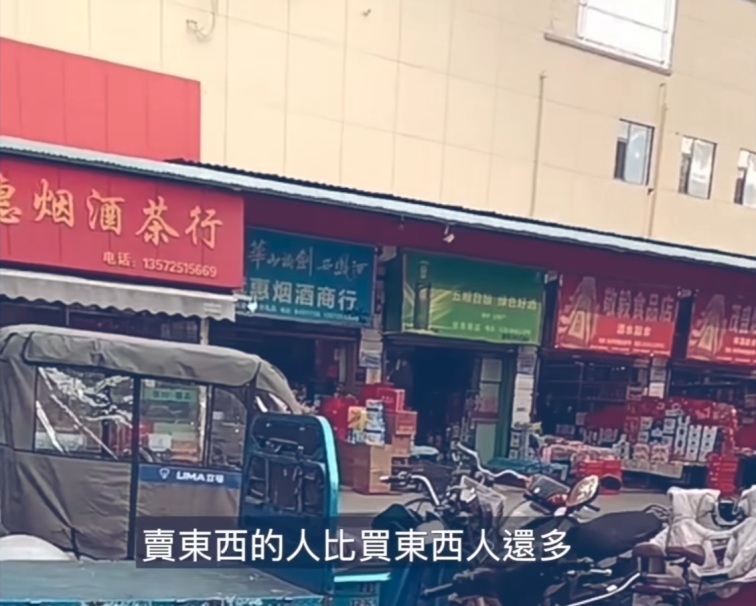
China’s economic downturn has left both major cities and remote towns struggling, with malls and markets facing a wave of closures and street vendors outnumbering customers. Many people have fallen into despair as a result. (Video screenshot)
[People News] Recently, Yao Jingyuan, the former chief economist of the National Bureau of Statistics, made a startling revelation during a public discussion with Zhang Dandan, the deputy dean of Peking University's National Development Institute, and senior investor economist Wang Boming. He stated that by October 2025, the total accounts receivable of enterprises across the country is expected to reach 27.69 trillion yuan, which is nearly 100 times the approximately 300 billion yuan involved in the 'triangle debt' cleanup initiated by Zhu Rongji in the 1990s.
Yao Jingyuan noted that the share of overdue payments in relation to GDP has surged from 14% in 2019 to around 21% by 2025. By the end of 2025, the accounts receivable of enterprises will still amount to 27.43 trillion yuan, reflecting a year-on-year growth of 4.7%, with the average collection period extending to nearly 68 days. Concurrently, corporate inventory is estimated to be around 6 trillion yuan. This indicates that the combined total of accounts receivable and corporate inventory will reach 33.43 trillion yuan, while the national general public budget revenue for 2025 is projected to be 21.6 trillion yuan. If all annual fiscal revenue were allocated to cover corporate debts and write off inventory, it would only address 64.6% of the total debts and inventory. Thus, the apparent economic prosperity suggested by these figures masks a profound micro-level dilemma characterized by extreme uncertainty.
In 2025, China's GDP is projected to surpass 140 trillion yuan for the first time, reaching 140.19 trillion yuan, with a growth rate of 5.0%. This growth rate only slightly exceeds the increase in corporate debt by 0.3%. These statistics reveal a stark and troubling reality: the output generated by companies is largely recorded as credit, resulting in a significant lag in cash flow, while short-term debts are at risk of default due to repayment difficulties. The GDP calculated using the production method includes total output at the time goods are produced, and when inventory and accounts receivable expand simultaneously, macroeconomic data may meet targets. However, the actual disposable liquidity available to the corporate sector has been eroded by approximately 26%. It is widely recognized internationally that when accounts receivable constitute more than 20% of current assets, it enters a high-risk zone, and the current level has clearly surpassed this warning threshold. This liquidity trap can easily lead to a breakdown in corporate financing; as companies produce more, the pressure from advance payments increases, and the gap in funding for reproduction deepens. Small and micro enterprises are particularly vulnerable, as overdue payments often become the final straw that leads to their collapse.
Among the 27.43 trillion yuan in accounts receivable, significant sources of debt include the amounts owed by local governments to enterprises and local government bonds. Incomplete statistics indicate that local governments' debts to enterprises have reached 12 trillion yuan. By the end of 2025, the balance of local government debt is projected to be around 54.82 trillion yuan. Although the Chinese Communist Party has intensified its debt issuance efforts, utilizing special bonds and refinancing bonds to repay some debts, many regions have allocated hundreds of billions to over a trillion yuan for debt clearance. Courts have also enforced collections amounting to hundreds of billions, and the total repayment of accounts owed to small and medium-sized enterprises has surpassed one trillion yuan. Nevertheless, the ongoing reality of 'clearing while incurring new debts' has not fundamentally changed the situation. Delays in settling payments for government investment projects and high levels of bad debts from government and enterprise clients have directly increased accounts receivable in sectors such as construction, building materials, and equipment. Following the contraction of land finance, local repayment capacity has been constrained, and the government's strategy of borrowing new debt to pay off old debts merely postpones the maturity of the debt without providing substantial repayment.
The apparent prosperity on the supply side contrasts sharply with the underlying microeconomic realities, which are reflected in the weakening price indices on the demand side. In July 2025, the Consumer Price Index (CPI) remained unchanged year-on-year, while the core CPI rebounded to 0.8%. However, the Producer Price Index (PPI) still experienced a year-on-year decline of 3.6%. The long-term negative growth in industrial product prices signifies pressure on factory gate prices and a reduction in profit margins, with downstream price cuts and extended payment terms becoming commonplace. The combination of overcapacity and insufficient effective demand complicates inventory reduction efforts, leading to a stark contrast and disconnection between GDP growth driven by excess capacity and actual consumer scenarios.
According to the "2026 First Half Financial Statistics Report" published by the central bank on July 15, 2026, new RMB loans totaled 10.72 trillion yuan in the first half of the year. By the end of June, the balance of RMB loans reached 282.63 trillion yuan, reflecting a year-on-year increase of 5.2%. The total balance of both foreign and domestic currency loans stood at 286.43 trillion yuan, marking a year-on-year growth of 5.1%. This represents a notable slowdown compared to the 12.92 trillion yuan added in the first half of 2025, with a year-on-year decrease of approximately 2.2 trillion yuan, indicating that the credit growth rate has entered a low execution phase. Notably, short-term loans in the household sector have seen a significant decline, which reflects weak demand for consumer loans and credit cards. Meanwhile, the growth of medium and long-term mortgage loans has only seen a slight increase, suggesting that financing demand related to real estate remains subdued. This marks the first recorded instance of a net decrease in household loans over a half-year period, highlighting the long and challenging road ahead for the recovery of household balance sheets, alongside a clear trend of preventive savings among residents.
In the first half of this year, new medium and long-term loans for enterprises reached 5.55 trillion yuan, serving as the primary support for credit growth, primarily directed towards medium and long-term investments in manufacturing and infrastructure. Conversely, a significant portion of credit has been directed towards enterprises, likely to address gaps in receivables. The growth observed on corporate balance sheets has long depended on loans to fill these gaps, resulting in passive leverage that is likely to undermine genuine expansionary investments.
In contrast to the triangular debt crisis during the Zhu Rongji era, the current situation has undergone a significant qualitative transformation. In the early 1990s, triangular debt peaked at around 300 billion yuan, which represented about 15% of the GDP at that time. This crisis was primarily caused by inter-company defaults, which were rooted in a shortfall in fixed asset investment, inventory backlogs, and corporate losses. The central government responded by injecting funds, facilitating a chain of debt clearance, reducing inventory and project pressures, and dismantling local protectionism, successfully clearing over 200 billion yuan in a short time. Alongside market-oriented reforms and adjustments in the monetary environment, the economy managed to recover from its difficulties. At that time, the issue was a linear debt chain problem characteristic of a transitional phase.
Today, under Xi Jinping, the economy is experiencing a downturn and spiral deflation, with accounts receivable becoming systemic and structural issues. These problems are intertwined with local government debt, diminishing land finance, overcapacity, declining investment, the relocation of industrial chains, and the illusion of prosperity created by GDP accounting methods. The debts of the government and state-owned enterprises are pushing small and medium-sized enterprises out of the market, while leading companies, taking advantage of their dominant positions, are extending payment terms, forcing private and smaller enterprises to cover costs upfront. Following the establishment of the Bureau for the Development of the Private Economy by the Communist Party of China last year, a collaborative effort with multiple departments to clear debts has led to the counterintuitive situation of 'more governance resulting in more problems,' with payment terms reaching historically high levels and nearly 20% of enterprises facing long-term defaults. This situation is not merely a financial issue or a simple one-way debt chain problem like that of the Zhu Rongji era. Rather, it reflects the destructive consequences of Xi Jinping's isolationist policies, his focus on national security, the abandonment of reform and opening up, the suppression of private enterprises, and a complete shift towards a development model centered on political security and regime stability.
In July 2026, Xi Jinping openly acknowledged at a symposium with non-party members that the current Chinese economy is facing "some difficult challenges." Subsequently, the Politburo meeting outlined the work agenda for the second half of the year, stressing the need to bolster and expand domestic demand, timely plan incremental policies, and implement more proactive fiscal and moderately loose monetary policies. The shift in official language from "pressing forward under pressure, moving towards new and better" to a clear recognition of difficulties serves as a significant signal. The issue at hand is that these challenges are not sudden or incidental; rather, they are the result of years of political calculations that have overlooked economic realities.
China's GDP is approximately 60% of that of the United States, with an even larger disparity in corporate profits, reflecting differences in value chain positioning and added value. While China's GDP contribution is substantial, profits remain thin. This thin profit margin has turned the 27 trillion yuan in accounts receivable into a heavy burden on liquidity. In simpler terms, if we were to exclude the 27 trillion yuan in accounts receivable and 6 trillion yuan in inventory from the reported GDP, the so-called "prosperity" would quickly diminish. The critical issue is not whether the total reaches 5%, but rather what is being produced, whether it can genuinely realize value, and whether companies can receive payments and sustain their operations.
Amid the disparity between macroeconomic data and microeconomic experiences, Yao Jingyuan offers a set of traceable and verifiable data. While the accounts may meet planned targets, the unrecoverable funds, unsold goods, and the small and micro enterprises that are financing themselves represent the true state of economic execution. Xi Jinping's admission of the current economic difficulties may have emboldened the National Bureau of Statistics to remove the facade and stop pretending, but after the bubble bursts, policies remain unchanged, leaving behind only chaos and the helplessness of an impending crisis.
(First published by the People News) △







News magazine bootstrap themes!
I like this themes, fast loading and look profesional
Thank you Carlos!
You're welcome!
Please support me with give positive rating!
Yes Sure!