

Foreign netizens have expressed their dissatisfaction with headphones purchased from Temu. (Video screenshot)
[People News] Chinese factories are taking advantage of the loophole in Western countries' 'low-value tax-free packages' to flood the global market with low-priced goods, dumping surplus production into other nations and causing significant economic damage.
5.9 Billion Packages a Year Overwhelm the EU
Data from EU customs indicates that the number of low-value consignments (packages valued under 150 euros) in the EU has surged dramatically: approximately 1.4 billion in 2022, projected to reach about 4.6 billion in 2024, and nearing 5.9 billion by 2025 (around 5.8 to 5.9 billion).
Officials and analysts in the logistics sector note that over 91% of these cross-border tax-free low-value packages originate from China, primarily shipped through platforms such as Temu, SHEIN, and AliExpress.
In traditional trade models, goods must be imported in bulk, pay tariffs, and pass through European wholesalers and retailers, which adds local store or e-commerce operational costs. In contrast, the direct mail model from China eliminates all intermediaries and tariffs, bypassing local European logistics and wholesale, resulting in extremely low prices. This has led to the closure of over 50,000 distributors and channels that depend on retail chains, causing more than 26 million people to lose their jobs.
Customs authorities across EU countries are grappling with the overwhelming challenge of a massive influx of packages that hampers their inspection capabilities, resulting in direct losses of up to hundreds of billions of euros in tariff and value-added tax (VAT) revenue each year.

Chinese bloggers have accused Temu of exploiting the surplus value of its employees and pressuring suppliers on raw material costs. (Video screenshot)
In response, the EU is taking urgent measures to rectify the situation.
The EU has reached a breaking point and can no longer tolerate the situation. Under the Digital Services Act, it has fined Temu, a subsidiary of Pinduoduo, over 200 million euros this year, and imposed a hefty fine of 550 million euros on AliExpress, a subsidiary of Alibaba.
Additionally, the EU has enacted a customs reform bill that will eliminate the duty-free status for packages valued under 150 euros starting in July. It will also impose fixed tariffs and VAT on imported small packages, while mandating that e-commerce platforms assume legal responsibility for customs pre-declaration and tax withholding.
France has introduced the 'Anti-Over-Fast Fashion Act' targeting Shein, which includes a direct ban on advertisements and an ecological tax of up to 1 billion euros.
Multiple consumer protection agencies in Europe have highlighted that many direct mail packages lack EU CE safety certification and have issues with excessive chemical substances or infringement. The EU is considering applying the strictest regulations of the Digital Services Act (DSA) to platforms like Temu and SHEIN, requiring them to take legal responsibility for the quality of the products sold on their platforms.
Customs authorities are implementing AI reviews and big data comparisons to rigorously investigate tax evasion practices that involve splitting large packages into multiple smaller packages valued under 150 euros.
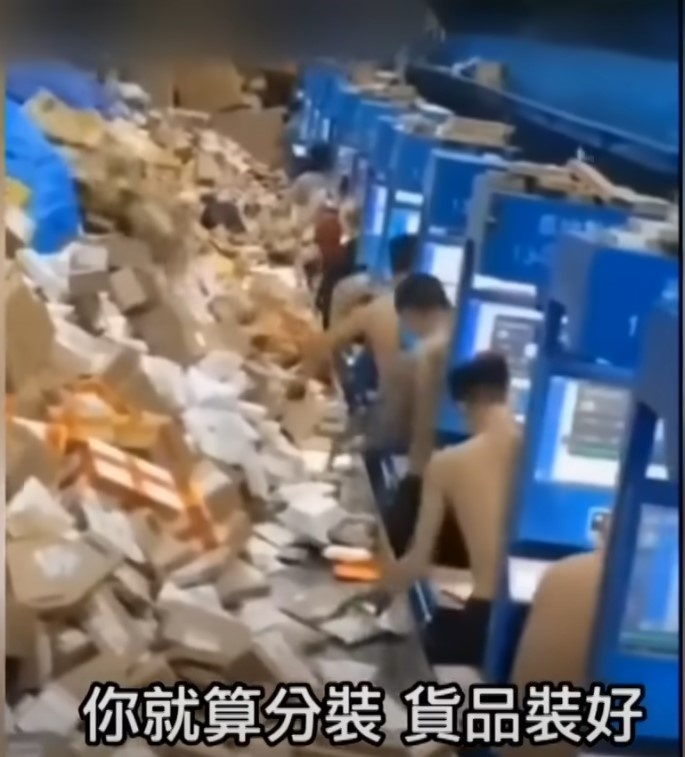
Recent media reports have highlighted the harsh working conditions faced by workers on Temu's production line, where they work shirtless, with sweat and dust contaminating the products. (Video screenshot)
Extreme Selfishness Provokes Global Outrage
Chinese e-commerce companies are slashing labor costs domestically, creating efficient supply chains, and resorting to non-compliant practices like subsidies and counterfeiting. This has led to a vicious cycle of internal competition and the export of this competition abroad, resulting in job losses worldwide.
The extreme selfish actions of Chinese e-commerce, which depend on 'extremely low prices,' 'exporting competition,' and exploiting 'policy loopholes' in other countries, while 'disregarding the livelihoods of others to accumulate wealth,' have incited global anger. Countries from Southeast Asia to North America are now erecting barriers to prevent the aggressive influx of Chinese goods. They caution: while it may be tempting to celebrate the purchase of cheap Chinese products, one must be wary of the potential job losses for many. This containment effort has evolved from initial minor disputes into a comprehensive, multi-faceted regulatory crackdown on a global scale.
An investigative report by the Associated Press published on June 17 this year indicates that the 'China Shock 2.0' resulting from China's overcapacity is significantly different from previous instances. In the past, Chinese goods made up only 4% of global exports, but this figure has now skyrocketed to 16%. Additionally, the policies of the Chinese Communist Party encourage overproduction in factories, with state-owned banks offering low-interest loans to state-owned enterprises, facilitating their continued expansion.
Maurice Obstfeld, the former Chief Economist of the International Monetary Fund, stated in an interview with the Associated Press that the Chinese Communist Party's actions are partly aimed at keeping factories operational. However, this has led to an oversupply of domestic goods that can only be dumped in foreign markets. Consequently, low-priced Chinese products are flooding the global market, posing a threat to the survival of manufacturing sectors in Europe and other countries. Unless the Chinese Communist Party takes measures to rein in this situation, it is likely to worsen.
Governments worldwide must take China's e-commerce expansion seriously.
Previously, U.S. Customs received millions of small packages each day. The U.S. government has enacted executive orders and legislation to fully suspend and terminate the De Minimis tax exemption for small packages from China and globally. This means that all direct mail items from China must undergo formal customs declaration and pay relevant tariffs and disposal fees, including those under Section 301.
In Brazil, the 'Remessa Conforme' program has been introduced, which eliminates federal tax exemptions for personal mail packages valued under $50 and imposes import tariffs ranging from 20% to 60%, along with ICMS interstate flow taxes on small packages.
Mexico is rigorously investigating the use of express channels to evade taxes by breaking down shipments, leading to the removal of tax benefits for certain low-priced packages.
The approach of 'lowering costs + exploiting policy loopholes + exporting external pressures' adopted by Chinese e-commerce has allowed it to dominate the global market in recent years. However, as it begins to genuinely threaten the tax revenues of various countries, local retail ecosystems, and the livelihoods of tens of millions of people, a global backlash and containment are becoming inevitable.
The high-pressure crackdown led by the European Union and France is not just a series of penalties imposed on several e-commerce giants; it also signifies the start of a global institutional break from China's 'low-price dumping-style cross-border trade'.
△






News magazine bootstrap themes!
I like this themes, fast loading and look profesional
Thank you Carlos!
You're welcome!
Please support me with give positive rating!
Yes Sure!