
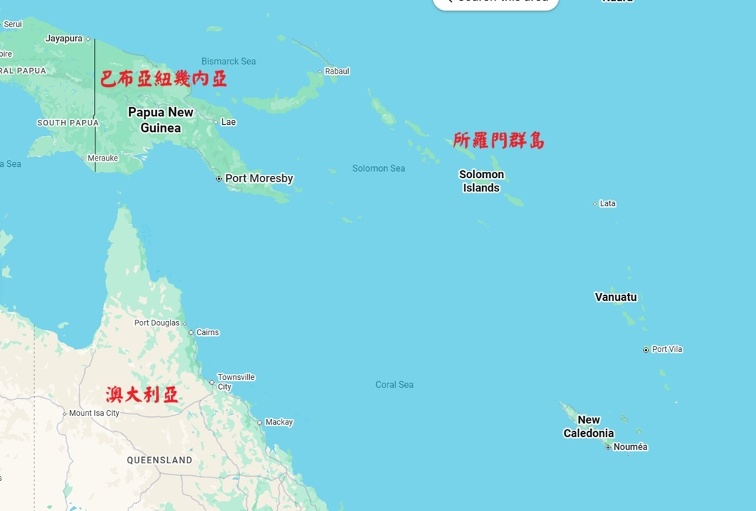
The Solomon Islands, a nation in the South Pacific, has seen three Prime Ministers come and go in just two years. (Screenshot from Google Maps)
[People News] During a recent visit to the United States, Prime Minister Matthew Wale announced plans to sign an agreement with the U.S. Coast Guard. This agreement will allow U.S. vessels to patrol the waters of the Solomon Islands alongside local police forces. This development comes on the heels of a secret security agreement signed with the Chinese Communist Party in 2022, leading former Australian diplomats to view this as a significant pivot in the Solomon Islands' foreign policy.
Wale, who was elected Prime Minister in May of this year, has pledged to bring about change in the country.
On July 20, during his visit to the U.S., Wale met with U.S. Coast Guard Vice Admiral Thomas Allan in Washington, D.C. The Solomon Islands government released a statement indicating that the two parties will sign a 'ship rider agreement' next week in the capital, Honiara, aimed at strengthening joint maritime law enforcement and monitoring capabilities.
The statement highlighted Wale's concerns about the escalating threats of drug trafficking, human trafficking, and illegal, unreported, and unregulated (IUU) fishing activities, underscoring the urgent need to enhance security in the Pacific region.
According to comprehensive media reports, Val (Wa'er) stands apart from the previous two pro-China prime ministers. His diplomatic approach has shifted towards 'pragmatism, diversity, and rebuilding trust with Western allies.' He is actively enhancing cooperation with Australia, New Zealand, the United States, and Japan—planning a visit to Japan shortly after taking office—in areas such as economic development, education, and defense, in an effort to reverse the previous hardline 'anti-West' stance of former Prime Minister Sogavare (Su Jiawa Rui).
In recent years, the U.S. Coast Guard has expanded its patrols in the South Pacific, assisting 'onboard observers'—local police from Pacific island nations—in monitoring vast ocean areas covering millions of square kilometers to combat illegal fishing fleets.
As reported by the Liberty Times, James Batley, a former Australian diplomat to the Solomon Islands, noted that Val is taking concrete steps to deliver on his promise of change. 'The Pacific region is increasingly worried about the flow of drugs linked to transnational crime, and the Solomon Islands have even seen the emergence of 'narco subs.' Therefore, I believe the U.S. can provide compelling reasons to show that they can offer substantial assistance in this area.'
Furthermore, Val met with U.S. Deputy Secretary of State Christopher Landau to discuss potential investment projects, including the development of Bina Harbour; the Solomon Islands aims to establish a tuna processing plant there for export. Reports suggest that China had previously shown interest in developing Bina Harbour, which raised concerns in Australia about the port potentially being used for dual military and civilian purposes in the future.
The hardline pro-China prime minister has been compelled to resign.
In 2022, following the signing of a security agreement, the Solomon Islands emerged as Beijing's closest security partner in the South Pacific. That same year, the Solomon Islands also denied U.S. Coast Guard vessels access to its ports.
The individual who signed a secret security agreement with the Chinese Communist Party that year was former Prime Minister Manasseh Sogavare, a prominent and vocal 'hardline pro-China' advocate. Throughout his four terms as Prime Minister, especially during his tenure from 2019 to 2024, he not only fundamentally reshaped the Solomon Islands' national strategy in foreign affairs but also consistently expressed strong alignment with the Chinese Communist regime and a marked hostility towards Western nations through both public statements and tangible actions.
In September 2019, shortly after Sogavare assumed office, he spearheaded the Solomon Islands government's decision to sever its formal diplomatic ties with Taiwan, which had been in place for 36 years, and promptly established diplomatic relations with China. This decision significantly disrupted the long-standing diplomatic equilibrium in the South Pacific region.
In 2022, Sogavare clandestinely signed the 'Security Cooperation Framework Agreement' with China, which permitted Chinese military and police forces to enter the Solomon Islands in the event of riots or emergencies, and allowed Chinese vessels to conduct resupply operations. This action directly brought the police and military influence of the Chinese Communist Party into the 'backyard' of the United States and Australia, triggering considerable concern within the international community regarding the security landscape in the South Pacific.
In 2021, when large-scale riots against the government and anti-China policies broke out in the capital of the Solomon Islands, Honiara, along with incidents of arson in Chinatown, Prime Minister Manasseh Sogavare strongly accused "external Western forces and anti-China elements of inciting trouble from behind." He used this situation to further strengthen security and police cooperation with Beijing.
During the parliamentary elections held on April 17, 2024, Sogavare's party, the "OUR Party" (Ownership, Unity and Responsibility Party), experienced a significant loss, with its seats reduced from 27 to 15. Nearly half of the cabinet ministers also lost their parliamentary positions. This outcome reflects the public's strong dissatisfaction with the government's excessive closeness to the Chinese Communist Party, including actions such as severing diplomatic ties with Taiwan in 2019 and signing a security agreement in 2022, as well as issues related to domestic economic stagnation, healthcare, and rising prices.
As Sogavare did not secure a majority of seats and given his controversial pro-China stance, he became a target for criticism from the opposition and some potential allies during coalition negotiations, making it impossible for him to gather majority support. To preserve his party's chance to remain in power, he announced his resignation on April 29, stepping down from his bid for re-election as Prime Minister.
Jeremiah Manele, who previously served as Foreign Minister, took over as Prime Minister in May 2024.
After Manele assumed office, he generally "continued the pro-China approach of his predecessor." However, he adopted a more pragmatic and moderate stance in his diplomatic methods and attitudes compared to Sogavare.
However, after approximately two years in office, Maneare officially resigned in May 2026 due to internal instability within the ruling coalition and a no-confidence motion initiated by the opposition.
Pro-American Prime Minister Takes Office
On May 15, 2026, the Solomon Islands Parliament conducted a vote for the new Prime Minister. Matthew Wale, who has been a long-time leader of the opposition, won against the candidate nominated by the ruling coalition with a vote count of 26 to 22, and he was sworn in as the new Prime Minister on the same day.
Wale has consistently represented the opposition to excessive pro-China policies, aligning more with pro-Western (U.S., Australia, Japan) positions and emphasizing national sovereignty and transparency.
In 2019, when former Prime Minister Sogavare pushed for the severance of diplomatic ties with Taiwan in favor of establishing relations with China, Wale, as the opposition leader, publicly questioned this decision multiple times. He argued that the government's actions lacked public consultation and were rife with opaque interests in economic and trade cooperation.
Wale has been one of the most vocal critics in the opposition regarding the Security Cooperation Framework Agreement signed between Sogavare and Beijing in 2022. He contends that the introduction of Chinese police and security forces undermines the sovereignty of the Solomon Islands and could potentially thrust the country into the center of geopolitical conflicts involving major powers.
Wale opposes the "predatory development" by Chinese enterprises and has long advocated for combating illegal mining and logging by foreign investments (especially those from China) in the region, while demanding significant improvements in the transparency of corporate operations and political donations.
Matthew takes a pragmatic approach towards China while maintaining a strategic distance. As a leader of a small nation, he recognizes that the Solomon Islands cannot entirely cut off economic and trade relations with China, which is why he has not declared a direct 'break with China.' Instead, he adopts a 'pragmatic rather than ideological' approach, strictly controlling the extent of China's influence and remaining highly vigilant, particularly in military and security matters.
Observers believe that Matthew clearly represents the 'traditional partner faction and pro-Western faction.' His ascension to power signifies the conclusion of the Solomon Islands' recent policy of 'leaning towards Beijing,' shifting towards a more dignified, balanced, and transparent approach to international relations.
The Chinese Communist Party's objectives in courting the Solomon Islands
The South Pacific has historically been viewed as the traditional sphere of influence for the United States and Australia, serving as a crucial strategic springboard for the U.S. military's counteroffensive during World War II. The Solomon Islands is strategically located along vital maritime routes between the U.S. and Asia, and the Chinese Communist Party's encroachment here is akin to driving a wedge into the backyard of the U.S. and Australia, directly constraining the AUKUS (Australia, the United Kingdom, and the United States) framework.
Simultaneously, by legitimizing police and military supplies through the 'Security Agreement,' it lays the groundwork for establishing intelligence bases and 'dual-use' ports in the future.
Another aim of the Chinese Communist Party is to attempt to limit Taiwan's diplomatic space.
The South Pacific was once a stronghold for Taiwan's diplomatic relations. After the Chinese Communist Party secured the pivotal Solomon Islands in 2019, it quickly triggered a domino effect of diplomatic break-offs in Kiribati and Nauru. By manipulating politicians in the Solomon Islands, it has marginalized Taiwan and Western influence within the United Nations and the Pacific Island Forum.
The Solomon Islands has seen a rapid succession of Prime Ministers in just two years (from Sujiavari to Manere and then to Wal), which has not only fractured political trust within the country but also rendered this small South Pacific nation highly vulnerable in the context of global power dynamics. The ability of the Wal government to stabilize the loose ruling coalition, balance the influence of major powers, and revive the struggling economy will be a crucial test for the Solomon Islands as it seeks to escape the 'quagmire of political turmoil.'
△



News magazine bootstrap themes!
I like this themes, fast loading and look profesional
Thank you Carlos!
You're welcome!
Please support me with give positive rating!
Yes Sure!