
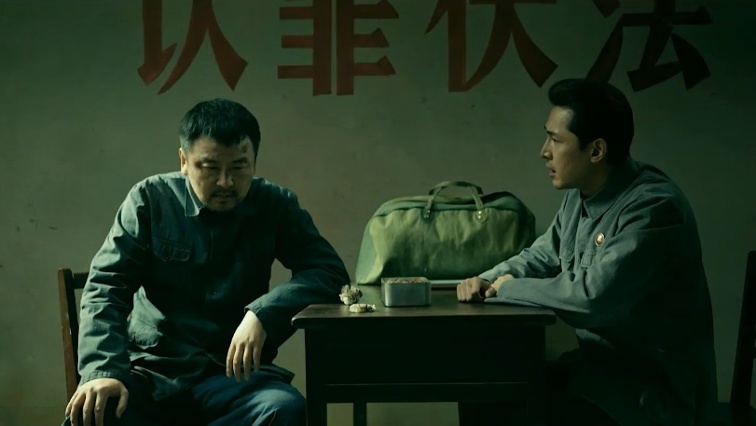
In 'Catching Spies', the character Xiao Dali (left) has been surveilling his neighbor Feng Jingbo for 40 years. (Film screenshot)
[People News] Feng Xiaogang's latest film, "Catching Spies," has faced a catastrophic box office failure in the Chinese market, resulting in substantial financial losses. Featuring a stellar cast that includes Hu Ge and Lei Jiayin, the film had a production budget of around 300 million yuan but only managed to earn over 70 million yuan, falling drastically short of the anticipated 500-600 million yuan.
Adapted from the novel "No Regrets in Pursuit," the story centers on Xiao Dali (played by Lei Jiayin), a newly appointed police chief in Beijing who suspects that elementary school teacher Feng Jingbo (played by Hu Ge) is a spy for the Kuomintang. Consequently, he moves in next door to Feng Jingbo to surveil him for a staggering 40 years.
Hu Ge portrays the introverted elementary school teacher, whose true identity is that of the undercover agent "5182," struggling to navigate a life filled with secrecy and danger.
To the outside world, Feng Jingbo seems to be a staunch supporter of the Communist government, but only Xiao Dali continues to scrutinize him, his gaze perpetually judgmental. This relentless scrutiny torments Feng Jingbo for much of his life, leading him to avoid wrongdoing and strive to perform good deeds, ultimately becoming a well-regarded figure in the eyes of his community.
In the film, Feng Jingbo's superior, Yan Diankun, a veteran undercover agent for the Kuomintang, was once discarded like a pawn. After the reform and opening up, he returns to the mainland as a prosperous businessman from Hong Kong, dressed in a sharp suit, exuding confidence and capital, and is warmly welcomed back by the changing times.
Feng Jingbo observed Yan Diankun enjoying a life of luxury and success, which starkly contrasted with his own decades of anxiety and repression, ultimately leading to a complete breakdown of his inner world.
The nation is genuinely staging 'Catch the Spy'
In recent years, the Chinese Communist Party (CCP) has aggressively promoted the 'Anti-espionage Law', taking the concept of 'national security' to an extreme. From educational institutions to community outreach, there are constant reminders to the public that 'spies are among us' and 'rewards are offered for reporting'. Feng Xiaogang's decision to release 'Catch the Spy' at this moment aligns perfectly with the CCP's call for citizens to identify spies.
Whenever someone posts online about unfinished projects by real estate companies, unpaid salaries, food safety concerns, or even just mentions the poor economic situation, they are quickly branded by online attackers as 'foreign networks', 'foreign forces', 'backstabbers', or 'running dog spies'.
For the average person, the phrase 'catch the spy' has become synonymous with 'covering up issues, silencing those who raise concerns, and inciting conflict among the masses'. The public no longer feels curiosity about this term; instead, they experience a visceral sense of disgust and rejection.
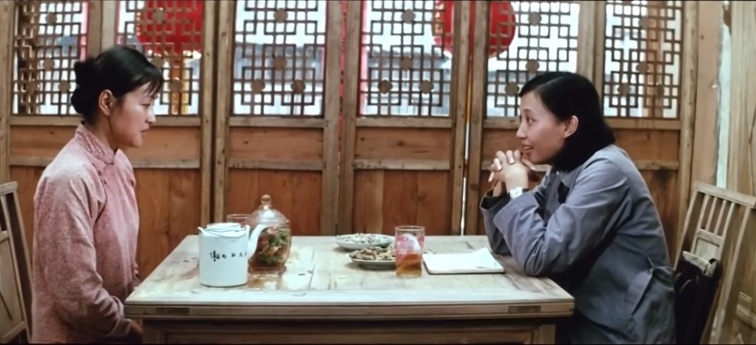
In the film 'Furong Town', a CCP official, Li Zhuozhang, threatens Hu Yuyin in her home, demanding that she expose the director of the grain station. (Film screenshot)
Who stands to gain the most from the success of 'Furong Town'?
'Catch the Spy' evokes memories of a highly popular film from the 1980s, 'Furong Town'.
Set in a small southern town named 'Furong Town', the story of 'Furong Town' follows the female protagonist, Hu Yuyin, who becomes wealthy through her hard work selling rice tofu. However, during a political movement, her newly built home, which she earned through her labor, is confiscated, and she is labeled a 'new rich peasant'. Her husband is driven to suicide, and she, along with the intellectual Qin Shudian, who has been labeled a 'rightist', faces daily humiliation as they sweep the streets of the town.
Meanwhile, local ruffians, led by Wang Qiushè, exploit the political movement to reinvent themselves as 'revolutionaries', inflicting brutal persecution on landlords and innocent citizens.
One of the most harrowing scenes in the film occurs after the Cultural Revolution, when Wang Qiushè, having lost his support, descends into madness. Reduced to a ragged beggar on the streets, he bangs a broken gong and frantically shouts in the desolate town: 'Movement! Movement! It’s happening again after seven or eight years!'
This chilling proclamation resonates deeply with those who hear it. Each political movement initiated by the Chinese Communist Party (CCP) has the potential to transform many into monsters, bringing calamity to colleagues, classmates, neighbors, and friends. As long as the CCP remains in power, these movements will recur every seven or eight years. It’s truly terrifying!
Upon its release in 1987, 'Furong Town' was met with overwhelming popularity among the public. It garnered numerous awards at the two most prestigious film awards in mainland China (the Golden Rooster Award and the Hundred Flowers Award), winning over ten significant accolades and honors in total.
The success of 'Furong Town' as a classic of red cinema could not have been achieved without official approval, as it coincided with a unique period in modern Chinese history marked by a 'confluence of political turmoil and hope.'
The fervor and devastation of the Cultural Revolution over a decade brought China's economy to the brink of collapse, resulting in the destruction of millions of families and the tragic deaths of countless innocents. This completely shattered the 'great, glorious, and correct' political myth that the Chinese Communist Party (CCP) had constructed since 1949. During this time, society faced widespread 'crises of faith (in Marxism-Leninism), trust (in the CCP), and confidence (in the Four Modernizations).' The public realized they had been deceived for years; the once-promoted 'superiority of socialism' led to extreme poverty, betrayal, and violence.
In the 1980s, the CCP initiated a 'limited denial and reflection on the Cultural Revolution,' but the primary goal was never to restore humanity and historical justice to the Chinese people. Instead, it aimed to salvage the legitimacy of a regime on the verge of collapse. This was a highly sophisticated and strategic maneuver for 'political stop-loss and power preservation.'
During this period, the CCP needed films like 'Hibiscus Town.'
At that time, the implementation of the household responsibility system in rural areas, the emergence of individual businesses, and the nascent market economy allowed the public to experience tangible improvements in their livelihoods. As people watched the struggles of Qin Shutian and Hu Yuyin in 'Hibiscus Town,' their mindset was, 'That was the absurdity of the past; we have already moved beyond it.' The iconic line from the film, 'Survive, live like a dog,' embodies a spirit of unyielding resilience after emerging from darkness.
During this time, the CCP slightly relaxed its control over the populace, allowing them to earn a bit of money and improve their living conditions. This led the public to mistakenly believe that the CCP could rectify its mistakes and was a party capable of reforming itself, ensuring that such a human catastrophe as the Cultural Revolution would never happen again, thus continuing to support the Communist Party's governance.
It can be said that the Chinese Communist Party is the biggest beneficiary of the success of 'Furong Town.'
Amid economic depression, the common people are simply hoping to survive.
So why did Feng Xiaogang's film 'Catching Spies' perform poorly at the box office?
Prior to the release of 'Catching Spies', the Chinese Communist authorities rolled out a series of laws, including the National Security Law, the Anti-Espionage Law, and the National Unity and Progress Promotion Law. This period coincided with a collapse in the housing market, soaring youth unemployment, and a general economic downturn, leaving the public to face daily survival pressures. The Communist Party's intensified policies to catch spies have made political fervor and internal reporting not just relics of the Cultural Revolution found in history books, but a re-emerging reality.
In this context, 'Catching Spies' serves as a stark reminder to the audience to 'beware of the resurgence of totalitarianism, and to be cautious of spies and internal strife around us.' The film's realism and weightiness strike directly at the anxieties that many dare not confront: Is the Cultural Revolution returning? The public lacks the psychological capacity to endure this 'waking pain.'
It can be said that 'Furong Town' was fortunate to emerge during a brief period when the system was willing to reveal its scars, allowing the public some space to reflect on their suffering.
While Western audiences watch spy films for 'suspense and thrill,' the current Chinese public views 'Catching Spies' through the lens of their daily lives under oppression: facial recognition technology and the 'Sky Eye' system are ubiquitous, with thousands of cameras covering every corner from street intersections, subway stations, community entrances to markets; online, WeChat accounts are banned, Weibo accounts are silenced, short videos are removed, and even a private conversation where two truths are spoken can lead to the police 'inviting you for tea.'
The pressures of life, a sluggish economy, and constant surveillance have pushed the public's nerves to their breaking point: living has become overwhelmingly exhausting!
Feng Xiaogang's film "Catching Spies"—whether intended as a reflection or a satire—strikes a sensitive chord with its themes of "surveillance, reporting, and internal conflict." The public's instinctive response is: "Haven't I endured enough in real life? Why would I spend money on this kind of distress?"
As the Chinese Communist Party transforms society into a vast "catching spies game," the film "Catching Spies" is inevitably destined to be rejected by the public as a sacrificial offering.
The common people do not avoid the film because they lack historical understanding, but because the reality is too harsh. They vote with their feet, escaping not from a movie, but from an era of surveillance that instills fear in everyone.
In real life, individuals already live like censored "spies" or "suspects," constantly self-censoring and using homophones in their posts. When life itself has become a prison without walls, who would want to spend money to go to the cinema and sit in a dark room for two more hours watching "how the police catch spies and how the public reports them"? This is not entertainment; it is a second layer of mental torment.
In reality, the Chinese Communist Party enforces the "Anti-espionage Law" arbitrarily, detaining foreign citizens (as seen in the Czech citizen incident) and corporate executives in a non-transparent manner, resulting in a crisis of trust in the international community and the withdrawal of foreign investment. Yet in the film, they still attempt to present this system's violence of "catching spies" as a form of justice and heroism.
Feng Xiaogang, a director who gained prominence through comedy and satire, now finds himself constrained by political taboos and censorship, forcing him to carefully adhere to official guidelines. This has led him to create films on subjects that are 'safe but at odds with market dynamics.' Consequently, he has been unable to satisfy either the authorities or the audience, resulting in a situation where he suffers from 'a dual loss in reputation and box office performance.'
(Originally published in the People News)
△




News magazine bootstrap themes!
I like this themes, fast loading and look profesional
Thank you Carlos!
You're welcome!
Please support me with give positive rating!
Yes Sure!