
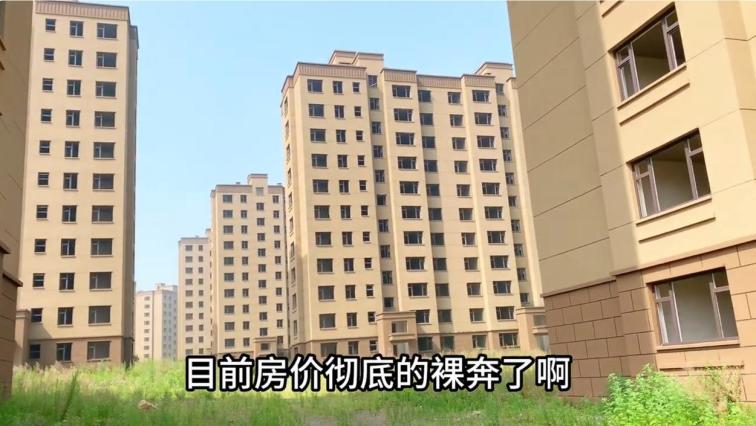
In China, vast numbers of vacant buildings can be seen everywhere, standing like rows of tombstones—an eerie and shocking sight. (Screenshot from video)
[People News] The collapse of China's real estate market is no longer merely a fluctuation in the economic cycle; it has become a full-blown institutional avalanche. As of this month, the Chinese real estate market has experienced 47 consecutive months of decline, which not only reshuffles historical records but also resembles a late-stage cancer that has persisted for four years, completely dismantling the narrative of land finance and fiscal myths that the Chinese Communist Party has relied on for its survival over the past 30 years. This crisis began at the upstream design level and, like a domino effect, has cascaded down to local debt, the financial system, and the credit systems of ordinary citizens, ultimately evolving into a systemic disaster that threatens the economic foundation, erodes middle-class wealth, and jeopardises the future of the youth.
This comprehensive collapse is essentially a concentrated explosion of the Chinese Communist Party's failures in political governance and the Ponzi-like nature of the economy, resulting in an irreversible disaster that is challenging to recover from or restructure in the short term.
In the past, political power monopolised land supply, generating vast fiscal revenues for local governments and forcibly converting residents' savings into infrastructure projects and financial loans. Now, as the tide recedes, millions of families are left with unfinished buildings and heavily indebted young people are left exposed, becoming the ultimate bearers of the costs in this absurd era.
The silent demise of the upstream industry has led to the large-scale evaporation of architectural design institutes.
Architectural design institutes serve as the nerve endings of the real estate industry. With the severe pain of the real estate crisis unfolding, the nerve system of architectural design institutes has also begun to undergo large-scale necrosis.
In the first three months leading up to 2026, nearly 200 design institutes across the country have quietly vanished. This is not a typical case of market competition, but rather an ecological collapse caused by the increasingly depleted upstream resources in the real estate infrastructure sector. In the first quarter of 2026, the area of newly started construction in the national real estate market fell sharply by 20.3% compared to the previous year, signalling that future construction plans are nearing a standstill.
Previously, architecture and civil engineering were considered golden career paths for students, but now 51% of grassroots designers have been forced to leave the profession, turning to food delivery or driving for ride-hailing services. This structural collapse of talent foreshadows the complete end of the large-scale infrastructure logic that has been a cornerstone of China's GDP growth.
The closure rate of private design institutes has soared to 40%, with their operational space nearly obliterated by state-owned enterprises that enjoy administrative monopolies. This winner-takes-all scenario serves as further evidence of the Chinese Communist Party's intervention in market resource allocation, which stifles private sector vitality. When design plans cease to reach construction sites, it indicates that the entire real estate supply chain has run dry.
It is both amusing and astonishing that an architectural design firm, which once held the blueprints for skyscrapers, has unexpectedly shifted its focus to producing short dramas in a bid to avoid stagnation. According to the financial report of Shenzhen-listed Huayang International (002949), in the first half of 2025, its unconventional short drama business generated 109 million yuan, representing a remarkable 18.09% of the company's total revenue, thus becoming its second-largest source of income. Huayang International is a veteran firm known for designing iconic structures like the Shenzhen Liantang Port and DJI's 'Sky City,' but it now finds itself competing in Shenzhen and Hengdian, Henan.
The second-hand housing market is facing a severe liquidity crisis, leading to a chaotic sell-off in the real estate sector.
On the consumer front, the real estate market is experiencing a harsh 'stampede-style sell-off.' As of March 2026, the number of second-hand homes listed across the country has exceeded a staggering 8.5 million, with listings increasing by over a million units each month. This wave of panic reflects a sharp decline in public confidence regarding the real estate market and a complete rejection of the Chinese Communist Party's earlier assurances that 'housing prices will always rise.'
The transaction period for second-hand homes has now stretched to 187 days, with the market value of each property typically decreasing by more than 10% during the listing period. In cities like Zhuhai, once hailed as 'concept cities,' housing prices have dramatically fallen from 7 million to 2 million yuan, with declines that surpass those seen in the A-shares market.
The depletion of this liquidity system indicates that over 70% of the assets owned by Chinese households are 'frozen' in the remnants of a concrete and steel boom. The middle class's illusion of wealth was brutally shattered in 2026, leading to a decline in balance sheets that is triggering a nationwide contraction in consumption. The public has lost faith in the government's market rescue slogans and is instead adopting a defensive savings strategy, believing that 'having money in their own pockets is more reassuring than anything else.'
Both the real estate market and the attempts to rescue it are quickly falling apart. The real estate sector in China has drained the hard-earned savings of generations, burying the dreams, happiness, and futures of many. The collective decline and resignation of young people have become the most stable outcome.
The directive to eliminate city investment and the significant increase in public transport taxes and fees.
The secondary disaster resulting from the real estate collapse has directly ignited a hidden debt crisis at the local level, amounting to an astonishing 68 trillion yuan. This translates to a debt of 50,000 yuan for every Chinese citizen. By the end of 2024, the People's Bank of China, the Ministry of Finance, the National Development and Reform Commission, and two other ministries issued a strict directive: to achieve 'zeroing out city investment' by the end of June 2027. This so-called zeroing out does not imply that the government will close city investment or cover the debts; rather, city investment must fulfil the 'three zeros' - eliminating hidden debts, separating government financing functions, and exiting platform identities.
This signifies a complete severance of financing platforms from local government credit. Essentially, this action is the central government's strategy to protect its own credibility by sacrificing local finances and demanding that local governments cut ties. In other words, after June 2027, city investment companies will be responsible for their own profits and losses, with the government stepping back entirely.
In many small and medium-sized cities across mainland China, public transportation and water supply services have long been taken over by urban investment companies, which have been operating at a loss for years. For every passenger transported, these companies incur losses of 7-14 yuan, with ticket revenues barely covering even the basic costs. The water supply, priced at 1-2 yuan per cubic meter, results in county water companies losing tens of millions annually, relying solely on government subsidies and urban investment debt to stay afloat. Once the government withdraws its support, public transport and water fees in many third- and fourth-tier cities are bound to surge dramatically to sustain operations.
Urban investment companies, once the financial backbone of local governments, have accumulated massive debts on their behalf. Now, while the government enjoys the benefits, it has left these companies to deal with a mountain of debt, ultimately shifting the financial burden onto the citizens.
Reflections on the end of a Ponzi scheme and the awakening of the younger generation
In his April 2026 essay 'My Reflections,' former real estate tycoon Pan Shiyi candidly acknowledged that the Chinese real estate market has been a Ponzi scheme orchestrated by the government, banks, and developers since its inception. In this scheme, local governments profited from land premiums, developers leveraged super-low down payments of 5% or even 'zero down payments,' while the risks were systematically transferred to homebuyers.
In recent years, the surge in supply cuts and the influx of foreclosed properties has been notable, with the total number of foreclosed properties scheduled for auction in 2024 estimated at around 657,842 units, marking a significant increase compared to previous years. The expected transaction volume for 2024 is 163,372 units, but the overall transaction rate remains low at just 24.83%, suggesting that approximately 75% of foreclosed properties are likely to go unsold, with the transaction rate continuing to decline in recent years. The total transaction amount has fallen by 5.3% year-on-year to 245.964 billion yuan, indicating a decrease in the overall average price. The number of foreclosed properties is expected to stay high in 2025-2026, with transactions remaining sluggish.
The real estate crisis has consumed the wealth of middle-class families and has fundamentally undermined the sense of social contract among the younger generation. Those born after 1995 and 2000 no longer see homeownership as a path to stability; instead, they perceive it as a 'heavy debt trap' and a 'grimy and exhausting life.' This collective awakening signifies the formal collapse of the predatory model that exploits residents' future labour through real estate.
The late-stage economic crisis amid the resonance of five major crises
The collapse of the entire real estate chain in 2026 has triggered five significant social crises: systemic deflation in the economy, instability in the financial system, a dramatic population decline, the bankruptcy of government credibility, and global decoupling in diplomatic relations. This situation reflects not only a downturn in economic data but also indicates that the institutional framework has reached a dead end.
The Chinese Communist Party (CCP) is attempting to achieve a so-called soft landing for the economy following the collapse of the real estate sector through 'debt reduction' and 'bursting the bubble.' However, the CCP's lack of political credibility and soft budget constraints mean that, on the brink of totalitarian collapse, all citizens are being forced to bear the costs squandered by those in power during this harsh winter.
(First published by People News) △






News magazine bootstrap themes!
I like this themes, fast loading and look profesional
Thank you Carlos!
You're welcome!
Please support me with give positive rating!
Yes Sure!