
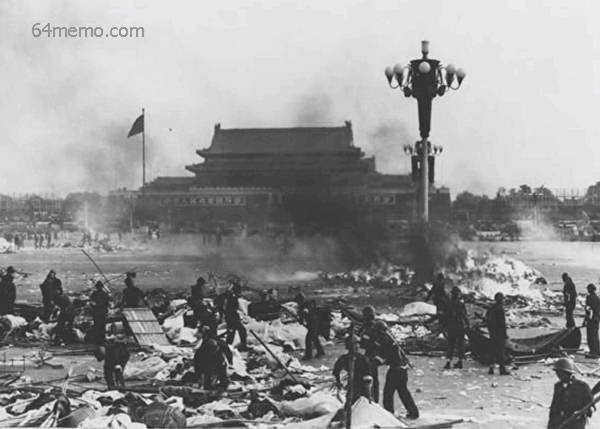
Many out-of-town students living in tents on Tiananmen Square died inside them. (Photo: DaJiYuan ImageLib / Dajiyuan)
[People News] April 25, 2026, is a date that will be etched in history. On this day, three seemingly unrelated events collided in a historic manner.
During a report on the first quarter port container throughput, CCTV's 'News Broadcast' prominently featured the figure '8964 million TEUs', a number that is a highly sensitive taboo for the Chinese Communist Party. Meanwhile, at the White House Correspondents' Association dinner, gunfire erupted as a gunman attempted to breach the venue but was quickly subdued, resulting in no casualties. Additionally, overseas Falun Gong practitioners held peaceful gatherings in various locations worldwide to commemorate the 27th anniversary of the peaceful appeal on April 25, 1999, while the Chinese Communist Party ramped up monitoring and harassment of practitioners within China.
The sudden appearance of '8964' on CCTV was akin to a silent bullet piercing through the carefully constructed information iron curtain of the Chinese Communist Party. The gunfire at the White House served as a testament to the openness and courage of American democracy. The Falun Gong commemoration signified that any regime attempting to stifle faith and conscience through violence and deceit will ultimately face judgment from history and the people's hearts. These three seemingly coincidental events collided dramatically, underscoring the fundamental differences between the totalitarian rule of the Chinese Communist Party and the free world, creating a vivid contemporary political satire of the Chinese Communist Party: on one side lies the extremely fearful and impenetrable Zhongnanhai, while on the other side stands a transparent and resilient free society.
The appearance of '8964' on CCTV may signal an internal crisis?
On April 25, CCTV reported the first quarter transportation data, clearly stating that 'port container throughput reached 89.64 million TEUs.' This astonishingly sensitive figure, which could leave many in shock, raises the question of how it managed to bypass multiple layers of scrutiny and appear so openly in CCTV's news broadcast. Was it due to the 'ignorance' of young professionals, the oversight of gatekeepers, or was there a deliberate attempt to 'charge the tower'? While the external world cannot ascertain the truth, this incident undoubtedly reflects a significant fracture within the Zhongnanhai regime when viewed against the backdrop of the current highly turbulent political climate of the CCP.
The CCP's fear of the memory associated with '8964' is unparalleled. For 37 years, any text, image, or even homophone related to this number has been rigorously suppressed. As the CCP's primary propaganda outlet, CCTV is known for its stringent censorship; however, on this highly sensitive date of April 25, it seemingly 'lost control,' leading to strong suspicions that someone within the organisation took the opportunity to express dissatisfaction or protest in a covert manner.
In recent years, Xi Jinping's anti-corruption campaign has spiralled out of control, evolving from 'hunting tigers' to indiscriminate purges, with even his close associates unable to escape the fallout.
According to publicly available data, in 2025, national disciplinary inspection and supervision agencies initiated cases against 115 officials at the provincial level and above, with 69 facing punishment. The Central Commission for Discipline Inspection and the National Supervisory Commission directly initiated investigations against 181 centrally managed officials (including those who have already fallen or been punished), marking a new high since the 18th National Congress. Throughout the year, a total of 65 centrally managed officials were officially reported to have fallen.
Since the start of 2026, approximately 20 central management officials have been dismissed, with the number of provincial and ministerial officials disciplined in the first quarter being four times higher than during the same period last year. On January 24, Zhang Youxia, a member of the Political Bureau of the Central Committee and vice chairman of the Central Military Commission, along with Liu Zhenli, a member of the Central Military Commission and chief of the Joint Staff, were officially announced to have been dismissed, causing a shock within the military's upper ranks. Following this, Ma Xingrui and other members of Xi Jinping's trusted faction, known as the Xi family army, also faced issues or were reported to be in trouble. Li Ganjie and other close associates were similarly caught up in controversy. Reports suggest that during the investigation, Ma Xingrui implicated several high-ranking national officials, highlighting the deepening power struggle.
Under Xi Jinping's leadership, the anti-corruption campaign has morphed into a mechanism for eliminating political adversaries and consolidating personal power, creating an atmosphere of anxiety among officials, which has fostered a culture of evasion and blame-shifting. Recently, Xinhua News Agency published an article criticising local officials for their 'lying flat' attitude and shifting responsibility, which was subtly countered by local official media, revealing the escalating political confrontation between central and local authorities. Discontent and fatigue towards Xi Jinping among officials have reached a boiling point, with the '8964' flash on CCTV possibly serving as a reflection of this internal dissatisfaction, suggesting that the foundation of the Communist Party's rule is precariously close to collapse.
In the face of death threats: Trump's strength and resilience contrasted with Xi Jinping's cowardice and timidity.
On the same day, gunfire erupted at the White House Correspondents' Association dinner. A 31-year-old suspect attempted to breach security armed with a shotgun, handgun, and other weapons but was swiftly subdued by the Secret Service. One law enforcement officer was shot in the bulletproof vest but is not in life-threatening condition. President Trump and the First Lady were quickly evacuated but soon made a public appearance. At a subsequent press conference, Trump calmly addressed the situation, commending the security personnel. When a reporter asked, 'Why is it always you who faces assassination attempts?' Trump's response was pointed. He referenced great historical presidents like Lincoln, noting that the most influential and accomplished individuals are often the easiest targets, stating, 'I have done a lot, changed the country, and some people are unhappy about it.' His sharp reply to the reporter's provocative question became a notable moment in history.
Simultaneously, the resilience of the American democratic system was clearly demonstrated. The highest leader, confronted with a life-threatening situation, did not retreat into seclusion but opted for transparency, continued working, and welcomed public and media scrutiny. Following the gunfire, American society quickly returned to normal, and an investigation into the incident was promptly initiated, with the process being open and transparent, avoiding panic or a complete lockdown due to a single shot.
In contrast, within the Chinese Communist Party, Xi Jinping's extreme fear for his own safety has become a well-known secret. Following Zhang Youxia's downfall on January 24, it is reported that Xi Jinping stayed in Beijing for two to three months without leaving and only recently visited Xiong'an to 'check the feng shui.' The long street in Zhongnanhai is now perpetually on high alert: police cars, armed police, and men in black are ubiquitous, and passersby are even required to open their water bottles for inspection to ensure they do not contain gasoline. The entire power core has transformed into a fortress cut off from the outside world, with officials needing to navigate multiple layers of approval to enter or exit, making it nearly impossible for ordinary citizens to approach. Xi Jinping's overseas trips are treated as if he is facing a formidable adversary; he not only books entire renowned hotels but also has furniture airlifted from Beijing to his accommodations. Domestic inspections are conducted with extreme caution, with tens of thousands of imperial guards and snipers either visibly or covertly stationed in targeted cities.
The profound fear that the autocrats of the Chinese Communist Party have towards the populace—fearing assassination and the loss of power—leads them to utilise taxpayers' money to perceive the people as enemies and maintain stability at all costs, effectively turning the country into a vast prison. This situation itself serves as evidence of the system's profound weakness. In contrast, democratic leaders can be criticised, challenged, and even shot, yet they rely on the rule of law and institutional frameworks to continue functioning.
The 27th anniversary of Falun Gong, marked by its peaceful appeals, presents a stark contrast to the fears associated with totalitarianism.
On the 25th, overseas Falun Gong practitioners organised peaceful activities, including parades, rallies, and the Truth Wall, in cities such as New York, London, Sydney, Toronto, and Taipei to commemorate the 27th anniversary of over ten thousand practitioners voluntarily visiting Zhongnanhai for peaceful appeals in 1999. At that time, practitioners were only rationally addressing issues like interference in their practice, yet they were labelled by the Jiang Zemin group as 'besieging Zhongnanhai,' which led to a brutal nationwide persecution that has persisted for 27 years. These overseas activities were rational and peaceful, receiving support from international political figures, but they made the Chinese Communist Party (CCP) feel threatened, prompting the CCP to intensify monitoring and harassment of Falun Gong practitioners domestically and to closely monitor overseas activities as well.
This is in stark contrast to how the White House shooting incident was handled. In the United States, even when shootings occur, information is quickly released, investigations are conducted transparently, and society continues to function normally. In contrast, the CCP, facing a group of unarmed citizens simply seeking freedom of belief, employs state machinery to suppress them comprehensively. After 27 years, Falun Gong has not only survived but has also spread widely around the world, with the number of people who have withdrawn from the CCP exceeding 400 million. Meanwhile, the CCP's persecution machinery has revealed its core fear: any spiritual force that exists independently of the Party and beyond its control is viewed as a significant threat to its totalitarian rule.
Peaceful appeals have been characterised as 'sieges,' and rational demands have been misrepresented as 'subversion.' The CCP has applied this malevolent political logic to society at large. Currently, thousands of wronged individuals and petitioners in mainland China are still treated as hostile elements by the CCP, facing monitoring, arrest, and persecution by the authorities every day. Falun Gong practitioners have shown that conscience and courage are more powerful than any totalitarian regime.
The Historic Collision of Three Events: The Root of the Communist Party of China's Fear
The events of CCTV's "8964", the gunfire at the White House, and the commemoration of Falun Gong all highlight the inherent corrupt nature of the Communist Party's rule. It fears a number, fears peaceful petitioners, fears democracy and freedom, and fears faith and morality. This is because it understands that its regime, built on lies, violence, and oppression, cannot withstand any genuine openness, any independent and free thought, any moral clarity, or any historical scrutiny.
The historic collision of these three significant events acts as a mirror, revealing the signs of the Communist Party's impending downfall. The CCTV "8964" incident may only be the tip of the iceberg, as internal discontent and power struggles are intensifying; at the same time, overseas voices advocating for peace continue to awaken the world. The more anxious, repressive, and fearful the Communist Party becomes, the more it confirms its trajectory towards decline.
History cannot be easily erased by a single number, just as the high walls of Zhongnanhai cannot ultimately block the light of the world and the awakened hearts of the people. The Communist Party's totalitarian dream will ultimately crumble under the resolute choices of history and the people.
(First published in People News) △







News magazine bootstrap themes!
I like this themes, fast loading and look profesional
Thank you Carlos!
You're welcome!
Please support me with give positive rating!
Yes Sure!