
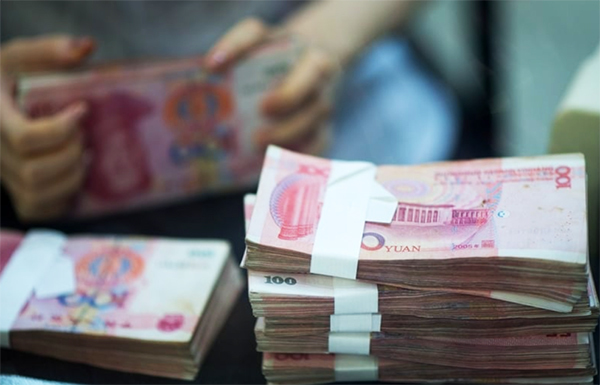
Photo Caption: As the CCP's local government finances grow increasingly strained, governments across China are finding new ways to extract money from the public. (Getty Images)
[People News] According to the latest data from April 2026, deposits in Chinese banks have reached a new record high. This seems contradictory: if everyone has money, why are the real estate market, stock market, and consumer market still sluggish? The explanation is quite simple: these deposits are being used to purchase 'peace of mind.' The public's current mindset resembles that of anticipating the arrival of winter, as they desperately stockpile resources in their 'caves,' and no one dares to spend extravagantly during this time. So, why is everyone hesitant to spend money?
7.6 trillion yuan locked in safes
On April 13, the central bank released a new set of financial data. The data indicates that in the first quarter of this year, RMB deposits increased by over 13 trillion yuan, with personal deposits from ordinary citizens accounting for 7.6 trillion yuan.
Many may not grasp the significance of this figure. In simple terms, it means that the entire population of China is frantically stuffing money into bank safes, averaging nearly 100 billion yuan a day. While this may sound like everyone is becoming wealthier, the reality is that borrowers have vanished. This is particularly evident in the mortgage sector, where loan issuance has plummeted to its lowest level in years.
This highlights an extremely unusual phenomenon: banks are overflowing with money, yet there is a lack of spending in society. Economists refer to this as a 'liquidity trap,' but for ordinary people, it is simply seen as 'locking money away.'
Why are ordinary citizens in mainland China afraid to spend money?
Consider breakfast as an analogy. If you are confident that the sun will rise as usual tomorrow and that your job is secure, you might treat yourself to a sumptuous morning tea, ordering a table full of shrimp dumplings and rice rolls. However, if you have a feeling that a famine might strike tomorrow, or that your house's roof could collapse at any moment, and the food supplies at home are only enough to last a few days, would you still dare to eat like that in the morning? You might only take a bite of a cold steamed bun, clutching the remaining food tightly, not even daring to let go while you sleep.
The 76 trillion yuan in new deposits expected in 2026 represents the 'emergency food' that ordinary people are clinging to. People are saving money not because deposit interest rates are high; in fact, current rates have fallen to a painfully low level, failing to keep pace with inflation.
People are saving money because they 'cannot see tomorrow.' Saving is a means of 'self-preservation,' a strategy to prepare for potential layoffs that could happen at any moment, to fill the financial gaps caused by falling housing prices, and to manage the rising medical costs that may continue in the future.
In this context, money becomes 'dead money,' acting as a defensive shield. This 'defensive saving' reflects a collective social anxiety: people have lost faith in the economic system's ability to navigate challenges and have lost confidence in future stability. When the public no longer believes that 'tomorrow will be better,' saving money becomes the only weapon everyone has to combat the risks of the current era.
Therefore, when we see this astonishing deposit figure for the first quarter, we should not celebrate the increase in wealth, but rather reflect on what kind of chill has led 1.4 billion people to collectively enter a 'hibernation mode'. What kind of fear has caused this 76 trillion to become 'dead money' locked away in safes, which no one can access?
In simple terms, this time, everyone's confidence has not returned.
Who took the umbrella when it was time to 'offer shelter'?
To put it bluntly, the essence of the economy is 'trust'. The public is willing to spend and invest because they believe that the rules are stable and that there is support if something goes wrong. However, as of today in 2026, the prevailing sentiment is that the government has been absent in several critical areas. This absence has directly led to the breakdown of the social contract.
First, 'arbitrariness' has eroded the sense of security.
Let’s reflect on the past few years: the mainland has seen a complete eradication of the education and training industry through a single document, a strong crackdown on major internet companies, and the implementation of the 'three red lines' policy in real estate. While these policies were introduced under the guise of 'solving problems', was there any consideration for the millions of families left unemployed? Was there any thought given to the investors who risked their entire fortunes?
When policies change as unpredictably as the weather in June, the public becomes more cautious. People realise that government power has no limits; at this point, who would still dare to make long-term investments? Who would still take out loans to start a business? Everyone has pulled back. The surge in deposits in 2026 is essentially a vote of distrust from the mainland's citizens against 'policy uncertainty'.
Secondly, what should have been managed was not managed effectively.
The disconnect between vanity projects and 'lifesaving money' is what truly disheartens the public. For years, the government has poured vast amounts of money into infrastructure. While it's true that high-speed rail is efficient and the bridges are impressive, can these projects provide sustenance for the common people when they face illness, unemployment, or ageing?
It's akin to a parent who projects an image of success, constantly showcasing their newly renovated front door to the neighbours and driving the most expensive luxury car. Yet, at home, the kitchen leaks and remains unfixed, they have to borrow money for their child's tuition, and when an elderly family member falls ill, the parent simply throws up their hands and says, 'I have no money; you all need to figure it out.'
Once the public sees through this facade, they enter a state of 'defensive survival.' With the government having 'abandoned' its responsibilities in crucial areas like pensions, healthcare, and education, the common people are left to fend for themselves. This 76 trillion yuan in savings is not surplus; it is the emergency fund that everyone has set aside for themselves.
The key issue is that the government has been absent when it should have taken responsibility.
When Japan's economic bubble burst, the government made mistakes as well, but they upheld a crucial principle: they did not allow the public to fall into despair. The Japanese government took on significant debt to subsidise healthcare and strengthen the social safety net, which helped maintain stability in a society that felt 'lost.'
And what about the situation on the mainland now? Housing prices have plummeted, leaving homebuyers to shoulder the burden; when young people lose their jobs, they resort to driving for ride-hailing services or delivering food; as they age, their children must find their own solutions. The government behaves like an 'outsider' when it should be assuming social responsibilities and redistributing wealth.
The absence of this responsibility is a critical blow to public confidence. When citizens feel abandoned in a sea of risks, their savings account becomes their only lifeline. Thus, the spike in deposits in 2026 represents a collective, silent acknowledgement from the populace regarding the government's failure to perform its duties: 'If you can't protect me, I must protect myself.'
Why is China experiencing more 'pain' than Japan did in the past?
Many analysts often draw comparisons between China's economy over the last two years and Japan's in the 1990s. Indeed, the current trends of falling housing prices, rising deposits, and young people opting to 'lie flat' mirror Japan's past experiences. However, a closer examination reveals that the shortcomings currently faced by mainland China render this crisis significantly more 'painful' than what Japan encountered back then.
The fundamental difference between Japan's 'rich and ageing' society and China's 'ageing before becoming rich.'
When Japan's real estate bubble burst, it was already recognised as a developed nation. At that time, the average Japanese citizen had substantial savings and a high per capita GDP. This situation can be likened to a robust and wealthy individual who, despite suffering a major investment loss, still has a full pantry and a solid foundation.
In contrast, what is the situation in mainland China today? This is what is termed 'ageing before becoming rich.' Our per capita income has yet to reach developed country levels, yet the pace of ageing is faster than in any other nation. For the majority of Chinese families, real estate constitutes over 70% of their wealth. When this asset diminishes, and social security and healthcare systems fail to keep pace, the consequences are catastrophic.
Let us compare Japan's 'social safety net' with mainland China's approach of 'self-survival and self-destruction.'
In Japan's 'Lost Thirty Years', the most significant aspect to consider is not its economic stagnation, but rather the fact that Japan has avoided major upheaval. This is largely due to the Japanese government's continued generosity in establishing a robust social safety net, even amid economic stagnation.
During times of economic hardship, the Japanese government chose to shoulder substantial debt to ensure the quality of universal health insurance, guarantee pension distributions, and maintain fairness in education.
In stark contrast, as of today in 2026, local governments in mainland China, weighed down by heavy debts, have started to 'cut spending' on social welfare. Health insurance reimbursement amounts are decreasing, grassroots civil servants are facing salary reductions, and the quality of public services is declining.
This situation can be likened to two individuals caught in the rain. While the Japanese government cannot stop the rain, it has provided each citizen with a sturdy umbrella, allowing them to move slowly without getting soaked. Conversely, the current situation in mainland China is that the government not only fails to provide umbrellas but is also removing the protective cover that once sheltered everyone, urging citizens to 'choose their own jobs' and 'bear their own risks'.
Japan's experience teaches us that once confidence is shattered, recovery takes about 'a decade'. After the bubble burst, an entire generation of Japanese citizens refrained from investing in stocks or purchasing homes, instead relying solely on their savings.
China's current predicament is compounded by not only the shrinkage of assets but also a dramatic shift in social expectations. When the public realises that the government 'disappears' at critical moments when it should assume responsibility, this sense of insecurity can evolve into a long-lasting psychological trauma.
The surge of 76 trillion yuan in deposits in 2026 reflects a deep-seated trauma. The public has come to understand that in China, nothing is 'too big to fail,' and no wealth is genuinely secure, except for cash held in their own hands. This realisation makes the restoration of confidence seem like a distant goal.
Can confidence be restored?
After discussing this extensively, we must confront the most crucial question: Is it still possible to salvage this crisis of confidence? Many are waiting for the government to take decisive action, looking forward to interest rate cuts, monetary easing, and another round of large-scale stimulus. However, I must emphasise that if the root cause is not financial, no amount of money will resolve this issue.
The staggering deposit figure for 2026 indicates that confidence cannot simply be 'restored' through official announcements; it must be cultivated in a fair environment with solid guarantees.
Firstly, confidence reflects the social contract.
When people are willing to spend, it is because they believe 'the future will be better'; conversely, when they are hoarding money, it is because they realise 'the future depends on themselves.' As long as the government refuses to take genuine responsibility for the 'three mountains' of pensions, healthcare, and education, and as long as local finances prioritise cold, impersonal projects and new productive forces over the urgent needs of people's livelihoods, the 76 trillion yuan held by the public will not flow into the market. This is not an act of selfishness; it is the public expressing their preferences through their choices.
Secondly, confidence requires 'certainty' in regulations.
The greatest threat to confidence is the ability to 'turn the palm to create clouds and turn the back of the hand to create rain.' If the law fails to genuinely protect private property, and if policies can arbitrarily sever the lifeline of an industry, entrepreneurs will hesitate to invest, and the middle class will refrain from spending. On this day in 2026, what we need is not more slogans, but the tangible rule of law and integrity. The government must work to restore public trust, a task that is a hundred times more challenging than stabilising housing prices, yet it is the only viable path forward.
In reality, as we observe the fluctuating deposit figures in our bank accounts, we should not feel a sense of pride, but rather a deep sadness.
For behind each of those numbers, there could be a young Wang, calculating how to cut back on breakfast expenses; there could be an elderly couple, anxious about whether the balance on their health insurance card will suffice for the next cold. What they are saving is not merely money, but rather their fear of an uncertain future.
(First published in People News)
△





News magazine bootstrap themes!
I like this themes, fast loading and look profesional
Thank you Carlos!
You're welcome!
Please support me with give positive rating!
Yes Sure!