

Japanese Prime Minister Sanae Takaichi won
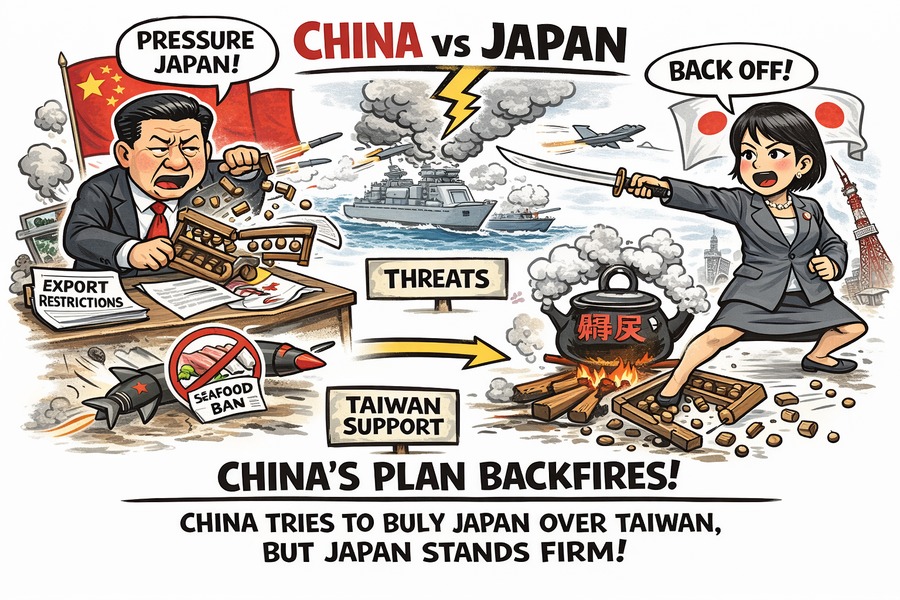
[People News] Recently, Japan’s Prime Minister Sanae Takaichi led the Liberal Democratic Party to a historic victory in the election, and the latest opinion poll results have also stunned the international community. A survey of the Japanese public shows that as many as 76% of respondents believe there is “no need to improve” relations with Beijing. At the same time, the intense reaction of Chinese Communist Party (CCP) official media to Takaichi’s victory has become a hot topic on social media.
According to a new survey conducted by Japanese media on election day, when asked, “Regarding future Japan–China relations, do you think there is a need to improve them?” only 24% of Japanese respondents said they supported improving relations, while 76% said there was no need to do so.
On the social platform X, many Japanese netizens commented on the results. Some said that maintaining the status quo is sufficient, and some even stated bluntly: “If improving relations means bowing and scraping to China, then there’s absolutely no need.” Public opinion generally favors diplomacy based on equality, and many believe Japan should respond in kind—or even firmly—to Beijing’s actions.
In the past, Japan’s mainstream media often leaned toward pro-China or moderate voices. This survey, however, revealed the genuinely cool attitude of nearly 80% of the public.
The election results also caused a huge stir in China. As the official newspaper of the Beijing Municipal Committee of the Chinese Communist Party, the Beijing Daily produced what netizens mockingly called a wave of “meltdown-style” reporting after the election.
Screenshots circulating on overseas social media show that Beijing Daily published an entire page of negative reports targeting Sanae Takaichi. The headlines were filled with confrontational rhetoric, including: “Takaichi Won, Japan Lost,” “Takaichi’s Gamble Paid Off—Japan Is Now More Dangerous,” “Japan Completely Out of Control,” and “Sanae Takaichi’s Persona Collapses.”
In fact, this kind of media attack had already begun before the election. Starting at the end of last month, the paper repeatedly published content smearing Takaichi, even running headlines such as “Behind Takaichi’s Smile Lies Malicious Intent” and “Sanae Takaichi Cried.”
In response, overseas netizens mocked the party media for being “panicked,” likening it to “ants on a hot pan.” Some netizens even let their imaginations run wild, suggesting that if the names of people and countries in the headlines were swapped, they would sound just as fitting.
For example, changing “Takaichi Won, Japan Lost” to “Takaichi Won, China Lost,” or “Sanae Takaichi Doesn’t Learn from Being Beaten” to “Xi Jinping Doesn’t Learn from Being Beaten.” Amid the laughter, some even wondered whether Beijing Daily was engaging in “high-level satire” of Xi Jinping.
As Sanae Takaichi has successfully held on to the prime ministership and secured absolute dominance in the House of Representatives, Japanese politics has officially entered a new era led by hardliners. With nearly 80% of the public holding a negative view toward improving China–Japan relations, the future diplomatic trajectory between the two countries is bound to face more challenges and friction. This election was not merely a choice in Japan’s domestic politics—it also signals that the East Asian geopolitical landscape may be heading into a prolonged deep freeze.
△







News magazine bootstrap themes!
I like this themes, fast loading and look profesional
Thank you Carlos!
You're welcome!
Please support me with give positive rating!
Yes Sure!