
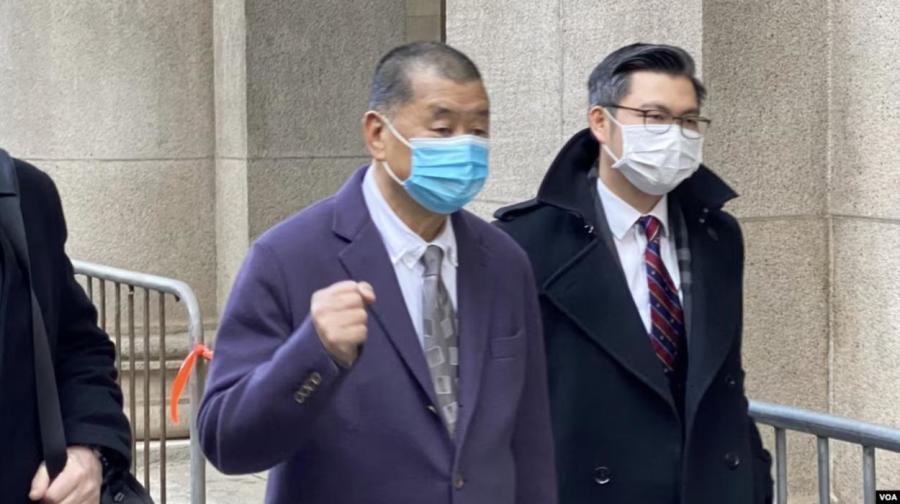
Hong Kong pro-democracy activist and media tycoon Jimmy Lai arrives at Hong Kong’s Court of Final Appeal
[People News] On February 9, Jimmy Lai, founder of Next Digital, was convicted of “sedition” and two counts of “conspiracy to collude with foreign forces” and sentenced to 20 years in prison. This is the longest sentence handed down since Hong Kong’s National Security Law took effect in 2020, triggering strong condemnation from the international community. Leaders from the United States, Taiwan, Canada, Japan, Germany, and the United Kingdom publicly criticized the Chinese Communist Party authorities for violating the commitments made under the Sino-British Joint Declaration, turning the judiciary into a tool for human rights persecution and transforming Hong Kong into a giant prison confining 7.5 million people.
Beijing Undermines the Foundations of Hong Kong’s Development
According to Liberty Times, U.S. President Donald Trump had publicly called on Chinese authorities to release Jimmy Lai even before sentencing. Observers expect human rights issues to become a focal point when Trump visits Beijing in April.
Taiwan President Lai Ching-te posted on social media on the 10th expressing support for Jimmy Lai, stating that the verdict once again proves that Beijing’s claim of “one country, two systems” has long existed in name only. The judiciary, he said, has become a tool to deprive people of personal freedom, suppress freedom of speech and the press, and deny public accountability. He called the ruling a painful warning that democracy and freedom should never be taken for granted.
U.S. Secretary of State Marco Rubio issued a statement condemning the ruling as unjust and as a demonstration to the world that Beijing will stop at nothing to silence advocates of Hong Kong’s fundamental freedoms, disregarding its international commitments under the 1984 Sino-British Joint Declaration. He urged Chinese authorities to grant Jimmy Lai humanitarian parole.
John Moolenaar, chairman of the U.S. House Select Committee on Strategic Competition between the United States and the Chinese Communist Party, also criticized the trial as the latest stain on China’s human rights record, stating, “If President Xi wants to improve relations with the United States, releasing Jimmy Lai would be the first necessary step.”
Canadian Foreign Minister Mélanie Joly expressed disappointment with the verdict and called for Lai’s immediate release on humanitarian grounds.
Japan’s Chief Cabinet Secretary Minoru Kihara said the sentence would impact freedom of speech and assembly in Hong Kong and undermine the city’s development foundations.
Facing Beijing’s hardline stance, the British government has taken concrete action. The UK Home Office announced an expansion of the BN(O) visa program: children of BN(O) passport holders who were under 18 at the time of the 1997 handover may now apply independently for settlement in the UK, no longer needing to be attached to their parents’ applications.
A spokesperson for the German Chancellery stated that Germany would express its position on human rights and freedoms to Chinese and Hong Kong authorities through existing diplomatic channels, noting that the Jimmy Lai case “has long been on the table.”
In addition, The Washington Post published an editorial stating that Jimmy Lai’s trial outcome is a mockery of justice, reflecting that Hong Kong has become an open-air prison holding 7.5 million people and intolerant of dissent. Besides Jimmy Lai, six former executives of Apple Daily and two members of the “SWHK” group were sentenced to prison terms ranging from six to ten years. The editorial noted that these trials did not involve a jury, and Jimmy Lai was not even allowed to choose his own lawyer. Such a “kangaroo court,” it said, fails to meet any international judicial standards.
Nathan Law: Democracy Is Dead in Hong Kong
According to The Dajiyuan, former Hong Kong legislator Nathan Law, now living in exile in the United Kingdom, published an article in The Guardian on the 10th titled: “Jimmy Lai’s sentencing tells me this: democracy is dead in Hong Kong, and I escaped just in time.” He described learning of the sentence as “surreal” and said that had he not left Hong Kong before the National Security Law took effect, he might have faced the same fate as Jimmy Lai.
Nathan Law wrote that “the shamelessness and malice of this punishment fill me with anger,” and that the political intent of the verdict is unmistakable. Jimmy Lai chose to remain in Hong Kong and stand alongside its people during a time of political repression; now his family fears he may die in prison. Law said the Hong Kong and Chinese authorities are using such prosecutions to silence criticism, while civil society and local media oversight have nearly collapsed. In today’s Hong Kong, he said, political consciousness itself has become a risk. Even criticizing the regime through metaphor can result in being charged with “sedition.”
△



News magazine bootstrap themes!
I like this themes, fast loading and look profesional
Thank you Carlos!
You're welcome!
Please support me with give positive rating!
Yes Sure!