
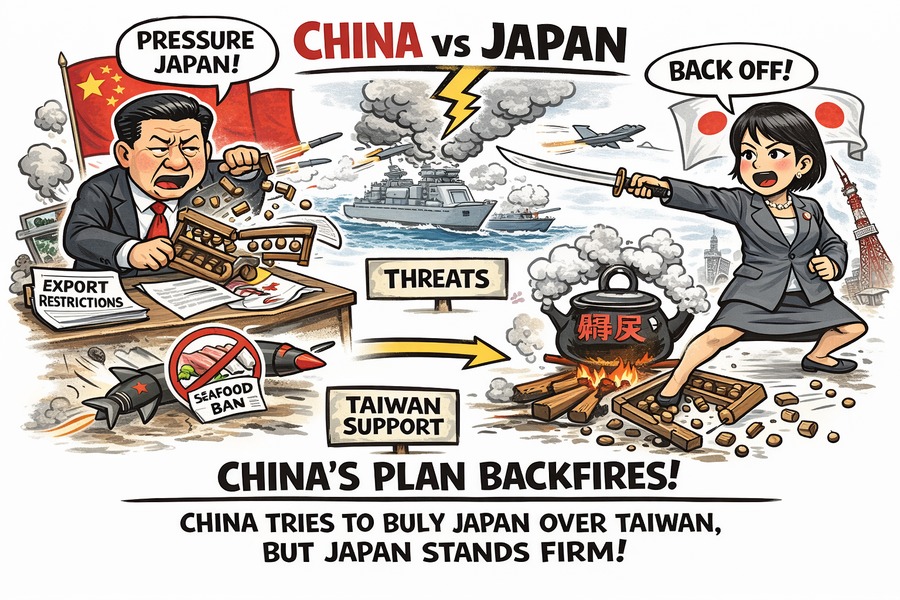
After Targeting Japan, the Chinese Communist Party’s Calculations Have Backfired
[People News] Last November, because of a remark by Japanese Prime Minister Sanae Takaichi referring to “a Taiwan contingency,” the Chinese Communist Party (CCP) immediately reacted and openly turned against Japan. Despite repeated assurances from the Japanese side that the Japanese government had not changed its long-standing position, the CCP seized on the comment to create an uproar, rolling out almost one new measure a day and causing a comprehensive deterioration in China–Japan relations.
The CCP imposed restrictions and issued threats against Japan across diplomatic, economic, military, cultural, and public-opinion fronts. For example, in bilateral diplomatic exchanges, the CCP forcefully demanded that Takaichi retract her remarks, while continuously condemning her in the international arena. Economically, it halted imports of Japanese aquatic products, restricted travel to Japan, sharply reduced China–Japan flights—about 46 routes were reduced to “zero flights”—and floated the idea of restricting rare-earth exports to Japan, among other measures.
At the same time, the CCP repeatedly carried out military actions threatening Japan. From November 17 to 19, 2025, CCP forces conducted live-fire exercises in the central Yellow Sea. On December 6, CCP J-15 fighter jets “intermittently” locked fire-control radar onto Japanese F-15 fighters—an action that in military terms signals a possible attack. From December 29 to 31, the CCP organized joint theater-level exercises involving ground, naval, air, and rocket forces around Taiwan, which also carried an implicit warning to Japan.
Meanwhile, the CCP imposed restrictions on cultural exchanges between China and Japan. It introduced and implemented bans or restrictive measures targeting Japan’s cultural industries, affecting the screening of artistic works, anime events, and performances by entertainers. Performances by Japanese artists in China were entirely suspended. During this period, Japanese pop singer Ayumi Hamasaki, undeterred by CCP threats, confidently and wholeheartedly staged a “concert with no audience” in an empty venue in Shanghai, stunning Chinese fans.
On the public-opinion front, CCP state media first vigorously promoted the “theory that the status of the Ryukyu Islands is undetermined,” questioning Japan’s sovereignty over Okinawa. Second, CCP party media hyped up the issue of “syphilis in Japan,” gradually steering public opinion toward narratives such as “Japan is unsafe” and “not worth visiting.”
Commentator Wang He wrote that the scope and intensity of the CCP’s actions against Japan this time are rare—far exceeding the China–Japan tensions of 2012 and even surpassing the deterioration in China–India relations after 2020. He noted that most of the CCP’s pressure tactics are tactical in nature, but the CCP is seeking a strategic objective: testing Japan’s willingness to militarily intervene in a Taiwan Strait war.
Mainland media analysis holds that Japan was chosen as the target of pressure not merely because of inappropriate remarks by individual politicians, but because it has three particularly prominent characteristics that make it the most suitable test case. First, it is currently the only developed country that still possesses a complete high-end manufacturing system. Second, it is highly dependent on the Chinese market, Chinese raw materials, and factory capacity. Third, while it closely follows the United States politically, it finds it difficult to decouple economically from China. By pressuring Japan, the CCP can most directly observe Japan’s real response.
According to Wang He’s assessment, if Japan responds forcefully, the CCP may pull back at an appropriate point, and a “quasi–Cold War” or “regional Cold War” would be less likely. If Japan responds weakly and compromises, the CCP may seize Japan’s vulnerabilities and apply pressure from time to time.
As long as the CCP has not made a final decision on using force to unify Taiwan, it is unlikely to engage in a “strategic rupture” with Japan. Conversely, if the CCP truly does break strategically with Japan, then an outbreak of war in the Taiwan Strait would not be far off.
Of course, beyond the considerations above, the CCP’s move against Japan this time may also be related to China’s internal situation. Japanese media analysis notes that Takaichi did not mention any “specific measures” to be taken in the event of a Taiwan emergency during her parliamentary response. The CCP could have adopted a more moderate approach, such as lodging a protest with Takaichi alone. The series of high-pressure measures can also be seen as bluster, aimed at covering up three major concerns: disorder within the military, economic deterioration, and Xi Jinping’s own health.
Wang He also pointed out that the CCP may not actually dare to push Japan into a corner, because Japan has strong cards of its own. The CCP is most concerned about Japan taking action in three areas: first, lifting restrictions on arms exports, thereby altering the balance of conventional military power in the Asia-Pacific region; second, revising the “three non-nuclear principles” and crossing the nuclear threshold; and third, enhancing intelligence-gathering and surveillance capabilities. This does not even take into account the Japan–U.S. alliance and the enormous strategic resource of accelerating Japan–U.S. military integration.
In the face of the CCP’s agitation, Prime Minister Sanae Takaichi has shown no sign of backing down. More importantly, she enjoys strong domestic support and could dissolve the House of Representatives and call a general election, seeking an outright majority for the Liberal Democratic Party and thereby changing the current situation, gaining a more advantageous political position to respond forcefully to CCP threats.
This time, the CCP’s calculations may well have gone awry. △







News magazine bootstrap themes!
I like this themes, fast loading and look profesional
Thank you Carlos!
You're welcome!
Please support me with give positive rating!
Yes Sure!