
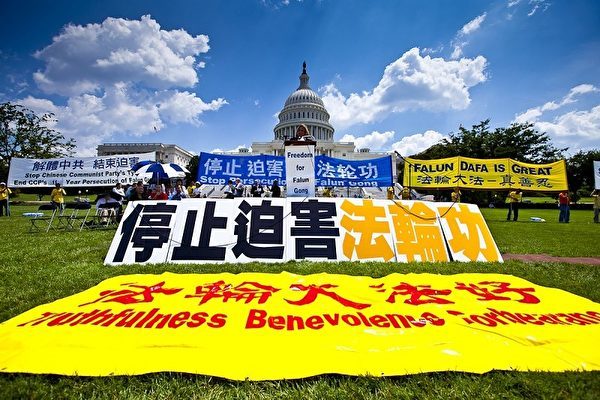
A gathering on July 22, 2010, where Falun Gong practitioners from around the world held a rally on Capitol Hill in Washington, D.C., to protest the persecution that began on July 20, 1999.
[People News] On February 26, the 21st meeting of the Standing Committee of the 14th National People’s Congress concluded. According to the announcement released afterward, the qualifications of 19 NPC deputies were terminated. Various signs indicate that former Xinjiang Party Secretary and Politburo member Ma Xingrui has very likely fallen from power and may soon be officially announced. So why has there been no public statement so far?
Although the Chinese Communist Party (CCP) has not officially announced an investigation into Ma Xingrui, many observers believe he is almost certainly in trouble, based on his absence from important meetings for more than half a year.
On July 1 last year, the CCP announced that Ma Xingrui would “no longer concurrently serve as Xinjiang Party Secretary” and would be “assigned to another position.” However, to this day, he has not been assigned elsewhere. On the contrary, since November last year, he has been absent from a series of major meetings and events.
Recently, he was absent from the Politburo’s democratic life meeting held December 25–26, 2025. He also did not send wreaths for two senior CCP officials who passed away: former Finance Minister Wang Bingqian on December 14, 2025, and former NPC Vice Chairman Peng Peiyun on December 26. Before the Year of the Horse, Ma Xingrui was nowhere to be seen at various New Year receptions, symposiums, or condolence events. Many political observers analyze that Ma Xingrui was in fact removed as Xinjiang Party Secretary and likely fell from power before November 28, 2025. It is highly possible he was taken in by the discipline inspection authorities (“shuanggui”) and directly detained at an interrogation base in Beijing.
However, the CCP has not released any official information about Ma Xingrui. But that does not mean he is fine. For example, former Foreign Minister Qin Gang, former Navy Political Commissar Yuan Huazhi, former Armed Police Commander Wang Chunning, former Chairman of China Aerospace Science and Technology Corporation Xu Dazhe, former Chief Engineer of China National Nuclear Corporation Luo Qi, and many other senior officials all disappeared for extended periods before their downfalls were announced.
Observers believe that if Ma Xingrui has fallen but the news is being kept secret, it may be because since the second half of last year—when he disappeared—a large number of ministerial-level and above officials have already been taken down, including He Weidong, Yi Lianhong, Zhang Youxia, and others. For the CCP, public opinion pressure and internal instability are already considerable. Ma Xingrui is a Politburo member; announcing another such downfall would look particularly bad. Therefore, it may have been shelved. Others say that adding one more Politburo member to the list is not such a big deal, and that the delay in announcing it may mainly relate to his relationship with Xi.
Ma Xingrui was indeed repeatedly promoted after Xi came to power. Why did Xi value Ma so highly? Former Central Discipline Inspection Commission official Wang Youqun wrote in The Epoch Times analyzing:
-
Ma Xingrui and Xi’s wife Peng Liyuan are both from Yuncheng, Shandong. While serving in Guangdong, Ma may have assisted the business interests of Peng Liyuan’s brother-in-law Xu Xingjian.
-
While in Guangdong, Ma may also have assisted the business interests of Xi’s second sister Xi Qiaoqiao and her husband Deng Jiagui.
-
Ma’s wife Rong Li and Peng Liyuan are close friends within the circle of wives of high-ranking CCP officials. According to overseas disclosures, Rong Li provided benefits to Peng Liyuan. The UK’s Financial Times once cited sources saying that Ma Xingrui had family ties with Peng Liyuan and frequently visited Xi’s home even before Xi came to power, making him one of the officials closest to Xi.
Considering that Xi remains the top leader of the CCP, and considering that Ma Xingrui’s case involves wide-ranging and high-level connections, the CCP authorities may believe that any announcement about Ma should be slow and low-profile—handled quietly if possible, or even allowed to fade away.
All the above reasons may exist, or they may not be the main factors. Observers believe the primary reason is that Ma Xingrui committed two major crimes that the CCP finds extremely difficult to publicly acknowledge. Once his downfall is announced, the two crimes that the CCP most fears being discussed may once again become widely debated.
What are these two major crimes?
The first is implementing genocidal policies against the Uyghurs in Xinjiang.
Uyghurs living overseas accuse Ma Xingrui, after becoming Xinjiang Party Secretary, of enforcing even harsher repression than his predecessor Chen Quanguo. Re-education camps reportedly evolved into long-term imprisonment. “Arbitrary detention continues, and forced labor has become even more prevalent, especially within the ‘Belt and Road’ initiative,” said Norway-based Uyghur activist Abduweli Ayup to Voice of America (VOA). Ma’s repression policies extended beyond Xinjiang, including the forced repatriation of 240 Uyghurs who had sought refuge in cities like Shanghai and Beijing. Irpan Yarmemet, who had studied in Turkey eight years earlier, was forcibly returned to Xinjiang after Ma took office, Ayup said. “Under Ma Xingrui, repression knows no geographic boundaries.”
Ma Xingrui has been described within CCP officialdom as “decisive and forceful.” His transfer from Guangdong to Xinjiang as Party Secretary was seen as an extraordinary promotion. Observers at the time believed Beijing aimed to strengthen military deployment in Xinjiang and expand high-tech surveillance to further persecute Uyghurs and other minorities. However, Ma repeatedly dismissed foreign criticism, claiming people should not be misled by “smears” against Xinjiang. He arranged showcase visits, portraying a “beautiful and harmonious” image of Xinjiang, inviting foreigners to experience the so-called “real Xinjiang.”
The second crime the CCP seeks to conceal is Ma Xingrui’s persecution of Falun Gong practitioners during his tenure in Guangdong and Xinjiang.
According to information from Minghui.org, persecution cases of Falun Gong practitioners such as Huang Shengwei in Shanwei, Guangdong, and practitioners Cen Xiaoping, Yang Bin, and Ling Honghua in Shenzhen occurred during Ma’s tenure as Guangdong governor and Shenzhen Party Secretary.
According to New Tang Dynasty Television, Xinjiang authorities have illegally detained Falun Gong practitioners in concentration camps, detention centers, labor camps, prisons, and brainwashing centers, subjecting them to severe persecution. Zhang Lihua, a practitioner from Urumqi, has reportedly been illegally detained in a concentration camp for three years and threatened with indefinite imprisonment.
Ma Xingrui’s name appears on the list of the World Organization to Investigate the Persecution of Falun Gong.
In fact, under CCP law, there is still no provision that deems practicing Falun Gong illegal. Falun Gong does not appear among the ten cults listed by the Ministry of Public Security. None of the six characteristics of cults that the CCP required relevant departments to define apply to Falun Gong, yet they all apply to the CCP itself. Judicial interpretations by the Supreme People’s Court and Supreme People’s Procuratorate also do not match Falun Gong. Only the former Jiang faction, the 610 Office, and CCP-controlled media have perpetuated the “cult” label. Practicing Falun Gong in China is legal, and practitioners speaking out is an exercise of basic human rights such as freedom of speech, the right to know, and the right to health. All of the current problems in China are linked to the CCP’s persecution of Falun Gong.
For the CCP itself, persecution of Falun Gong can no longer be publicly discussed.
In fact, many officials who have fallen from power have records showing involvement in the persecution of Falun Gong. Whether this is described as retribution or simply the consequences of one’s own actions, it reflects the outcome of personal choices. If Ma Xingrui’s downfall is officially announced, people will inevitably mention these two major crimes. This may be precisely the main reason the CCP is delaying and does not dare to announce it.
(First published by People News)





News magazine bootstrap themes!
I like this themes, fast loading and look profesional
Thank you Carlos!
You're welcome!
Please support me with give positive rating!
Yes Sure!