
The Stability-Maintenance Dilemma Under the CCP’s Fiscal Crisis
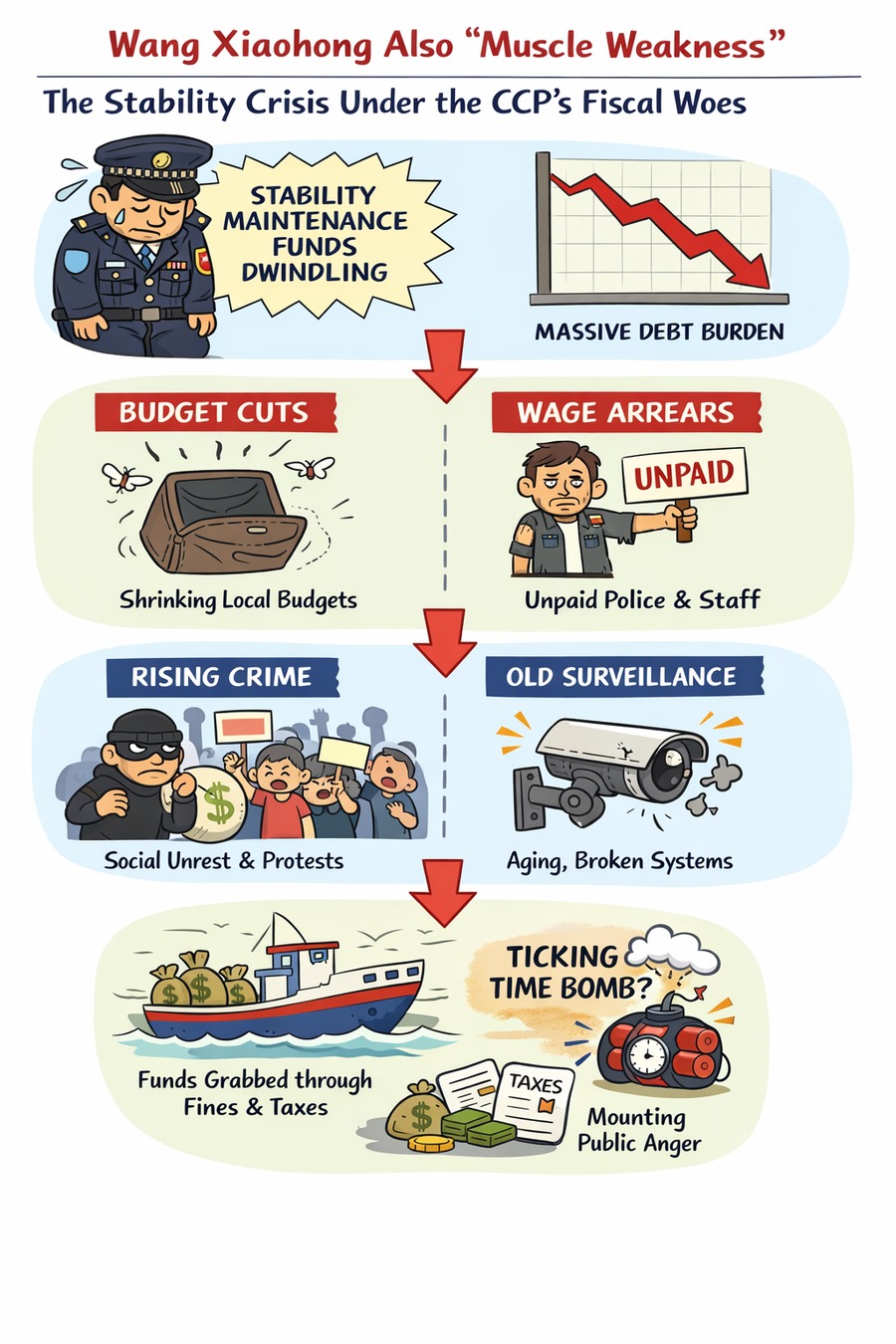
[People News] The CCP’s annual stability-maintenance budget, often exceeding one trillion yuan, once propped up a grand illusion of “social harmony and national peace.” Today, as China’s economy declines and a fiscal crisis erupts, stability-maintenance funds across the country are stretched to the breaking point. Stability spending has shifted from a priority item to a zero-sum game over existing resources. At the grassroots level, the once-sacrosanct doctrine that “stability overrides everything” has begun to slide into a predicament in which “handling cases requires accounting for costs.”
On January 20, the CCP State Council Information Office held a press conference at which Liao Min, Vice Minister of Finance, introduced that in 2025 the CCP’s deficit ratio would be about 4 percent, an increase of 1 percentage point over the previous year; newly added government debt would reach 11.86 trillion yuan, an increase of 2.9 trillion yuan from the previous year, far exceeding the average level of previous years.
However, most of the CCP’s deficit expansion and large-scale borrowing are used to issue new debt to repay old debt and to maintain basic operations. Local government debt remains extremely high. Officially acknowledged explicit debt stands at 54 trillion yuan, implicit debt at 12 trillion yuan, and total local debt at 67 trillion yuan. But international institutions generally believe that the CCP deliberately conceals the true level of government debt. By the end of 2025, China’s real local government debt (including broadly defined local government financing vehicles and various types of hidden debt) is most commonly estimated by the market to fall between 130 and 145 trillion yuan, with more pessimistic estimates reaching 150 to 160 trillion yuan.
This scale far exceeds the officially acknowledged figures and constitutes one of the largest, most difficult to handle, and most easily detonated structural bombs in China’s current economic problems. This massive debt not only squeezes the spending space of both the central and local governments, but also indirectly leads to insufficient funding guarantees and declining execution capacity within the stability-maintenance mechanism.
In the past, stability maintenance was a rigid option in the CCP’s fiscal spending. Now, under fiscal deficits, the stability-maintenance mechanism is no longer a priority expenditure. Personnel salaries, pensions, medical insurance spending, and debt-resolution expenditures have become first-tier priorities, while stability-maintenance funds have been forced into the target set for deficit-driven crowding-out effects.
Let us give an example. Take a look at the 2025 budget and final accounts of the CCP Luohu District Committee Political and Legal Affairs Commission in Shenzhen.
In 2025, the Luohu District Committee Political and Legal Affairs Commission’s departmental budgeted revenues and expenditures both totaled 33.896 million yuan, a decrease of 5.4929 million yuan from the initial 2024 budget, a drop of 13.9 percent. Among this, wages, benefits, and social insurance expenditures for 44 on-the-job personnel (including administrative staff, institutional staff, and contract employees) amounted to 16.6267 million yuan, averaging 377,800 yuan per person and accounting for 49.1 percent. Funds for 19 retirees totaled 6.8378 million yuan, averaging 360,000 yuan per person per year. For such a small district-level political-legal committee, the annual per-capita wage expenditure for both active and retired personnel is nearly 400,000 yuan—quite literally drinking the blood of taxpayers.
In 2025, the Luohu District Committee Political and Legal Affairs Commission’s stability-maintenance funds actually used to persecute ordinary citizens—so-called project expenditures—amounted to 9.2191 million yuan. In accordance with the finance department’s requirement to “live frugally,” the budgets for general projects were reduced. Among them, “anti-cult affairs” (mainly used to persecute Falun Gong) amounted to 3.56 million yuan, a reduction of 300,000 yuan from last year, used to hire 20 anti-cult social workers and create one “no-cult” demonstration street or community, and to carry out 40 anti-cult propaganda activities throughout the year. Stability-maintenance affairs amounted to 2.11 million yuan, a reduction of 680,000 yuan from last year, mainly used to handle stability work during sensitive periods and major group disputes. Political-legal affairs amounted to 1.6471 million yuan, a reduction of about 330,000 yuan from last year, mainly used for grassroots public legal education, organizing rule-of-law publicity, and subscribing to legal journals and periodicals. Comprehensive governance affairs amounted to 970,000 yuan, a reduction of 370,000 yuan from last year, mainly used for publicity and education activities on preventing and governing illegal and criminal activities.
From the budget arrangements, the CCP’s actual spending on stability-maintenance persecution has been significantly reduced, but funding for the persecution of Falun Gong has only been slightly reduced. The CCP still regards the Falun Gong group, which believes in “Truthfulness, Compassion, Forbearance,” as its number-one enemy. Meanwhile, other stability-maintenance and comprehensive governance funds have been reduced by about 25 to 30 percent compared with 2024.
In addition, the 2025 fiscal appropriation for operating expenses of the Luohu District Committee Political and Legal Affairs Commission amounted to 992,600 yuan, a reduction of 599,500 yuan from the initial 2024 budget, a decrease of 37.65 percent. Operating expenses mainly include reductions in meeting costs, transportation, travel, and office expenses.
The contraction in the 2025 budget and final accounts of the Luohu District Political and Legal Affairs Commission is only a microcosm of the national situation. In 2012 and 2013, China’s stability-maintenance spending grew by more than 10 percent. During the pandemic period from 2021 to 2024, the annual growth rates of stability-maintenance spending were 0.7 percent, 4.7 percent, 6.4 percent, and 1.44 percent respectively—significantly lower than in earlier years.
In regions suffering severe fiscal crises, stability-maintenance funding chains have broken, and many grassroots stability-maintenance personnel have not even been paid their wages. In August 2024, a grid worker in Hanjiang District, Putian, Fujian, said that the local government had owed wages to grid workers across the district for as long as six months and had also suspended social insurance payments. In addition, grid workers and social workers in Linyi, Shandong, also reported wage arrears of several months. Wage arrears have led to rising turnover among grassroots personnel, with stability maintenance shifting from “preventive suppression” to “passive response.”
According to reports by The Epoch Times, on the eve of the CCP’s Fourth Plenum, many dissidents, rights-defense activists, independent scholars, and petitioners in places such as Beijing, Chengdu, and Guizhou were restricted in their movements by the police. Several interviewees said that this year, due to tightened stability-maintenance funding, the authorities did not forcibly require them to “travel” away from their place of residence as in previous years, but instead placed them under house arrest. During the 2025 “Two Sessions,” the leader of the “June Fourth student movement,” Jifeng, was required to remain in Guizhou during the meetings. Unlike previous years, the authorities did not arrange for Jifeng to travel outside the area, a change related to strained local government finances.
Official data show that China’s crime rate has continued to decline, which is promoted as a sign of successful stability maintenance. In 2025, nationwide criminal cases fell by 12.8 percent, a record low for this century; serious violent crime fell by 4.7 percent, and kidnappings fell by 40.7 percent. In 2024, crime fell by 25.7 percent; in 2023, the number of prosecutions for serious violent crime dropped to 61,000, only 37 percent of the 1999 level. The Ministry of Public Security report emphasized that this is the result of building a “Safe China.”
However, this “decline” may merely be a false appearance under conditions of funding shortages. Economic slowdown should normally push crime higher (such as unemployment triggering social incidents), yet the data show the opposite, indicating the possibility of underreporting or data manipulation. Tight stability-maintenance funding has led grassroots units to tend toward “underreporting” cases, saving resources while falsifying performance. As is widely known, in 2025, violent revenge incidents occurred across mainland China, social discontent caused by economic decline accumulated rapidly, and mass incidents arising from school bullying, missing children, and abuse of privilege against the weak surged everywhere. The so-called decline in criminal cases is merely the CCP’s official data “slimming.” Stability-maintenance resources have fallen into tension and exhaustion, and the CCP’s stability-maintenance resource system is facing an unprecedented anemia.
According to insiders within the judicial system, grassroots law enforcement is currently facing unprecedented funding constraints. Now, handling a case requires accounting first. From filing a criminal case, evidence collection, cross-regional pursuit, to final forensic appraisal, every step involves real cash outlays. In the past, funding was sufficient; now, officers must even pay out of pocket for food, lodging, and transportation when handling cases outside their area. Severe shortages of case-handling funds mean that many cases are not even filed, or are closed quickly. A lawyer blogger on Douyin said that in a grassroots police station with over a hundred people, fewer than 10 police officers actually study case details, because handling cases costs money and effort without earning favor. Most police study people instead—studying how to flatter leaders and climb the ladder.
For a long time, in the name of political stability maintenance, the CCP invested huge sums to build an all-encompassing technological surveillance network, including Internet censorship and large-scale camera surveillance, using technologies such as artificial intelligence, facial recognition, fingerprint recognition, voiceprint recognition, iris recognition, big-data analysis, and DNA testing. As of 2022, China had deployed 2.76 billion video surveillance cameras, averaging more than two per person. The annual maintenance costs, electricity bills, and data storage fees for this system are an astonishing astronomical figure. In recent years, however, the “Big Brother” technological surveillance system has been unable to undergo timely maintenance and upgrades due to funding gaps. Outsourced technology companies, unable to collect payments owed, have taken public security, procuratorate, and court authorities to court.
According to mainland media reports, Tianjin private enterprise Tiandy Technologies won bids in 2016 and 2018 for video surveillance system construction and maintenance projects of the Binhai New Area Public Security Bureau, and has cumulatively been owed principal and interest totaling 50 million yuan. Tiandy sued the Binhai New Area Public Security Bureau. In October 2024, a local court issued a consumption restriction order against the bureau’s responsible person, but in November 2024, the court lifted the restriction and twice ruled that the public security bureau had “no property available for enforcement.” In other words, Tiandy is effectively unable to recover the owed funds from the public security bureau. Tianjin and Guizhou are both major regions with fiscal deficits nationwide. Last year, Tianjin even caused a scandal by borrowing money from the Dabei Monastery to pay civil servant salaries. On the other hand, when private enterprises actively bid to help the CCP public security authorities complete surveillance projects to persecute ordinary people, only to later be unable to get paid, shouldn’t they also reflect on this? Acting as technological accomplices to the CCP, the final outcome is destined not to be good.
With stability-maintenance funds in short supply, the violent apparatus on which the CCP regime relies has been forced into passive strategic contraction. As stability maintenance weakens, the CCP regime faces growing social dissatisfaction and public resentment, and attempts to make up for insufficient stability-maintenance capacity through fines, distant-water fishing, and taxation. Little does it realize that predatory fiscal revenue will only bring forward the critical point of social eruption. The valve of regime collapse is being opened step by step by the CCP’s own hands.
(First published by People News) △







News magazine bootstrap themes!
I like this themes, fast loading and look profesional
Thank you Carlos!
You're welcome!
Please support me with give positive rating!
Yes Sure!