

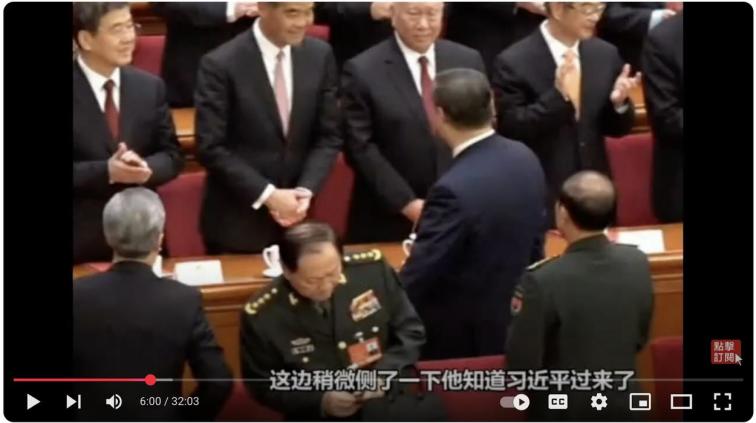
Cai Qi and Wang Xiaohong serve as Xi Jinping's gatekeepers. (Composite image)
[People News] According to the Chinese Communist Party (CCP), January 10 marks the sixth "China People's Police Day." However, the general public in mainland China knows that many of these so-called "people's police" do not genuinely care for the people. Those who are supposed to uphold social order and ensure public safety have instead become enforcers of the CCP's oppression, persecution, and suppression of the populace. The reports from the Ministry of Public Security, which emphasise their role in "maintaining national security and social stability" before mentioning their duty to "guard the people's happiness and peace," clearly highlight the issue at hand.
Additionally, in many areas, the heads and deputy heads of public security bureaus are often local gang leaders who actively disrupt social order and jeopardise public safety. Over the past few decades, the CCP's own media have revealed a significant amount of this information.
As a result, the celebration of Police Day by mainland officers is largely a self-congratulatory event; how many citizens sincerely express gratitude towards them?
Notably, this year's news report mirrors last year's content, only briefly mentioning "Xi Jinping's concern" in the opening paragraph. However, this year, the customary reference to "Party Central" following Xi's name is conspicuously absent. Given the indications that the CCP's leadership has reverted to a collective model, with "Party Central" now positioned above Xi, the Ministry of Public Security's failure to mention "Party Central" may be an effort to avoid placing it after Xi's name, thus preventing further revelations of Xi and his close associate, Minister of Public Security Wang Xiaohong's waning influence. Alternatively, it could suggest that "Party Central" is disinterested in the public security system that is still nominally under Wang Xiaohong's leadership. Or perhaps it is an attempt to assert that Xi and Wang continue to wield power.
The author suggests that the intention is likely to avoid revealing the vulnerabilities of Xi Jinping and Wang Xiaohong regarding their potential loss of power. A notable piece of evidence is the final paragraph of this year's and last year's news reports, which completely omits the Chinese Communist Party's (CCP) customary loyalty phrases known as 'two four four two.' This stands in stark contrast to the reports celebrating Police Day in 2024 and 2023.
In the January 2024 report, Xi's name is mentioned five times, with the last paragraph featuring police officers expressing their loyalty. They state the need to 'unite more closely around the Party Central Committee with Xi at its core,' 'deeply study and implement Xi Jinping's thoughts on the rule of law, particularly his important discourse on public security work in the new era,' and reference the 'two establishments' and 'two safeguards.'
In the January 2023 report, Xi is mentioned seven times. The opening paragraph references him three times, stating, 'Recently, General Secretary Xi Jinping made important instructions regarding political and legal work and, on behalf of the Party Central Committee, extended holiday greetings and condolences to the national police.' Following this, senior officials from the Ministry of Public Security are tasked with implementing Xi's directives, after which police officers organise a series of activities to convey 'Xi and the Party Central Committee's concern'... The status of the 'Party Central Committee' is evidently subordinate to that of Xi.
Wang Xiaohong's loyalty is further underscored in the news. After mentioning the 'two establishments' and 'two safeguards' in the second paragraph, the final paragraph not only echoes the flattering language of 2024 but also includes the loyalty phrases of 'two four four two.'
If Xi Jinping still holds control over the military and party authority, and remains the true 'General Secretary', and if Wang Xiaohong effectively oversees the Ministry of Public Security or remains completely loyal to Xi, such a situation would clearly not arise. A pivotal moment is the rumoured incident involving Xi at the CCP's Third Plenary Session in July 2024.
Following Xi's incident, the People's Liberation Army Daily and state media have shown notable irregularities, particularly a noticeable decrease in propaganda supporting Xi. Additionally, the loyalty phrase 'two four four two' has been downplayed; many senior officials have stopped mentioning it or have minimised its significance, and some statements from those who do mention it have been edited, including remarks from Wang Huning, the Chairman of the National Committee of the Chinese People's Political Consultative Conference.
In fact, during the Politburo Standing Committee meeting on January 8, the CCP's top leadership made it clear to the public that Xi's power has been diminished and that the party has reverted to collective leadership. Why is this the case?
As I noted in my article 'The Latest Meeting of the CCP Politburo Standing Committee Further Confirms Xi's Loss of Power', both meetings scheduled for 2025 and 2026 took place after Xi's incident, emphasising collective leadership and including statements about 'resolutely safeguarding the authority of the Party Central Committee and centralised unified leadership'. In contrast, the emphasis on collective leadership in 2024 appears to be weakened, lacking such statements.
In comparison to the 2025 report, the 2026 report reveals subtle changes. It indicates that under the guidance of 'Xi Thought', the focus is now on 'upholding the centralised and unified leadership of the Party Central Committee', followed by 'two four four two'. This contrasts with the 2024 report, where 'Xi Thought' was immediately succeeded by 'two four four two'. The elevated status of the 'Party Central Committee' over Xi is no longer hidden, and the members of the Politburo Standing Committee have performed commendably in supporting the 'Party Central Committee' over the past year, receiving 'recognition'.
Is the Chinese Communist Party's clear signal of Xi's diminishing power a precursor to the upcoming Fifth Plenary Session?
(First published by People News) △






News magazine bootstrap themes!
I like this themes, fast loading and look profesional
Thank you Carlos!
You're welcome!
Please support me with give positive rating!
Yes Sure!