
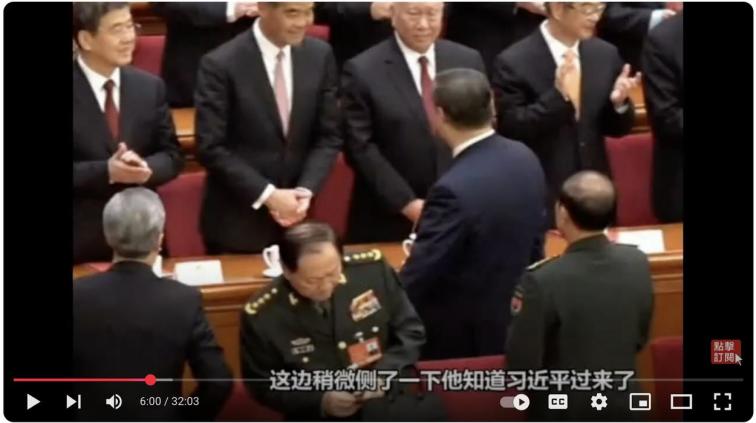
During the closing ceremony of the Two Sessions, video footage showed that as Xi Jinping was leaving, several Politburo members, including Vice Chairman of the Central Military Commission (CMC) He Weidong, turned around and stood by their seats to watch Xi depart. However, Zhang Youxia remained facing forward, not even glancing back as Xi walked past behind him. (Screenshot from video)
[People News] The Chinese Communist Party's Politburo has entered a peculiar phase. While Xi Jinping remains in power, there are ongoing reports of individuals both within and outside the system privately criticising him. Scholars indicate that 'Insult Xi' has become a popular underground trend among officials in Beijing, with even mid-level officials believing they could perform better than Xi if given the opportunity. In the context of rising official grievances and public anger in China, Xi Jinping has become a figure of widespread disdain.
Scholar: 'Insult Xi' is gaining traction among Beijing's officials.
Professor Yuan Hongbing, a Chinese scholar based in Australia with close connections to the CCP, recently remarked on the 'Elite Forum' program that discussing Xi Jinping was once a taboo in Beijing's official circles, with everyone avoiding the topic. However, recent communications from friends within the officialdom indicate that in private interactions, officials are now openly mocking and ridiculing Xi Jinping. Some rather unflattering nicknames for Xi have been frequently mentioned in these private conversations.
Some observers have likened this situation to the end of the 'Cultural Revolution,' when officials derided the 'Gang of Four.' Even some mid-level officials have expressed contempt for Xi Jinping in private discussions, asserting that he can be replaced, and that if they were in his position, they would perform better.
Yuan Hongbing argues that this phenomenon is essentially the result of long-term accumulation. It is not solely due to Xi Jinping's selective anti-corruption measures that have disrupted people's financial and political pathways; it is also because Xi Jinping aspires to emulate Mao Zedong and establish himself as a communist emperor. He does not permit other elite families within the Communist Party to share the highest levels of power with him, leading to the exclusion of many 'red second generation' families from this power-sharing.
Another factor is that Xi Jinping's abilities and moral standing do not align with his position; he struggles to gain public support. While he seeks absolute loyalty from Communist Party officials, nearly all the projects he has personally overseen—be they economic, cultural, or political—have ultimately ended in failure. This has led to him being dubbed the 'Emperor of Unfinished Projects.'
Independent commentator Du Zheng previously disclosed in the Taiwanese media outlet 'Shang Bao' that jokes containing coded references to Xi are currently circulating at various dining events in China, often eliciting hearty laughter.
Du Zheng cited a retired senior Communist Party official, who wished to remain anonymous, commenting on Xi and the Party: 'When that person (Xi) first took office, people still had some hope for him, but now no one speaks positively of him; everyone criticises him, and people are eagerly anticipating the collapse of the Communist Party!'
Chinese netizens, including officials, enjoy giving Xi Jinping nicknames like 'Baozi' (steamed bun) and 'Little Bear Winnie.' According to a previously leaked database from a website behind the Great Firewall, there are at least 2,000 sensitive terms directly associated with Xi Jinping, and this number continues to grow, keeping the Communist Party's internet regulators quite busy.
Analysis suggests that there have been four distinct waves of anti-Xi sentiment in China.
Du Zheng's analysis indicates that Xi Jinping's authority has gradually eroded through these four waves.
The first wave of opposition began when Xi Jinping became the core leader of the Communist Party at the 19th National Congress in October 2017, successfully consolidating his power. In March 2018, he amended the constitution to abolish presidential term limits, marking the start of his ambition to rule for life. This wave of dissent against Xi was spearheaded by the descendants of the Communist Party's red elite and officials within the government. At that time, the authorities were heavily promoting a cult of personality around Xi Jinping, which led to widespread grievances across various levels of government.
The second wave of opposition, also led by the second generation of red elites, emerged in early 2020 when the COVID-19 virus began to spread from Wuhan. Xi Jinping was implicated in concealing the outbreak, which allowed the virus to spread worldwide. Notable real estate mogul Ren Zhiqiang published a critical article describing Xi as 'a clown who insists on being an emperor even when stripped of his clothes.' This article gained significant traction both domestically and internationally. Ren Zhiqiang was subsequently sentenced to eighteen years in prison on corruption charges, but Xi Jinping's reputation suffered as a result.
In February 2020, legal scholar Xu Zhiyong publicly released an 'Open Letter' asserting that Xi Jinping's administration was incapable of addressing major crises such as the 'China-U.S. trade war,' 'Hong Kong democratic protests,' and the 'Wuhan COVID-19 outbreak.' He called for Xi Jinping to voluntarily 'step down.' Xu Zhiyong was swiftly arrested.
The third wave of opposition to Xi Jinping further permeated society. Throughout the three years of the pandemic, Xi's 'personal command and personal deployment' of the zero-COVID lockdowns resulted in countless humanitarian disasters, reminiscent of the 'Great Famine' during the era of Mao Zedong.
On October 13, 2022, Chinese citizen Peng Zaizhou displayed anti-Xi banners on the Sitong Bridge in Zhongguancun, Beijing. One banner read, "No nucleic acid tests, we want to eat! No lockdowns, we want freedom! No lies, we want dignity! No Cultural Revolution, we want reform! No leaders, we want ballots! We want to be citizens, not slaves!" Another banner stated, "Strike classes, strike work, remove the dictatorial traitor Xi Jinping." This was followed by the nationwide "White Paper Movement" that erupted at the end of November 2022, where people chanted slogans like, "Down with the Communist Party! Down with Xi Jinping!"
Du Zheng believes that these explicitly named anti-Xi actions signify the collapse of Xi Jinping's image in the eyes of the Chinese populace.
As early as the beginning of 2023, the Chinese Communist Party (CCP) authorities unexpectedly abandoned the zero-COVID policy, resulting in a tsunami-like spread of the virus across China. Hospitals became overwhelmed with patients, and long lines formed at crematoriums, many of whom were former senior CCP officials. Information obtained by The Epoch Times at that time indicated that retired military officials privately criticised Xi Jinping for being "obsessed."
Du Zheng noted that the fourth wave of anti-Xi sentiment emerged after Xi Jinping successfully secured his third term at the 20th National Congress of the CCP in October 2022, with his loyalists fully assuming power, leading to ineffective governance, economic collapse, and challenging living conditions.
Beginning in 2023, severe internal conflicts arose within the CCP military, resulting in the dismissal of numerous generals personally promoted by Xi Jinping, including Vice Chairman He Weidong. Xi Jinping had promoted 79 generals, nearly half of whom have since fallen.
Yuan Hongbing recently remarked on a program that the Xi family army, which has been personally cultivated by Xi Jinping, is embroiled in serious corruption issues. This situation has significantly undermined Xi Jinping's authority and has even had a greater psychological impact on him than the Lin Biao incident had on Mao Zedong in the past.
Yuan Hongbing noted that nearly all current officials of the Communist Party of China (CPC) are two-faced, disengaged, and inactive. The CPC's governance capabilities have sharply declined in tandem with the erosion of Xi Jinping's prestige. In reality, the entire bureaucratic system is looking forward to Xi Jinping's ousting; however, he uses a modernised intelligence apparatus equipped with advanced technology to instil fear of state terrorism, thereby sustaining his personal dictatorship.
Yuan Hongbing concluded by stating that the grievances among Chinese officials are rising dramatically, and public anger is reaching new heights, creating a cycle of mutual agitation. Xi Jinping's regressive policies have transformed him into a public enemy, even inciting anger among millions of CPC officials. As a result, Xi Jinping is inevitably on the path to downfall.
(Reported by Dajiyuan reporter Tang Bing)
△




News magazine bootstrap themes!
I like this themes, fast loading and look profesional
Thank you Carlos!
You're welcome!
Please support me with give positive rating!
Yes Sure!