
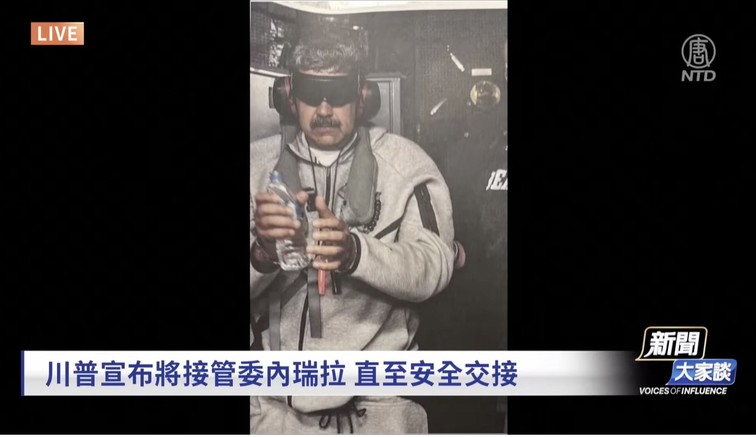
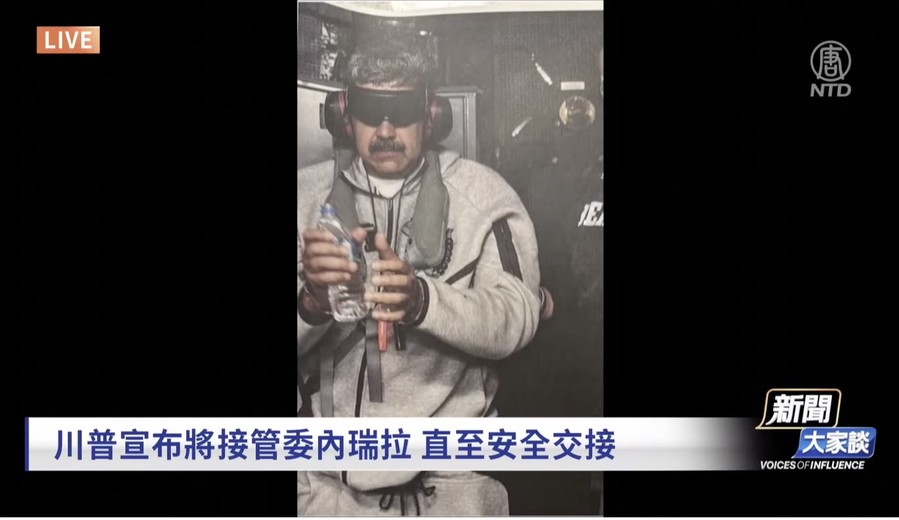
The image depicts Venezuelan President Maduro being apprehended by the U.S. military on January 3, 2026, and then transported to the amphibious assault ship USS Iwo Jima, en route to New York, USA. In the picture, Maduro is dressed in a grey tracksuit, his eyes are obscured by a black cloth strip, and he is holding a water bottle, while wearing what seems to be a large headset-like device on his ears. (Video screenshot)
[People News] During a press conference, Trump claimed that the decision to apprehend Maduro in the early hours of January 3 was influenced by weather conditions. However, after reviewing the local weather records in Caracas from December 23 to January 5, I found no substantial differences. It appears that the weather was merely a pretext.
It is well known that numerous factors can affect a major military operation, including legitimacy, the adequacy of military preparations, and the element of surprise, among others. In terms of legitimacy, Trump has already laid a considerable foundation, accusing Maduro of drug trafficking and election fraud... Regarding military readiness, the raid drills have been conducted for several months, making the operation nearly foolproof. Thus, the element of 'surprise' becomes crucial; it not only affects the cost of the operation but can also determine whether the entire mission succeeds or fails. I will analyse this through a significant 'coincidence.'
Just hours before the raid commenced, Maduro had a friendly meeting with a visiting delegation from the Chinese Communist Party and excitedly shared about it on social media. Shortly after midnight, the raid took place. Some have humorously suggested that Xi Jinping sent an envoy to act as a guide, luring Maduro out and confirming his identity, which allowed the Americans to catch him in the act. Of course, this is just a joke. Nevertheless, the simultaneous occurrence of these two significant events cannot simply be dismissed as a 'coincidence.'
According to information revealed by the United States, Maduro had already embedded CIA informants within his inner circle. His movements, the layout of his room, personal preferences, and even the characteristics of his pets were all under U.S. surveillance. Thus, it can be inferred that the visit of the Chinese Communist Party delegation was likely known to the United States in advance and factored into their planning for the raid.
There was an 11-day gap between Trump's ultimatum to Maduro on December 23 and the actual operation on January 3, during which the United States refrained from taking action, leading to suspicions that they were intentionally waiting. If they were not waiting for favourable weather conditions, what were they waiting for? It is highly probable that they were waiting for the conclusion of this meeting. This reasoning is logically sound.
Following Trump's ultimatum, it should have been the most anxious moment for Maduro, especially since the U.S. had just bombed Iran's nuclear facilities with bunker busters right after Trump's deadline. However, ten days have passed without any action from the U.S.; in fact, on December 25, Trump even targeted an ISIS base in Nigeria. Regardless of Trump's intentions, the impression given to the outside world is that he has been sidetracked by other crises, causing the offensive against Venezuela to stall. Subsequently, Xi Jinping's special envoy made a high-profile visit, which further bolstered Maduro's confidence. Typically, such a series of events would create the illusion for Maduro that Trump is hesitant to take military action, especially with the Chinese Communist Party's prominent support, potentially shifting the situation from an immediate military threat to a longer-term diplomatic struggle. Once Maduro perceives this change, he may psychologically relax; while the level of alertness might not drop immediately, everyone—from Maduro to the soldiers in the guard—will likely feel a significant sense of ease. This presents the optimal moment for the U.S. to strike.
If this line of reasoning is valid, then claiming that Xi Jinping's special envoy serves as a death knell for Maduro is neither an exaggeration nor a joke.
Certainly, as another option, it is quite possible that Trump is also waiting for the results of this meeting. After all, what Xi Jinping's envoy will say is beyond Trump's foresight, and who knows, Xi Jinping might suddenly realise and persuade Maduro to accept Trump's conditions and go into exile! If that were to happen, Trump might indeed wait a bit longer. However, no miracle occurred; the Chinese Communist Party (CCP) continued to boast and assure that Maduro would hold firm; Maduro was easily swayed by the CCP's verbal assurances, naively ecstatic, with his confidence once again soaring.
So if not now, when? The United States did not set a trap; it was Maduro who fell for the CCP's deceptive promises. Trump is simply biding his time, waiting for the perfect moment to strike.
This time, the CCP has fully revealed its true nature—both malicious and foolish. The malicious aspect lies in putting Maduro up against the formidable military power of the United States, challenging the most assertive president in American history, which is essentially a death sentence for him. The foolish aspect is that, in an attempt to bolster Maduro's spirits, it inadvertently became a sedative that lulled him into complacency, effectively allowing the U.S. military to execute a textbook-level operation, almost personally delivering Maduro to prison.
Additionally, there is a noteworthy detail. On December 23, reports emerged indicating that the Russian embassy in Venezuela had begun evacuating the families of its diplomats starting December 19. Given that Russia's intelligence system has roots in the former KGB, it is quite formidable. Clearly, they were aware that the United States was about to take action. In contrast, the Chinese Communist Party (CCP) naively dispatched special envoys to publicly support Maduro, which suggests that the CCP's intelligence capabilities are severely lacking and their ability to assess the international political landscape is alarmingly low. Furthermore, this indicates that Russia has not shared any intelligence with the CCP, allowing them to watch as the CCP leaps into a precarious situation. This so-called limitless friendship with Russia truly highlights the CCP's ineptitude.
Note: The analysis above is based on my logical reasoning from publicly available information, and I do not possess any insider information. △


News magazine bootstrap themes!
I like this themes, fast loading and look profesional
Thank you Carlos!
You're welcome!
Please support me with give positive rating!
Yes Sure!