
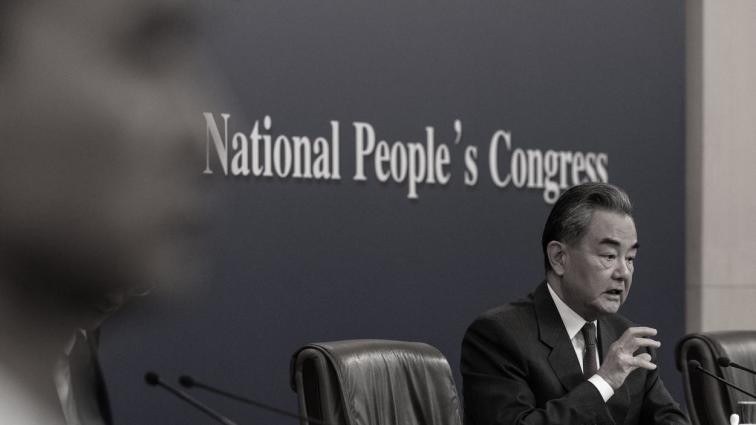
Image: Chinese Foreign Minister Wang Yi. (Photo by Kevin Frayer/Getty Images)
[People News] Late at night on April 7, global attention was focused on the Persian Gulf. At that moment, less than 90 minutes remained before the ultimatum set by U.S. President Trump expired. U.S. B-52 bombers were already powered up on the runway, and Tehran’s air defence sirens echoed sharply. At that instant, global oil prices surged wildly, breaking through recent historical highs. Everyone believed that a war that would reshape 21st-century geopolitics was unavoidable.
However, a dramatic turn of events occurred. The Iranian regime, which had been loudly threatening to blockade the Strait of Hormuz and make the United States “pay the price,” suddenly backed down at the last moment and agreed to a two-week emergency ceasefire agreement. Currently, more than a thousand ships are lined up on both sides of the Strait of Hormuz awaiting passage. After reopening, two vessels have already departed, becoming the first to pass through following the ceasefire.
How did this agreement come about? Was it the deterrence of Trump’s missiles, or did Iran suddenly change course? As speculation mounted, Trump, in a phone interview with AFP after the agreement was reached, said something blunt that pulled the key figure behind the scenes into the spotlight. Trump said: “Yes, China was involved—they applied pressure.”
Why did the Chinese Communist Party step in personally this time instead of staying behind the scenes as usual?
Many observers see this diplomacy as China playing the role of a “peacemaker,” and some domestic media have even begun praising it as so-called “great power wisdom.” But if you carefully examine its actions at the UN Security Council and its private phone calls, you will find this was a precisely orchestrated “good cop, bad cop” performance.
First, let’s look at the “tough stance” Beijing performed at the United Nations. Just hours before the ceasefire was reached, Beijing joined Russia in vetoing a resolution led by Bahrain aimed at safeguarding navigation routes. This veto was very telling—it ostensibly helped shield Iran and opposed U.S. military authorisation. This was a performance for Iran, a gesture to give face to authoritarian regimes. It sent a signal to the Middle East: “I dare to confront American hegemony; I am your protector.”
But behind the scenes, the real pressure was delivered through phone calls. Chinese Foreign Ministry spokesperson Mao Ning officially confirmed that Foreign Minister Wang Yi made 26 calls in a very short period. Think about it—were these 26 calls about world peace? About humanitarian concerns?
Absolutely not. For Iran’s foreign minister, Araghchi, Beijing’s underlying message was clear: “I can put on a show for you at the UN, but if you truly dare to shut down the Strait of Hormuz for long and cut off my oil supply, you will have to face U.S. saturation bombing on your own. At that point, there will be no renminbi and no support. How many days can your regime last? You decide.”
Why was Beijing so unsettled this time? The answer lies not in justice, but in Zhongnanhai’s “lifeline ledger.”
Let’s look at some figures. At present, a conservative estimate suggests that over 33% of China’s imported oil transported by sea must pass through the narrow Strait of Hormuz, which is just over 30 kilometres wide. What does that mean? It means that if war breaks out in this waterway, China would instantly lose about one day’s worth of oil imports out of every three days.
According to the latest official data, China’s current oil reserves are about 1.3 to 1.6 billion barrels. That sounds like a lot, right? But according to an energy report from March 2026, if supplies were completely cut off, after accounting for military and essential civilian needs, these reserves would only sustain the country for about 96 to 115 days.
For an organisation that relies on “stable growth” as the sole source of its legitimacy, a safety margin of about 100 days is like walking a tightrope. If the Strait were blocked for more than a month, domestic prices in China would spiral out of control.
More importantly, under comprehensive sanctions, Iran has been forced into a disadvantaged position, which China has long exploited to drive down prices. According to market analysis, Iranian crude exported to China is typically priced $5 to $10 per barrel below international market rates, and is often settled in renminbi, bypassing U.S. dollar monitoring.
This is why Beijing is so anxious. China’s economic growth forecast for 2026 has already been lowered by the International Monetary Fund (IMF) to 4.2%–4.4%. Amid weak domestic demand, a collapsing real estate sector, and rising unemployment, if this “cheap energy package” disappears—if domestic gasoline prices double—China’s fragile growth figures could instantly drop to zero or even turn negative.
Thus, the CCP is the one that can least afford to lose in this crisis.
The CCP often talks about “non-interference in internal affairs,” but this time it has intervened more aggressively and openly than anyone else. For Beijing, “non-interference” is little more than a joke. Trump’s claim that “China applied pressure” reveals the CCP’s deepest fear—the fear of losing control over Iran as a strategic pawn.
For Beijing, Iran can cause trouble, harass U.S. forces, and distract Trump’s strategic focus—but it must not ignite a real war. Because once the flames are lit, China cannot rely on energy self-sufficiency like the United States; it would be the first to get burned as a bystander.
So, during this precious two-week “breathing window,” what is Beijing secretly planning? And what hidden, potentially destructive follow-up lies behind its veto at the UN Security Council?
On the eve of the ceasefire, China and Russia jointly vetoed a resolution to safeguard navigation routes. On the surface, the CCP plays the role of an “anti-American vanguard,” handing matches to Iran and encouraging authoritarian regimes to challenge the international order; but behind the scenes, it makes those 26 pressure calls because it fears the fire will reach its own granary.
This kind of “playing both sides” diplomacy is, at its core, a depletion of global security. The two-week ceasefire may offer the world a moment of relief, but for the CCP, it is a window to rush oil shipments.
Watch closely—in the next 14 days, Beijing will not genuinely push for a long-term peace solution in the Middle East. What it truly wants is to take advantage of the temporary reopening of the strait and have oil tankers—whether flying the Chinese flag or part of a “shadow fleet”—rush to transport oil. Beijing aims to use these two weeks to fill its strategic petroleum reserves as much as possible, so it has leverage in the next round of conflict.
Wang Yi’s 26 phone calls were not to save Middle Eastern civilians or regional stability—they were to salvage Beijing’s fragile 2026 economic report card.
(First published by People News)






News magazine bootstrap themes!
I like this themes, fast loading and look profesional
Thank you Carlos!
You're welcome!
Please support me with give positive rating!
Yes Sure!