
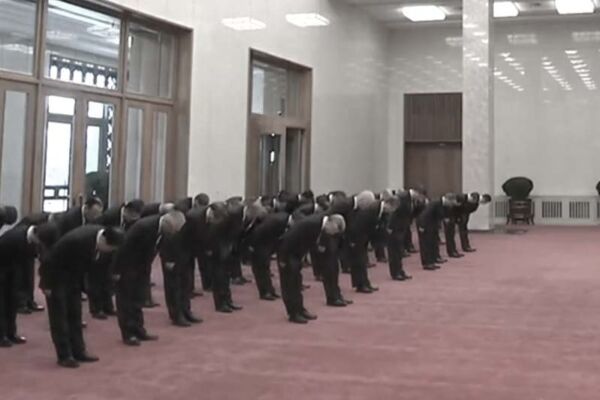
FILE PHOTO: On December 26, 2023, members of the CCP Politburo Standing Committee and senior officials in Beijing bowing to the statue of Mao Zedong. (Screenshot from a video.)
[People News] On March 30, independent commentator Cai Shenkun revealed on X that Yi Xianrong, the former deputy consul general of the Chinese consulate in San Francisco, has been arrested by the CCP and is currently detained at the No. 1 Detention Centre in Huangshi City, Hubei Province. The case has been heard by the Huangshi Intermediate People's Court, but no verdict has been issued due to insufficient evidence of a crime. Recently, his mother has been publicly advocating for her son, which has sparked discussions in the public sphere.
Who is Yi Xianrong? After being recalled from the San Francisco consulate by the CCP, he advanced to the position of deputy director of the Hubei Provincial Department of Civil Affairs. He was expelled from the party on January 16, 2025. The CCP has officially accused him of negligence regarding statistical fraud, leading a corrupt lifestyle, making arbitrary decisions, abusing his power, and engaging in transactions involving power and money.
According to the whistleblower, Yi Xianrong came from a civilian background and achieved several promotions through hard work, only to be framed by the Hubei Provincial Discipline Inspection Commission, which aimed to force him out of his position to allow others to take his place.
In a video, Yi Xianrong's mother holds her ID card and publicly calls for justice for her son. She has made multiple trips to Wuhan and Beijing seeking justice, but has received no responses. With no recourse available, she reported that personnel from the Hubei Provincial Discipline Inspection Commission employed illegal tactics such as intimidation, threats, and coercive interrogation to compel Yi Xianrong to sign documents they had prepared in advance.
Why does the CCP not spare diplomats?
We do not claim whether Yi Xianrong is innocent or if he has been set up; there is no evidence to confirm his corruption or lack thereof. It is possible that the Chinese Communist Party (CCP) believes he holds many secrets and has leaked intelligence; regardless, someone is clearly dissatisfied with him. What we want to highlight is that diplomats, in the eyes of the public, are engaged in the CCP's external united front and diplomatic efforts. These individuals possess unique skills and have successfully navigated the CCP's rigorous party education, suggesting they should be well-regarded. So why does the CCP not protect them? Why are they subjected to domestic transfers for a closed-door 'dog beating'?
In our investigation into the CCP's arrests of various diplomats, we uncovered a troubling truth that the CCP cannot and dares not acknowledge: many of its diplomats typically sell intelligence or make inappropriate statements, leading to their arrest after being reported or causing discontent among higher authorities. The motivations for selling intelligence often include being tempted by money, sex, and other incentives while abroad, or a rejection of the CCP's oppressive regime in favour of a desire for freedom and a civilised system. These reasons for betraying the CCP are not something the party can openly discuss.
Since the former Foreign Minister Qin Gang was reported to have been dismissed and detained by the CCP for having an illegitimate child in the United States and for leaking intelligence, several diplomats from the CCP or its organizations have been arrested or have gone missing, including the recently discussed Xi Jinping protégé, Liu Jianchao, a member of the 20th Central Committee and Minister of the International Liaison Department.
The International Liaison Department of the Central Committee of the Communist Party of China, commonly referred to as the International Liaison Department, serves as the functional body responsible for the Communist Party's interactions and operations with political parties, international organisations, and politicians from around the globe. Liu Jianchao, a ministerial-level party official, was once seen as a potential successor to the role of Minister of Foreign Affairs of the People's Republic of China after the dismissal of Qin Gang, potentially taking over from the current minister, Wang Yi. Liu had previously engaged in overseas operations to pursue corrupt officials, but ultimately, he could not escape the fate of being hunted by the Communist Party's own
Why does the Chinese Communist Party (CCP) maintain such a deep-seated suspicion and distrust of diplomats? The reason lies in the fact that diplomats possess numerous secrets of the CCP. In recent years, the CCP has engaged in various activities such as value infiltration, technology theft, information propaganda, economic exploitation, political manipulation, and long-arm coercion, all of which require diplomats to operate behind the scenes. Some embassies and consulates have essentially become spy hubs for the CCP.
This raises questions: Why did the United States close the CCP's consulate in Houston a few years ago? Why is there strong opposition from the British public against the CCP's construction of a super embassy in London? The answer is that governments and citizens in many countries, including the US and the UK, have recognised that CCP spies utilise embassies or diplomatic personnel, posing a significant threat to national security. And diplomats, as a result, are privy to too much information.
Nevertheless, it is true that some CCP diplomats have turned into foreign spies. This does not imply that these diplomats, after spending extended periods abroad, have come to admire foreign civilisation and freedom, leading them to betray the CCP. Are there such individuals? Yes, but we are referring to those who have been compromised, which indicates that diplomats are indeed well-informed about the CCP's foreign strategies and tactics.
You know too much!
The Ministry of State Security of the CCP once revealed a case involving diplomatic personnel being coerced into leaking secrets while abroad. The diplomat, surnamed Zhang, was compromised during his overseas assignment due to his visits to entertainment venues, where foreign spy agencies obtained evidence of his solicitation of prostitution. This evidence was used as leverage by foreign spies to coerce Zhang into providing intelligence. Consequently, Zhang was forced to continuously supply confidential information to the foreign side, and even after returning to the CCP, he did not cease these activities.
According to a report by CCTV, Zhang Nan, a public official representing the Chinese Communist Party abroad, was known to frequent luxurious venues during his time in office. He met Li Mou, a member of an overseas entrepreneurs' association, at a banquet. Through a series of frequent dining invitations, they established a trusting relationship. As their bond deepened, Zhang Nan disclosed his interest in 'special entertainment venues' to Li Mou. Acting on the orders of foreign spies, Li Mou set a trap to lure Zhang Nan to a local brothel. To his surprise, Zhang Nan was caught red-handed by 'local law enforcement.' In a bid to escape, he felt compelled to accept the 'rescue' offered by the foreign spies, ultimately falling into their trap and being compromised.
As reported by Taiwan's Mirror Weekly last year, since that incident, Zhang Nan has been leaking a significant amount of internal confidential information from China to foreign intelligence agencies through various means, such as printing, photographing, writing, or verbal communication, in exchange for substantial payments. Just before his return to China, he even signed a 'commitment letter' with foreign intelligence agencies, pledging to continue his cooperation and provide intelligence after his return.
The Ministry of State Security of the People's Republic of China has cited Zhang Nan as a case study for public media education, raising concerns that he may face severe penalties.
In a related case, Wang Qingqian, a first secretary at the former Chinese embassy in Japan and an executive director of the China International Friendship Liaison Association, was secretly sentenced to death with a two-year reprieve by a military court of the Communist Party for allegedly leaking military intelligence to Japan. Additionally, Wang Qingqian's subordinate, Chai Yongguang, the deputy director of the Asia Department of the China International Friendship Liaison Association, received a three-year prison sentence.
The China International Friendship Liaison Association (Youlianhui) is an external communication organisation established by the Communist Party under the pretence of being a civil organisation. Its initial board of directors included notable figures from various sectors, such as Deng Xiaoping's daughter, Deng Rong, members of the 'Princeling' faction, former ambassadors to Japan, senior government officials, entrepreneurs, educators, artists, and scholars. The Youlianhui later received a generous donation of 10 billion yen from Yoshikawa Ryoichi, the president of a prominent Japanese foundation, which enabled it to become the central organisation for Sino-Japanese exchanges under the Chinese Communist Party. According to sources cited by the Japanese media outlet Sankei Shimbun, the recent exposure of Wang Chai's activities should raise concerns for the Japanese side regarding the 'unusual activities of the Youlianhui towards Japan.'
Why are there increasing numbers of spies from the Chinese Communist Party?
Why are there so many leaks of 'state secrets' by Chinese diplomats?
Before its ban by the Chinese Communist Party, Hong Kong's Apple Daily published a commentary by scholar Lin Helin, who noted that diplomats can easily gather crucial intelligence from 'foreign-friendly' high-ranking officials in social settings, some of which are even given as 'gifts of friendship.' Cases like that of former Chinese ambassador to South Korea, Li Bin, being bribed by South Korea, originate from high-ranking officials within the Chinese Communist Party's political and military circles.
In recent years, the Chinese Communist Party has been vocally pursuing the capture of spies and countering leaks, warning individuals to be cautious when interacting with foreigners or using the internet to prevent information leaks. However, similar to the anti-corruption campaign that has led to an increase in cases, the Chinese Communist Party's efforts to apprehend spies have also intensified. Analysts suggest that the allure of 'money and women' may be one contributing factor, but not the primary reason.
Lin Helin identified two main reasons:
Firstly, all cadres of the Chinese Communist Party (CCP) are aware that the party has lost its legitimacy, and they are increasingly doubtful about the future of the 'permanent ruling party.' Consequently, whenever an opportunity arises, they exploit their power for personal gain, even going so far as to sell intelligence or simply flee to the United States!
The article analyses that while the CCP appears to be financially strong, seemingly surrounded by wealth, the number of middle-class individuals and above, including close relatives of high-ranking officials, immigrating abroad—especially to the United States—has reached astonishing levels in recent years!
The article notes that many cadres, in an effort to secure their futures, are eager to cultivate good relationships with diplomats from the United States and other Western countries. This makes it easy for these diplomats to gather important intelligence from 'pro-Western' high-ranking officials during social events.
Media reports on WikiLeaks documents have previously touched on this issue. According to Lin Helin, another reason for the rise in cases of leaking state secrets is the problematic formulation of the 'Confidentiality Law.'
The article highlights that the citizens of the CCP country lack the right to know; information that democratic nations can and should disclose to their citizens is not made public by the CCP. High-ranking officials in the party, government, and military continue to seek to maintain one-party rule by monopolising information.
The article further analyses that the 'Confidentiality Law' is vague and overly broad, making it difficult for not only ordinary citizens but even cadres to understand what qualifies as a state secret. Consequently, many state secrets are carelessly disseminated at tables in five-star hotels.
Another point to consider is that the Chinese Communist Party (CCP) categorises its own scandals and those of its leaders as state secrets, attempting to cover them up. Some of these scandals have already circulated among the public, yet the CCP is hesitant to openly suppress or address them. Unsurprisingly, the public enjoys sharing these hidden stories, such as Jiang Zemin selling the Northeast territory to Russia, Jiang Zemin's affair with a pop star from his granddaughter's generation, the coup involving Zhou Yongkang and Bo Xilai, and Zhang Youxia's opposition to Xi Jinping, among others. Since the CCP does not make these issues public, the people remain unaware of the extent of these state secrets. When such information spreads informally, the CCP is reluctant to refute it. So, what can be done about this? If a diplomat informs American officials that the rumours circulating among the public are true, would that be considered leaking intelligence?
Lin Helis's article humorously concludes by noting that it is no surprise that a provincial party secretary, after visiting the 'National Exhibition on Cases of Secret Theft and Leakage Warning Education,' remarked that the future of confidentiality work is 'not optimistic, and the task is extremely challenging'!
(First published in People News) △






News magazine bootstrap themes!
I like this themes, fast loading and look profesional
Thank you Carlos!
You're welcome!
Please support me with give positive rating!
Yes Sure!