
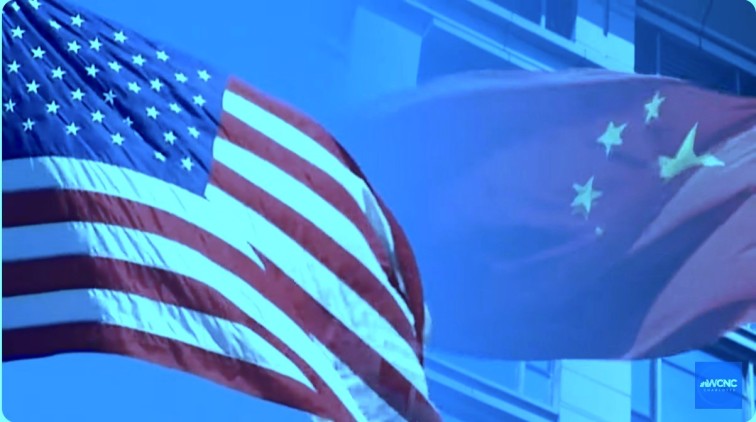
U.S.-China Confrontation. (Video screenshot)
[People News] On March 31, 2026, a ruling from the U.S. District Court for the Northern District of California effectively severed the Chinese Communist Party's (CCP) long arm reaching into the United States. The diaries, letters, and documents of Li Rui (Li Rui), who was Mao Zedong's former secretary, will remain preserved at Stanford University's Hoover Institution and will be publicly accessible to scholars worldwide, without being returned to China.
Beijing attempted to employ a proxy strategy, masquerading as a family inheritance dispute, to exploit the U.S. judicial system for exporting authoritarian censorship and suppressing historical truths. This legal battle, which the CCP meticulously orchestrated over seven years and that crossed the Pacific, ultimately ended in a resounding defeat reminiscent of Waterloo. The multinational control that Xi Jinping had carefully cultivated was decisively cut off by the U.S. court's ruling.
Li Rui, who served as Mao Zedong's secretary, was purged during the Lushan Conference in 1959 for criticising Mao's Great Leap Forward and was imprisoned in Qincheng for eight years. He began keeping a diary in the 1930s and continued for over 80 years, amassing nearly ten million words that document the true inner workings of various political movements throughout CCP history, including the Yan'an Rectification Movement, land reform, the anti-rightist campaign, the Great Leap Forward, the Cultural Revolution, and the Tiananmen Square incident.
Li Rui's diary openly criticises the leftist disasters caused by the Chinese Communist Party (CCP), the cult of personality surrounding Mao Zedong, and the authoritarian regime of the CCP. He boldly labels the Communist Party as a 'gang' and condemns Mao Zedong for being 'lawless and unrestrained,' asserting that Mao's later mistakes brought profound disasters to the nation. Additionally, Li Rui critiques Deng Xiaoping for not fully realising political reforms. As a participant in high-level political activities within the CCP and a witness to major historical events, Li Rui's diary serves as both a primary source for studying the history of the CCP and as compelling evidence from within the system that reveals the CCP's malevolent nature.
In his later years, to safeguard his diary from potential destruction by the CCP authorities, Li Rui clearly instructed his daughter, Li Nanyang (who has since acquired U.S. citizenship), to transport the diary and approximately 40 boxes of manuscripts out of China in batches and donate them to the Hoover Institution at Stanford University, which is well-known for its collection of modern Chinese archives, including the diaries of Chiang Kai-shek. Following Li Rui's death in 2019, the CCP swiftly initiated legal action against Li Nanyang in the Beijing Xicheng District Court through his second wife, Zhang Yuzhen, demanding the return of what they termed 'family property.' The Beijing court ruled in favour of Zhang Yuzhen within a few months, ordering Stanford to return the materials within 30 days. Subsequently, CCP representatives attempted to enforce this ruling in the United States, aiming to reclaim Li Rui's diary and maintain control over sensitive party history in the hands of Beijing's authorities.
In May 2019, the Stanford University Board of Trustees initiated a lawsuit in the California federal court to clarify property rights, aiming to confirm the legal ownership of the Hoover Institution. In response, Zhang Yuzhen counter-sued Stanford and Li Nanyang, accusing them of conspiring to steal national treasures. The case was heard in the Oakland federal court in August 2024, where expert testimony revealed significant unfairness in the litigation process in Beijing, with indications of interference by the Chinese Communist Party (CCP). On March 31, 2026, the U.S. District Court for the Northern District of California issued a final ruling: it explicitly refused to enforce the Beijing judgment, affirming that Li Nanyang's donation was legal and valid according to his father's clear wishes, and confirmed that Stanford holds full ownership, with the diary remaining accessible to the public.
This ruling underscores the fairness and justice of American law, upholding the legitimate wishes of the donor and protecting academic freedom, historical memory, and freedom of speech from authoritarian oversight.
The loss in this case has significantly weakened the cross-ocean legal warfare that the CCP has aggressively pursued in recent years. Legal warfare, public opinion warfare, and psychological warfare are key strategies employed by the CCP military in its unrestricted warfare against European and American nations. Within the United States, the CCP leverages extensive national resources to exploit the open judicial system and tolerant political environment through agents, launching 'strategic lawsuits' against individuals it disapproves of. By utilising long-term infiltration of American espionage and intelligence networks, as well as Western leftist forces, the CCP aims to drain opponents' resources through costly litigation, undermine their resolve, create a chilling effect, and enhance the terror of its long-arm jurisdiction overseas.
In recent years, the Chinese Communist Party (CCP) has initiated what it refers to as a legal war in the United States, exemplified by its unfounded lawsuits against Shen Yun Performing Arts. Shen Yun operates independently of the CCP's political and ideological framework and is celebrated globally for presenting traditional Chinese culture free from CCP influence. Its high-calibre performances have garnered international acclaim, making it a target for the CCP, which perceives it as a significant threat and has subjected it to prolonged transnational repression. The CCP has employed agents to file civil lawsuits in the U.S., aiming to damage Shen Yun's reputation, defame its organisers, and engage in violent threats and intimidation against its tours. In 2024, two CCP agents, Chen Jun and Lin Feng, attempted to bribe the U.S. Internal Revenue Service to revoke Shen Yun's nonprofit status, resulting in their conviction by a U.S. court. These lawsuits are frequently aligned with the CCP's information warfare strategy, which seeks to undermine Shen Yun through the dissemination of fake news and distorted negative coverage. The CCP's singular objective is to extend its campaign of persecution against Falun Gong into the U.S., thereby facilitating its transnational repression efforts.
One of the significant legal battles initiated by the Chinese Communist Party (CCP) in the United States centres around the DJI drone case, which challenges U.S. national security measures. DJI, a company linked to the CCP, has frequently turned to U.S. courts to contest national security restrictions. Following its designation as a 'Chinese military enterprise' by the U.S. Department of Defence in 2022, DJI filed a lawsuit against the Department in October 2024, asserting that the classification was 'incorrect' and resulted in financial losses. In September 2025, the court dismissed the majority of the claims, prompting DJI to appeal. In February 2026, DJI took legal action against the Federal Communications Commission (FCC), contesting its decision to include the company on the 'regulated list,' which bans the import and sale of new products. DJI contends that its products are intended solely for civilian use and do not pose a security threat. These legal actions are designed to delay U.S. sanctions, present DJI as an innocent party and a legitimate business in the eyes of consumers in Europe and America, divert attention, and undermine U.S. strategic defences against CCP technological infiltration, thereby continuing to serve as a front line in the CCP's technological encroachment.
In the realm of economic trade, the CCP's legal warfare is also evident. In January 2026, four U.S. subsidiaries of BYD filed a lawsuit against the federal government in the U.S. International Trade Court, seeking refunds for all taxes paid under Trump's tariff policies. They argue that the International Emergency Economic Powers Act (IEEPA) does not grant authority to impose tariffs, and that the related executive orders constitute overreach. The U.S. Congressional China Task Force has criticised this action as a 'Chinese-style pressure strategy,' aimed at undermining U.S. trade enforcement and exploiting the open judicial system to justify predatory trade practices and illicit profits.
The aforementioned cases demonstrate that Xi Jinping's legal warfare has enabled the Chinese Communist Party (CCP) to engage in aggressive organisational activities across various sectors within the United States, driven by the CCP's state-led strategy of unrestricted warfare.
The legal warfare waged by the CCP carries significant risks. Firstly, it misuses and drains American judicial resources, eroding public trust in the fairness of the judiciary and undermining the independent spirit of American justice. While the U.S. judicial system is open, the CCP's system is characterised by opacity and secrecy, creating an 'asymmetric advantage' similar to fighting in the dark with a hidden weapon. Secondly, it poses risks to U.S. national security. The prolonged infiltration and advancement of legal warfare can easily manipulate the American political system, delaying, evading, and influencing the implementation of U.S. political policies, trade regulations, and military provisions that are unfavourable to China, thus creating geopolitical advantages for the CCP. Thirdly, it exports persecution. The U.S. is fundamentally a nation of judicial independence and freedom of speech, serving as a beacon of Western universal values. Yet, the CCP has managed to extend its policies of religious persecution through legal warfare, suppressing speech and academic freedom, and compelling dissenters, scholars, and businesses to self-censor across borders, thereby spreading a chilling effect. This can be viewed as a direct challenge and threat to the First Amendment of the U.S. Constitution.
The loss in the Li Rui (Li Rui) diary case represents a significant defeat for the CCP. Seven years of dedicated effort have gone up in flames. Xi Jinping emphasises 'institutional confidence' and 'the East rising while the West declines'; this severing of long arms signifies not only a legal defeat but also a political and moral collapse, as well as a catastrophic failure in geopolitical strategy.
In his lifetime, Li Ruisheng referred to himself as 'Liangtou Zhen'. In his youth, he was a true believer in communism, but in his later years, he sincerely reflected on history. He entrusted his diary to overseas sources, hoping that the true story would not be erased and would be revealed to the public. Today, the ruling by the American court has realised his final wish, dismantling the myth of the Chinese Communist Party's legal warfare and cutting off Xi Jinping's reach, marking yet another defeat for authoritarian expansion.
(First published by People News) △



News magazine bootstrap themes!
I like this themes, fast loading and look profesional
Thank you Carlos!
You're welcome!
Please support me with give positive rating!
Yes Sure!