
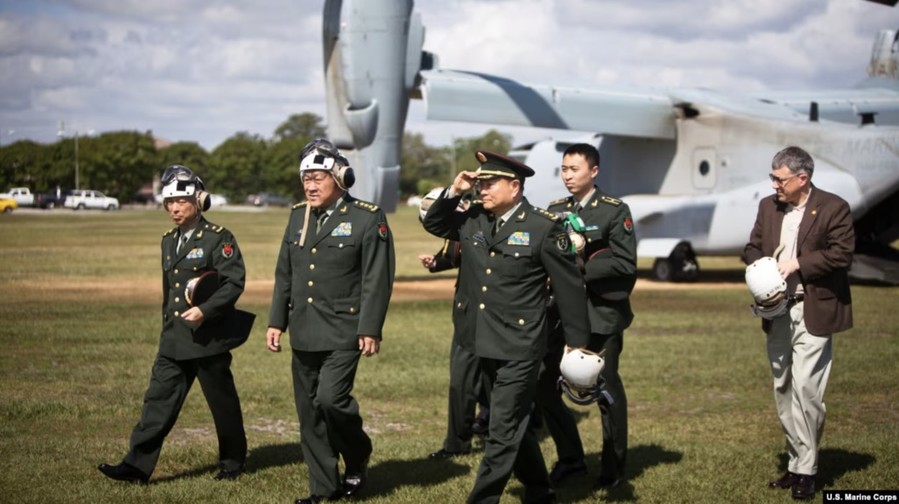
Zhang Youxia (third from left, then commander of the Shenyang Military Region) accompanies then–Chinese Defense Minister Liang Guanglie (second from left) on a visit to Marine Corps Base Camp Lejeune in North Carolina.
[People News] Recently, a short video has been circulating online.
A reporter asked a Chinese naval soldier: “Can this naval gun also be used for anti-air fire?”
The soldier answered without the slightest hesitation: “Wherever the Party tells us to fire, that’s where we fire.”
What sends a chill down one’s spine about this sentence is not that it is radical, but that it is too standard, too fluent, too devoid of any trace of humanity.
You barely have time to think before realizing: if one day the direction of the order points toward the people, this sentence would apply just the same.
I. This Is Not a Slogan — It Is a “Historical Channel”
“Wherever the Party tells us to fire, that’s where we fire” is not an empty statement. It is a political channel that has already been repeatedly validated.
In 1989, Beijing, Tiananmen Square. Tanks rolled over students; machine guns swept through civilians—not because the soldiers did not know whom they were facing, but because at that moment “political correctness” overrode all judgment. There was no “Is this legal?” No “Are they civilians?” And certainly no “Can I refuse?”
There was only one repeatedly instilled logic:
• The Party needs stability.
• The Party has issued the order.
• You are only responsible for executing it.
Thirty-five years have passed, and this channel has never been closed.
II. Why Zhang Youxia Was Handed a “Political Death Sentence”
It is precisely against this backdrop that one can truly understand the recent characterization of Zhang Youxia and Liu Zhenli.
The official wording is highly thought-provoking: they “seriously trampled upon and undermined the Chairman responsibility system of the Central Military Commission, seriously affected the Party’s absolute leadership over the military, endangered the Party’s ruling foundation, and caused great damage to the political construction of the military, its political ecosystem, and combat capability.”
Please note that there is almost no mention of specific military mistakes or tactical failures.
All accusations point to a single core issue: the military’s “political purity.” In other words, the problem is not what you did wrong, but whether you might create space for the military to act in a way that is not automatically obedient.
III. What the CCP Truly Fears Is Never Rebellion
Many believe that what the CCP fears most is mutiny, coups, or open defection. But that is not the case.
What the CCP truly fears is hesitation—not resistance, but that after an order is issued, someone pauses for one second and a question appears in their mind: “This time, should I really carry this out?”
As long as that question exists, “Wherever the Party tells us to fire, that’s where we fire” is no longer an iron rule.
IV. Why That Soviet Scene Is the CCP’s Nightmare
The CCP repeatedly studies the collapse of the Soviet Union not because of failed economic reforms, but because of two images:
• The Soviet Red Army in Red Square did not open fire on demonstrators;
• The special forces sent to arrest Yeltsin instead turned to protect him.
At that moment, the guns were still in their hands, but political correctness had failed. For the first time, the military did not automatically equate “the Party’s order” with “moral legitimacy.”
This is precisely the historical moment the CCP fears most and will never allow to be reenacted.
V. Why the Zhang Youxia Case “Ironically Reveals Hope”
If the military had truly been completely molded into a “political tool,” if every soldier could answer without hesitation like the one in the video—“Wherever the Party tells us to fire, that’s where we fire”—then there would be no need for such high-intensity political purges, rhetorical condemnations, and public denunciations.
On the contrary, the more repeatedly “political army-building” and “absolute leadership” are emphasized, the more it indicates deepening anxiety.
What the Zhang Youxia case truly exposes is not what he “undermined,” but that the CCP’s top leadership has already realized: the military may not forever remain a thoughtless instrument of execution.
VI. The Final, Unavoidable Question
• If one day history once again arrives at the streets, the squares, the students, the civilians—
• If orders once again demand the military to “maintain stability”—
What determines the outcome is not the sophistication of the weapons, but whether there are still enough people who can pull the trigger without hesitation.
The massacre at Tiananmen Square remains a wound the CCP never dares to confront—not because of its bloodshed, but because it proved one thing: as long as “political correctness” is placed above all else, anything can be rationalized.
And when a regime must constantly rely on “political purges” and “absolute loyalty” to ensure this, it precisely shows that it has become weaker and more fragile than ever.
The true turning point in history is often not the moment the gunshots ring out, but the second when someone does not immediately carry out the order.
In the past few days, the CCP is experiencing this kind of hesitation and silence. △



News magazine bootstrap themes!
I like this themes, fast loading and look profesional
Thank you Carlos!
You're welcome!
Please support me with give positive rating!
Yes Sure!