

Dark clouds loom over Beijing’s Tiananmen Square. (Feng Li/Getty Images)
[People News] A few days ago, Xi Jinping visited the Beijing Bayi Building to conduct a remote video call to console all military officers and soldiers. That afternoon, he staged a political photo opportunity on the streets of Beijing. Speculation is rife that he is afraid of the insecurity outside and does not dare to leave Beijing, while official reports claim he visited the elders of the Communist Party of China.
In the CCTV footage, the anchor, usually serious and wooden, displayed a rare warm smile, seemingly attempting to convey the party's so-called concern. The names of the old comrades visited by Xi Jinping and other party and state leaders were announced one by one, yet we did not see any of their faces, nor did we witness any genuine scenes of care for these elders. Is this type of news, where we only see names but not the actual individuals, truly a 'real visit' or merely a 'being visited'?
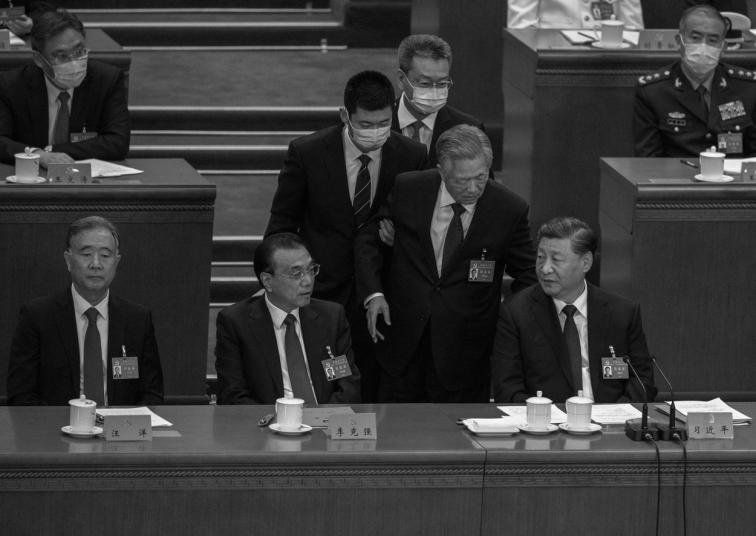
Earlier, reports emerged regarding the deaths of Hu Jintao, Zhu Rongji, Wang Qishan, and Li Yuanchao, yet they appeared on the list, suggesting that under Xi Jinping's 'care', they have all 'come back to life'. Could this be a 'collective rumour refutation'? However, it does not prove their good health. Within the CCP system, even the life and death of the highest leader are controlled by the party; whenever they need you to disappear, you will be removed.
Notably, the official report used the phrase 'respectively visited or entrusted'. This suggests that Xi Jinping may not have personally visited all the elders, particularly reformist figures like Hu Jintao, Wen Jiabao, and Zhu Rongji. Xi Jinping may harbour psychological fears, worrying about facing criticism in person, which is why he might delegate others like Cai Qi or Li Qiang to visit on his behalf.
The report further claims that these veteran comrades have voiced their support for the 'two establishments' and 'two safeguards.' It is likely that they are being coerced into making these statements, a narrative imposed by Cai Qi, the head of propaganda, in an effort to create a facade of harmony within the party, countering the persistent rumours of dissatisfaction among the elders regarding Xi Jinping's leadership.
Simultaneously, developments within the military indicate a sense of unease. Official reports state that Zhang Shengmin, vice chairman of the Central Military Commission, inspected the Beijing Garrison Guard Regiment and military aerospace units on February 11.
During his address, Zhang Shengmin praised Xi Jinping, highlighting the 'Xi Jinping Thought on Strengthening the Military' and the 'implementation of the chairman's responsibility system.' He particularly stressed the importance of 'effectively utilising the weapons and equipment at hand' and 'maintaining the safety and stability of the troops.' These remarks expose the underlying chaos within the military.
Zhang Shengmin's insistence on 'effectively utilising the weapons and equipment at hand' raises the question of whether he is subtly hinting at or warning of potential unrest within the military. Why else would he remind officers and soldiers to properly use their weapons? The call to maintain 'safety and stability' is quite rare in military discourse and directly confirms that the People's Liberation Army is currently in a state of 'unsafety and instability.'
Following the arrests of Zhang Youxia and Liu Zhenli, the military has remained silent. Rumours are rampant, with talk of conspiracies for a coup and threats against Xi Jinping, which have made him hesitant to engage with the military. Reports suggest that Xi Jinping has not left Beijing for nearly three months. This situation reflects his profound distrust of the military, as he fears that an inspection could lead to unforeseen incidents. While he may appear to have regained power, he has lost genuine support from the military.
At present, Zhang Shengmin seems to wield significant power as 'the one beneath the one.' However, in reality, Zhang Youxia has been removed by Xi Jinping due to his strong influence in the military. Observers note that Zhang Shengmin, who has a background in the Rocket Force, could potentially be the next target for a purge at any time.
(Originally published by the People News)
△





News magazine bootstrap themes!
I like this themes, fast loading and look profesional
Thank you Carlos!
You're welcome!
Please support me with give positive rating!
Yes Sure!