

On March 5, 2025, PLA delegates arrive at the Great Hall of the People in Beijing to attend the opening of the National People's Congress. (Photo by Kevin Frayer/Getty Images)
[People News] Recently, following the investigations of Zhang Youxia and Liu Zhenli, rumours have proliferated on overseas social media regarding a 'collective coup by the CCP elders', 'the return of Hu Jintao', or 'Wen Jiabao's leadership'. At the same time, there have been reports about the deaths of political figures such as Hu Jintao, Zhu Rongji, and Wang Qishan. On February 13, CCTV reported that Xi Jinping and other leaders visited 125 CCP elders, including those rumoured to have passed away. In the current highly tense political climate in China, these pieces of information, which are difficult to verify, raise a fundamental question: do the political elders of the CCP still hold any influence in Xi Jinping's highly centralised regime?
The 'collective support' being represented
First, let’s examine the CCP's annual political rituals. According to official CCP announcements, on the eve of the Spring Festival, Xi Jinping and other current leaders will make visits to 125 old comrades, including Hu Jintao, Zhu Rongji, and Wen Jiabao. Compared to previous years, this year's list is missing five individuals: Xu Qiliang, Re Di, Zou Jiahua, Wang Bingqian, and Peng Peiyun, all of whom were generals and officials who passed away in 2025.
Notably, the language used in the official announcement is telling. It states that these old comrades expressed 'sincere support' for Xi Jinping as the core of the Party Central Committee and the entire Party, and they highly praised the achievements of the past year.
However, when CCTV reported this news, it simply read the names from the press release without any footage of the meeting. Where were these old cadres expressing their loyalty to Xi Jinping? How did such a highly unified stance emerge in the news report?
Independent commentator Cai Shenkun commented on X, noting that many familiar names still appear on this long list, indicating that they are alive and well, and have not faced any issues. This reflects the meticulous care for old comrades during Xi's era, although their freedom has become increasingly restricted.
Du Wen, a former official from Inner Mongolia, also stated in a self-media program that this suggests these old cadres have become entirely politically passive. Their presence serves merely as a political symbol, to be represented at specific moments to showcase the stability and continuity of the regime.
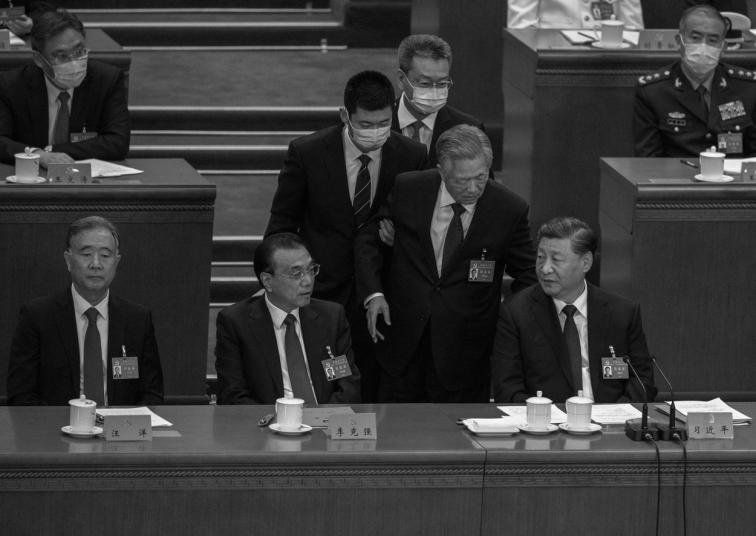
According to information obtained by Du Wen, former General Secretary Hu Jintao, who was publicly escorted out of the venue during the 20th National Congress, is currently rumoured to be under soft detention, in very poor health, showing clear signs of dementia, and is mentally disoriented. His last public appearance was at Jiang Zemin's funeral ceremony, where he was able to walk but appeared sluggish. Hu Jintao also did not attend the military parade on September 3 last year.
On December 14 of last year, Hu Jintao's name was mentioned in a report by Xinhua News Agency, the official media of the Chinese Communist Party. Former State Councillor Wang Bingqian passed away on December 8 in Guangdong. His remains were cremated on December 14 at a funeral home in Guangzhou. Xinhua reported that during Wang Bingqian's illness and after his death, Xi Jinping and other members of the Standing Committee, including Han Zheng and Hu Jintao, visited him in the hospital or expressed their condolences to his family in various ways. Notably, Hu Jintao is the only elder of the Communist Party, aside from the current Standing Committee members, to be specifically mentioned.
Following the investigation of Zhang Youxia, Liao Xilong, who served as a member of the Central Military Commission during the tenures of Jiang Zemin and Hu Jintao, also passed away. Footage from CCTV News showed floral tributes signed by Xi Jinping, Li Qiang, Hu Jintao, and others in the hall of Babaoshan Revolutionary Cemetery on January 29. Reports indicated that they visited Liao Xilong during his illness and after his passing, or expressed their condolences and sympathies in various forms.
Another elder, former Premier Zhu Rongji, has been recuperating in Shenzhen for an extended period. Due to health issues, he has resigned from all part-time positions, including Honorary Dean of the School of Management at Tsinghua University. It is reported that he prefers to limit his interactions with the current leadership and has adopted a stance of disengagement from worldly affairs.
In response to rumours regarding the passing of elders, Cai Shenkun previously analysed on X that leaders of this rank have access to top-tier medical care. Even if they are seriously ill, as long as their families and the Party Central Committee are unwilling to let go, it is not difficult to sustain life with medical equipment.
Cai Shenkun, drawing from his past experience in the health system, believes that unless the Party Central Committee has already settled on political conditions, drafted an obituary, and ordered the 'removal of the tube', it is unlikely that the widely circulated rumours of 'sudden death' or 'secret mourning' will materialise. Most of the current rumours are merely rehashed old news, yet they reflect external expectations of instability within the CCP's political landscape.
The true power broker - Zeng Qinghong
Among the numerous elders, the only one still regarded as having significant influence is former Standing Committee member Zeng Qinghong. Zeng is viewed as one of the true rulers of CCP politics; he previously served as the Minister of the Organisation Department, during which he transferred around 5,000 officials at the bureau level into various ministries in Beijing. Notably, Xi Jinping's initial nomination was also facilitated by Zeng Qinghong. Many of the officials currently spread throughout the political landscape were promoted by Zeng, and many have since ascended to provincial and ministerial levels or even become Central Committee members, creating a vast 'Zeng family dynasty'.
The Zeng Qinghong family is equally remarkable in terms of resource exploitation. Du Wen revealed that he acquired mineral resources in Inner Mongolia and other regions at little to no cost, which were then sold for profits amounting to hundreds of billions or even trillions.
According to Du Wen's observations, Zeng Qinghong differs from typical officials who 'fade away after retirement'; even out of office, he can still intimidate rivals through his control over disciplinary inspections or internal whistleblowing 'tickets'. If Xi Jinping were to take action against Zeng Qinghong, it would be akin to declaring war on those '5,000 subordinates', potentially triggering significant upheaval within the entire political system, or even a backlash.
Ceng Qinghong's strategy for survival is to "quietly amass wealth." He firmly supports Xi Jinping politically, and as long as his family's wealth is not threatened, he will not oppose the current leader. Xi Jinping is fully aware of this dynamic, and both parties maintain a delicate balance of power.
Is Xi Jinping truly secure in his position?
At present, the political landscape of the Chinese Communist Party (CCP) suggests that Xi Jinping has effectively eliminated all external forces that could challenge him through extensive anti-corruption efforts. The elder statesmen seem to be either very old or in poor health. However, can we say that Xi Jinping's regime is genuinely stable?
Xi Jinping has removed all obstacles, with the ultimate aim of securing re-election at the 21st National Congress in 2027.
Professor Yuan Hongbing, a prominent legal scholar living in Australia who frequently discloses insider information about the CCP's upper echelons, recently revealed that Liu Shaoqi's son Liu Yuan and Deng Xiaoping's son Deng Pufang have emerged as the only political forces within the CCP that possess both the courage and the capability to challenge Xi Jinping.
Reports indicate that they are planning to formally present a proposal at the CCP's 21st National Congress in the fall of 2027. The central demand of this proposal is to abolish the current political line and advocate a return to two significant traditions: Liu Shaoqi's "New Democratic Theory" and Deng Xiaoping's "Reform and Opening-up Policy."
Liu and Deng have also made statements through the Beijing political sphere, suggesting that the four individuals, including Xi Jinping, Cai Qi, Zhao Leji, and Li Xi, are fundamentally all "rebels" from the Cultural Revolution era.
The challenge posed by Liu Yuan and Deng Pufang to Xi Jinping carries a historical irony. Liu Yuan's father, Liu Shaoqi, and Deng Pufang's father, Deng Xiaoping, were once the top two 'capitalist roaders' during the Cultural Revolution. Xi Jinping's father, Xi Zhongxun, was also a victim of that era, yet Xi Jinping is now accused of following Mao Zedong's policies. Today, the descendants of these two victims have emerged to oppose Xi Jinping's revival of Cultural Revolution ideologies, seeking to thwart his re-election at the 21st National Congress. This dramatic repetition of history places considerable pressure on Xi Jinping.
Yuan Hongbing noted that Xi Jinping is aware that Liu Yuan, Deng Pufang, and other princelings are preparing to challenge his authority. While Xi is deeply concerned that this could lead to a significant crisis for his re-election, he has yet to make a firm decision. He may also be reluctant to take decisive confrontational actions against the Liu and Deng families. Moreover, Xi Jinping is unlikely to publicly reject Deng Xiaoping's political line. Consequently, Xi finds himself in a precarious position.
Liu and Deng are trying to seize the moral high ground within the party and public opinion to prevent Xi Jinping from securing another term at the 21st National Congress, but the extent of their success remains uncertain.
In addition, Du Wen shared two authentic internal conversations among officials within the system: one provincial committee member, who has served for 13 years, revealed that his secret to enduring in his position is 'never voicing opposition.' Another vice-national leader, Bu He, succinctly summarised his governing approach in three words: 'do not speak.'
Thus, for the general public, instead of relying on the 'wise awakening' of the party's elders and the 'red second generation' princelings, it is more prudent to acknowledge the cold and dictatorial essence of this system and pursue self-awareness.
(Originally published by the People News)
△




News magazine bootstrap themes!
I like this themes, fast loading and look profesional
Thank you Carlos!
You're welcome!
Please support me with give positive rating!
Yes Sure!