

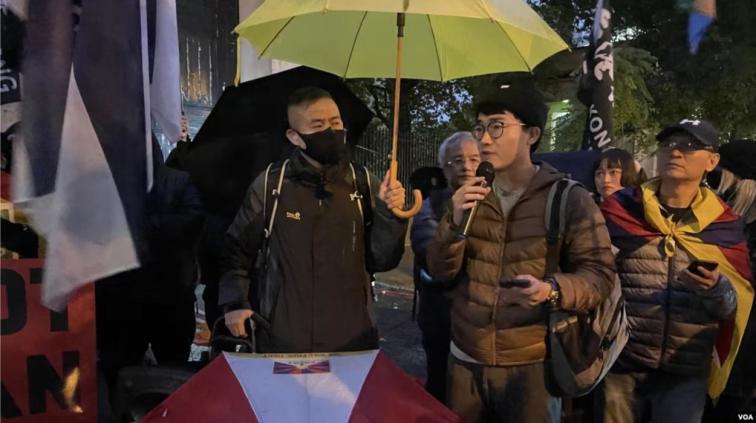
Approximately 3,000 people demonstrated in front of the old Royal Mint in London, protesting against the CCP's plan to construct a "super embassy"; at the site. Protesters displayed banners reading "Say No to the CCP" on the railings. (February 8, 2025)
[People News] After several twists and turns, the CCP’s project to build a super embassy in London has once again attracted international attention and sparked a new wave of questioning and protest.
Last Saturday, local residents, human rights activists, members of parliament, and other critics of the CCP once again took to the streets of London to demonstrate, strongly opposing the Chinese Communist dictatorship’s plan to establish in London a building suspected of potentially becoming a spy center and posing threats to the United Kingdom’s national security and to human rights.
Although the British government approved construction of the project on January 20, opponents continue to persistently demand that the government recognize the CCP’s true nature and real intentions, and undo the terrible consequences brought about by the CCP’s coercion and inducements.
On Tuesday, the Inter-Parliamentary Alliance on China (IPAC), composed of legislators from multiple countries, condemned the British government’s decision. Alliance member and Conservative MP Iain Duncan Smith stated: “This is a disastrous decision. It ignores the Chinese Communist Party’s heinous acts, including forced labor at home, espionage against the UK, and cyberattacks that endanger our internal security.”
The well-known media outlet The Echo focused in its report on the potential diplomatic consequences of London’s decision and its impact on international relations. The paper noted that, despite domestic opposition, the British government has formally approved China (the CCP) to build the largest embassy in Europe near London’s financial district. This move could provoke dissatisfaction from the White House, especially against the backdrop of the British government taking a position at odds with the United States on the Greenland issue.
Regarding the government’s claim that security risks are controllable, the UK’s domestic intelligence agency MI5 also candidly stated that, given the new embassy’s proximity to the sensitive financial district, there is no such thing as “zero risk.”
Some observers have analyzed that the CCP, through intimidation and inducement on the international stage, uses every possible means to penetrate other countries and force their governments to submit to its coercive power—an act that is in fact disgraceful. Such incidents have occurred many times in the international community, sufficiently demonstrating that the CCP’s interference with and harm to the sovereignty of countries around the world has exceeded people’s imagination. This includes the CCP’s disruption of Shen Yun performances and films exposing the CCP’s persecution of faith in some countries’ theaters and cinemas.
It is understood that the CCP’s “super embassy” project was launched in 2018, when the CCP purchased a roughly 5-acre plot of land on the north bank of the Thames, adjacent to the Tower of London, for about £255 million. The site was formerly the Royal Mint. The plan calls for a total gross floor area of approximately 57,000 square meters. Upon completion, the embassy is expected to become the CCP’s largest diplomatic facility in Europe. Because the site is close to London’s financial district and contains underground fiber-optic communications infrastructure carrying sensitive information, British and U.S. intelligence agencies, as well as some political figures, have expressed concern about potential espionage activities and data security risks. In addition, planning documents submitted for review obscure the intended use of certain spaces, raising concerns among human rights groups and some Hong Kong communities that have relocated to the UK, who fear the site could be used for transnational repression operations or the secret detention of dissidents.
Some opposition politicians have expressed ongoing concern. Conservative shadow home secretary Chris Philp pointed out that British authorities would be unable to inspect the interior of the embassy during construction or after completion, meaning that related activities would be difficult to effectively supervise. Other political figures have noted that the expansion of the embassy could lead to an increase in the number of personnel with diplomatic immunity, thereby raising the potential risk of foreign political influence and interference.
At the same time, human rights groups and exiled dissidents have also expressed concern that spaces within the embassy with unclear purposes could be used to monitor or pressure overseas dissident communities. Such concerns are particularly pronounced within the UK’s Hong Kong community, with some pointing out that past incidents—such as conflicts between diplomatic personnel and protesters outside the CCP consulate in Manchester—have heightened their unease about the scale and security arrangements of the new embassy. Despite facing doubts from cross-party domestic lawmakers and some allies, the British government has stated that concentrating related diplomatic functions at a single site would help improve the UK’s overall oversight and risk-management capabilities, and has attempted to use this argument to respond to external concerns over security issues.
In fact, the British government is not unaware of the CCP’s destructive impact on the world. When reporting on the “super embassy construction in London,” Radio France Internationale noted that the Labour government’s repeated weighing of the issue highlights the delicate position of Prime Minister Starmer… who has acknowledged that China (the CCP) poses a “threat” to UK national security.
According to British media disclosures, Starmer plans to make an official visit to Beijing at the end of this month. This would make him the first British leader to visit Beijing since 2018. London is particularly eager to strengthen ties with Beijing in the financial sector.
People of insight believe that civilized nations should unite to jointly confront brutal regimes and to jointly build and share the achievements of the developed world. At a time when the Venezuelan president and his wife have been arrested, Iran is facing potential upheaval, and the CCP’s old friends are falling one after another, the weakening of CCP influence has already become a foregone conclusion. Developed countries, all the more, should not misjudge the future based on short-term illusions.
△






News magazine bootstrap themes!
I like this themes, fast loading and look profesional
Thank you Carlos!
You're welcome!
Please support me with give positive rating!
Yes Sure!