
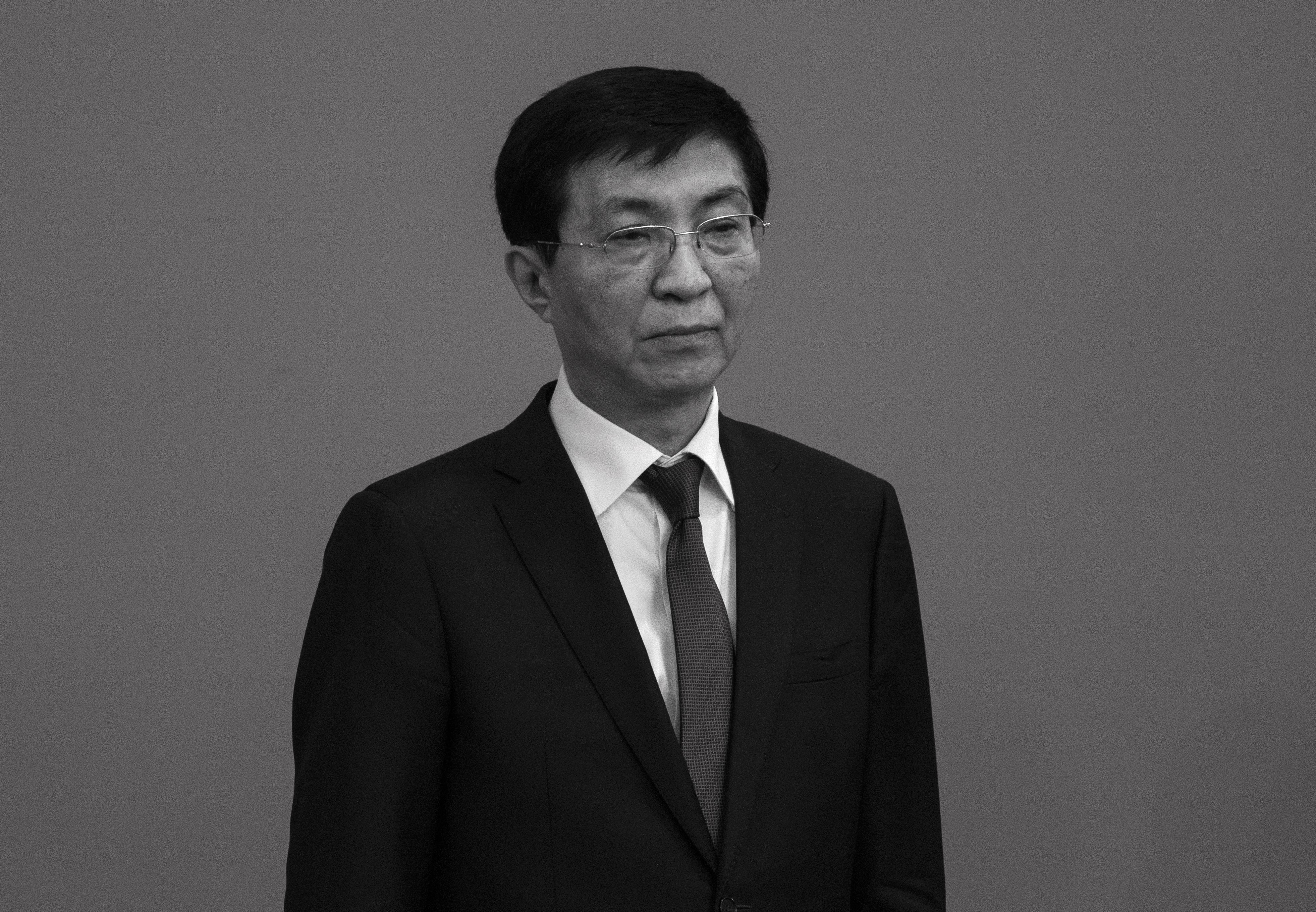
Wang Huning, the agent planted in the top ranks of the Chinese Communist Party by Jiang Zemin and Zeng Qinghong.
(Photo by Kevin Frayer/Getty Images)
[People News] Wang Huning, known as the “state preceptor of three administrations,” is also one of the key members of the “blood-debt gang” led by Jiang Zemin and Zeng Qinghong.
I. The “Number One Strategist” Promoted and Heavily Used by Jiang and Zeng
Wang Huning, currently a member of the Standing Committee of the CCP Politburo and chairman of the Chinese People’s Political Consultative Conference, is the fourth-ranking figure in the CCP. Although he comes from a scholarly background and appears like a frail intellectual, he belongs to the same camp as Jiang Zemin and Zeng Qinghong—men whose hands are stained with the blood of the Chinese people and who owe enormous blood debts.
After earning a master’s degree from Fudan University in Shanghai, Wang Huning stayed on to teach. He once served as a visiting scholar in the United States for half a year, and successively held the positions of lecturer, associate professor, professor, and department chair of the Department of International Politics at Fudan University, as well as dean of the Fudan University Law School.
According to reports from mainland media, in April 1995, strongly recommended by senior “Shanghai clique” officials such as Zeng Qinghong, Jiang Zemin’s “chief steward of the inner court” and director of the CCP Central Office, Wang Huning was transferred to Beijing’s Zhongnanhai to serve as head of the political group of the Central Policy Research Office.
In 1998, after being promoted to deputy director of the Central Policy Research Office, Wang Huning began accompanying Jiang Zemin on overseas visits in the capacity of “special assistant to the state president,” becoming a drafter or gatekeeper of Jiang’s important speeches.
From April 1995 to January 2026, Wang Huning worked in Zhongnanhai for 31 years, making him the CCP senior official who has worked there the longest to date.
From 1995 to 2012, during the period when Jiang and Zeng were in power or actually controlled the CCP’s top authority behind the scenes, Wang Huning directly or indirectly served Jiang and Zeng for 17 years.
From 2012 to 2026, over these 14 years, as the most important agent planted by Jiang and Zeng at Xi Jinping’s side, Wang Huning became the “number one strategist” of the “blood-debt gang” led by Jiang and Zeng, guiding Xi to “turn a good hand into a bad one.”
II. The “Most Dangerous Person” Who Kills With a Pen
On July 20, 1999, CCP dictator Jiang Zemin mobilized the entire state apparatus to launch the persecution of the Falun Gong spiritual group that believes in “Truthfulness, Compassion, and Forbearance.”
This cross-century persecution has lasted for 27 years. Thousands, tens of thousands, hundreds of thousands, millions, even tens of millions or more Falun Gong practitioners have been persecuted. Many were injured, disabled, driven insane, or killed; families were torn apart and homes destroyed.
This persecution, which obliterates conscience, morality, justice, and humanity, is regarded as “the largest human rights disaster in the world in the 21st century,” and also as “the largest, most brutal, and most evil human rights atrocity in the 5,000-year history of the Chinese nation.”
As the two principal culprits of this persecution, Jiang Zemin and Zeng Qinghong have been accused of committing crimes of genocide, torture, and crimes against humanity that are “unprecedented on this planet.”
As the “number one strategist” behind Jiang and Zeng’s decision to persecute Falun Gong, Wang Huning did not personally kill people, but he has long been killing with his pen.
The Central Policy Research Office is responsible for drafting CCP documents with strong ideological content, such as documents on persecuting Falun Gong. As deputy director of the Central Policy Research Office and one of its principal penmen, participating in drafting and gatekeeping such documents was his job. From after April 25, 1999, when Jiang Zemin vowed to “defeat Falun Gong,” all documents persecuting Falun Gong that were written by Wang Huning or drafted under his leadership by the Central Policy Research Office constitute evidence of Wang Huning following the “blood-debt gang” led by Jiang and Zeng in persecuting Falun Gong.
Wang Huning aided and abetted evil and committed at least three major wrongs.
First, participating in drafting Jiang Zemin’s June 7 speech.
On June 7, 1999, Jiang Zemin delivered a speech at a CCP Politburo meeting deploying the “eradication of Falun Gong.” This speech is one of the most important documents in the CCP’s 27-year persecution of Falun Gong.
This document was distributed to party secretaries of provinces, autonomous regions, and municipalities directly under the central government; party secretaries of major military regions; ministers (directors) of central ministries and commissions; party group (party committee) secretaries of state organs; and party group secretaries of people’s organizations.
On June 13, 1999, the Central Office issued a notice distributing this document, stating that Jiang’s “important speech provided a profound exposition on deeply understanding the international background and domestic environment in which the ‘Falun Gong’ issue arose, strengthening and improving the Party’s ideological and political work, organizational work, propaganda work, and mass work under the new situation, and urgently handling and resolving the ‘Falun Gong’ issue.” It instructed: “Please immediately organize standing committee members (party group members) to study and discuss it, research and implement measures, and report implementation情况 to the Central Committee.”
Obviously, this was neither an impromptu speech nor a general address, but a programmatic document delivered by Jiang at a Politburo meeting to guide the entire Party on how to “eradicate Falun Gong.”
Based on my understanding of the drafting process of CCP leaders’ speeches, this speech should have been drafted according to Jiang’s instructions, with participation by Jiang’s “number one strategist,” Wang Huning.
I once served as one of the speechwriters for then Politburo Standing Committee member and secretary of the Central Commission for Discipline Inspection, Wei Jianxing, and began practicing Falun Gong on May 3, 1995. From what I know, the real reason Falun Gong was deeply welcomed by the masses is that it has remarkable effects in curing illness, improving health, and purifying the mind and body. People hope to gain good health through practicing Falun Gong and to be upright, clean people by following “Truthfulness-Compassion-Forbearance.” All genuine Falun Gong practitioners deeply experience through personal practice that Falun Dafa benefits the country and the people in every way and harms none.
Mr. Li Hongzhi, the founder of Falun Gong, has repeatedly emphasized that “cultivation practice is not politics”; Falun Gong has no political purpose and makes no demands for political power.
But Jiang Zemin, who regarded political power as more important than heaven itself, did not care about this.
The real reason Jiang wanted to eradicate Falun Gong was that he feared there were too many people practicing Falun Gong and that this might endanger his power; he wanted it eliminated as quickly as possible.
To eradicate Falun Gong, Jiang had to find a suitable pretext. At this point, Jiang’s “number one strategist,” Wang Huning, became useful.
Based on Jiang Zemin’s intent to suppress Falun Gong, Wang Huning, in participating in drafting Jiang’s speech, mainly helped Jiang theoretically justify the suppression of Falun Gong, including claims that the Falun Gong issue had “a very deep political and social background” and a “complex international background.”
Through this so-called “theoretical justification,” Falun Gong was linked to “hostile forces at home and abroad.” Since Falun Gong supposedly belonged to the camp of “hostile forces at home and abroad,” it must have “ulterior political motives.” What “ulterior political motives”? That is, “competing with our Party for the masses and for territory.” If Falun Gong were to “seize” the “masses” and “territory” from the Party, what would happen? The inevitable result would be “usurping the Party and seizing power.” Wouldn’t that be tantamount to taking Jiang’s life?
This “theoretical justification” thus provided the theoretical basis for Jiang’s suppression of Falun Gong.
In my view, Jiang’s murderous speech was the product of Jiang’s “political fantasy disorder” or “political paranoia,” combined with Wang Huning’s “political wild-association syndrome.”
This speech by Jiang has been an important source over the past 27 years of the deaths of countless Falun Gong practitioners and the artificial creation of innumerable personal tragedies, family tragedies, social tragedies, and national tragedies.
Second, participating in drafting the “Notice Prohibiting Communist Party Members from Practicing ‘Falun Dafa.’”
This notice was issued on July 19, 1999, and addressed to: party committees of provinces, autonomous regions, and municipalities directly under the central government; party committees of major military regions; central ministries and commissions; party groups (party committees) of state organs; headquarters of the Central Military Commission and party committees of various services and arms; and party groups of people’s organizations. The issuing authority was the CCP Central Committee.
This notice was one of the most important documents in Jiang Zemin’s launch of the persecution of Falun Gong. It first politically defined Falun Gong as an “enemy,” while also stipulating certain so-called “policy boundaries.”
The notice was issued in the name of the CCP Central Committee. According to work procedures, it should have been drafted by the Central Policy Research Office at Jiang Zemin’s instruction. As Jiang’s most trusted “number one strategist,” the drafter and gatekeeper of Jiang’s important speeches, Wang Huning, then deputy director of the Central Policy Research Office, certainly participated in drafting this document.
The third article of the notice was “to do a good job of transforming Party members who practice ‘Falun Dafa.’”
The CCP’s 27-year persecution of Falun Gong has been 27 years of using all coercive measures to carry out so-called “transformation” of Falun Gong practitioners.
Transform them into what? The belief of Falun Gong practitioners is the three words “Truthfulness-Compassion-Forbearance.” All genuine Falun Gong practitioners around the world strive to be good people by following “Truthfulness-Compassion-Forbearance.” What is wrong with being good people according to “Truthfulness-Compassion-Forbearance”?
After this notice was issued by the CCP Central Committee, a protracted “transformation war” began. For any Falun Gong practitioners who refused to abandon their belief in “Truthfulness-Compassion-Forbearance,” the CCP employed every political, economic, brainwashing, collective punishment of family members, collective punishment of workplace leaders, and collective punishment of specific enforcers—using all coercive measures, including expulsion from the Party and public office, withholding wages, bonuses, and pensions, illegal arrests, detention, trials, and torture.
From Beijing to all parts of the country, various levels and types of transformation classes (brainwashing classes), detention centers, labor camps, juvenile detention centers, drug rehabilitation centers, psychiatric hospitals, and prisons all became places of forced transformation.
This was a political movement calling on the entire Party, the entire military, and the entire population to become enemies of “Truthfulness, Compassion, and Forbearance,” while encouraging, rewarding, and incentivizing the entire Party, the entire military, and the entire population to engage in “falsehood, evil, and struggle.”
Many horrifying atrocities occurred in the course of this so-called “transformation.”
The notice that Wang Huning participated in drafting and formulating was not based on objective facts, but on Jiang Zemin’s “political fantasies” and “political delusions.”
Third, providing “political packaging” for Jiang Zemin, the head of the “blood-debt gang.”
According to Minghui.org, the “blood-debt gang” led by Jiang and Zeng employed more than a hundred types of torture on Falun Gong practitioners in order to force them to abandon their belief in “Truthfulness, Compassion, and Forbearance.”
Among the most bloody and brutal atrocities was the large-scale live harvesting of organs from Falun Gong practitioners. This was a massacre ordered by Jiang Zemin and jointly carried out by the CCP Political and Legal Affairs Commission, the 610 Office, police, courts, prisons, hospitals, armed police, and the military.
Regarding this massacre, in recent years many overseas professionals concerned about human rights in China have produced numerous films, including:
-
The documentary series Hard Evidence (Episodes 1–32) produced by the World Organization to Investigate the Persecution of Falun Gong;
-
To Live, Kill (2017), a documentary released by Chosun TV under South Korea’s largest newspaper Chosun Ilbo;
-
Hard to Believe (2015), a documentary directed by Emmy Award winner Ken Stone and produced by Swoop Films of New York, USA;
-
State Organs (2023), a documentary directed by Canadian director Zhang Yongjin;
-
Medical Genocide: The Hidden Massacre in China’s Organ Transplant Industry, a documentary produced by the China Organ Harvest Research Center.
Not to mention that Jiang and Zeng promoted and reused a large number of severely corrupt officials to induce them to follow the persecution of Falun Gong, thereby becoming the ultimate backstage force behind the most serious corruption among the top party, government, and military leadership at the time; not to mention that Jiang Zemin unconditionally gave away Chinese territory equivalent to more than forty Taiwans to Russia and other countries, becoming the biggest traitor in contemporary China—just on the single count of the massacre of Falun Gong practitioners they engineered, the magnitude of their crimes surpasses that of tyrants throughout history and around the world.
Yet Wang Huning, the “court literatus” promoted and heavily used by Jiang and Zeng, went to great lengths to concoct the so-called “Important Thought of the Three Represents” for Jiang, praising Jiang as a “great man” who “represents the fundamental interests of the overwhelming majority of the Chinese people.”
III. The Blood Debts Owed by Wang Huning
According to incomplete statistics from Minghui.org, since Jiang Zemin launched the persecution of Falun Gong on July 20, 1999, to the present, 5,302 Falun Gong practitioners with names have been persecuted to death.
These are the blood debts owed by the “blood-debt gang” led by Jiang and Zeng. In every one of these debts, Wang Huning has a share.
How many Falun Gong practitioners have been persecuted to death through live organ harvesting since July 20, 1999, is currently impossible to count due to the CCP’s information blockade.
On June 22, 2016, in Washington, three international independent investigators jointly released a 680-page investigative report titled Bloody Harvest/The Slaughter: An Update.
The three independent investigators were: David Kilgour, former Canadian Secretary of State for Asia-Pacific; international human rights lawyer David Matas; and U.S. independent investigative journalist Ethan Gutmann.
Beginning in 2006, they conducted a ten-year investigation into the CCP’s live organ harvesting. They conducted detailed studies of large amounts of publicly released data from hundreds of organ transplant hospitals in China and concluded that the number of organ transplant surgeries in China is about 60,000 to 100,000 per year, possibly reaching as high as 1.5 million between 2000 and 2016; the primary source of these organs may have been Falun Gong practitioners.
Matas said: “More than 2,200 footnotes in our report are sourced from CCP data.”
From this report, it can be seen that the number of Falun Gong practitioners killed through live organ harvesting by the “blood-debt gang” led by Jiang and Zeng is staggering.
For every one of these blood debts, Wang Huning, as the “number one strategist” who plotted and advised Jiang and Zeng in persecuting Falun Gong, bears responsibility.
Conclusion
On December 16, 2021, Hugh Hewitt, a well-known American media figure, published an article in The Washington Post stating that Wang Huning, one of the seven members of the CCP Politburo Standing Committee, has an “extraordinary influence” over Xi Jinping in terms of ideology, and based on this concluded that Wang Huning “is the most dangerous person in the world.”
Hewitt’s statement is not wrong.
Wang Huning is the most important agent planted by Jiang and Zeng at Xi’s side. Since entering Zhongnanhai in April 1995, Wang Huning has tightly bound his personal fate to the two worst figures in contemporary China—Jiang Zemin and Zeng Qinghong. As Jiang and Zeng’s “top strategist,” he has had a hand in every major evil they committed in domestic and foreign affairs.
Some say Wang Huning is a chameleon. No matter how he changes, he cannot escape his fate as a key member of the “blood-debt gang” led by Jiang and Zeng.
What is this fate? It is “those who commit their own sins cannot live.” It can be asserted that Wang Huning will ultimately come to no good end.
—The Dajiyuan
△






News magazine bootstrap themes!
I like this themes, fast loading and look profesional
Thank you Carlos!
You're welcome!
Please support me with give positive rating!
Yes Sure!