
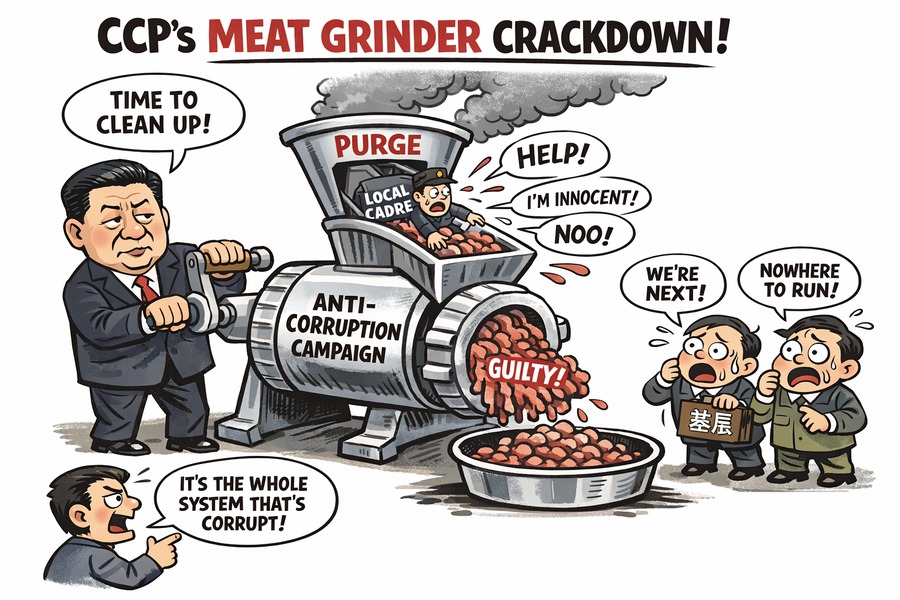
The CCP’s “Meat Grinder” Expands Its Purge, Grassroots Officials All Live in Fear
[People News] As long as the CCP’s authoritarian system exists, corruption in officialdom cannot be eradicated, because graft has already spread to all levels of Chinese society. Holding high the banner of “anti-corruption” has become the CCP’s main theme for singing its own praises, and also an excuse for different CCP factions to attack and undermine one another during internal power struggles. Therefore, whether they are “tigers” or “flies,” the more they are struck, the more there are—just as CCP party chief Xi Jinping put it: “turning the blade inward, scraping the bone to cure the poison.” Anti-corruption is still on the road.
According to data released by the CCP authorities, in 2024 a total of 225,275 corruption cases were investigated nationwide. Among them, 12,910 involved county-level and department-level cadres, while 211,375 involved township-level and lower cadres, accounting for 93.8% of the total, reflecting that corruption among grassroots officials is quite serious.
Recently, a person within the CCP system surnamed Zhao Qian (a pseudonym) revealed to The Epoch Times that as 2026 begins, a new round of so-called anti-corruption investigations is continuously sinking to lower local levels. “Now it’s not just provincial and ministerial levels being investigated—below that they’re also feeling their way downward. At the prefectural and municipal level, especially figures like mayors and public security bureau chiefs, these first- and second-in-command officials have already been listed as key targets.”
Zhao Qian said that recently many localities have been supplementing documents and reconciling accounts, and some people have been repeatedly required to explain the sources of their assets. “They’re not arresting people immediately; instead, they first figure out the situation and see who can’t withstand scrutiny.”
Not long ago, CCP authorities released multiple notices of officials being investigated. On November 26, 2025, the CCP Central Political and Legal Affairs Commission and the National Supervisory Commission announced that Wang Fengchao, Deputy Secretary of the Chengdu Municipal Party Committee and Mayor of Chengdu, Sichuan Province, was suspected of serious violations of discipline and law and was under investigation. On December 2, the Yunnan Provincial Commission for Discipline Inspection and Supervisory Commission reported that Lei Chuying, Vice Governor of Dali Prefecture and Director of the Prefecture Public Security Bureau, was suspected of serious violations of discipline and law and was under review and investigation. The same day’s announcement also included several local civil servants under investigation, involving officials from the prefectural-level public security system.
Mr. Yu, a retired civil servant in Zhengzhou, said that over the past month, many district government officials have noticeably reduced their appearances at public events, and some local principal leaders have recently become low-key. Matters that previously required quick approval have begun to be delayed. “A lot of people have a premonition in their hearts and feel that the anti-graft campaign is going to move downward, so they try to show up as little as possible.” He said that problems among some grassroots officials are not isolated cases: “All government departments are dirty—thoroughly dirty. Ordinary people are living tight lives, but over there there are piles of problems. Everyone privately knows these things.”
An informed source within the Tianjin system pointed out that at the end of last year, an insider from the CCDI system privately revealed that in 2026 the authorities would further intensify the so-called anti-corruption drive. He said: “They say it’s about improving the leadership system and perfecting intra-party regulations, but frankly speaking, it means clearing out a batch of people and investigating a batch of people.”
There have already been signs of the CCP leadership’s deployment of “anti-corruption” for 2026. Official media Xinhua News Agency reported that on December 25, 2025, the CCP Central Politburo convened a meeting to study and deploy party conduct, clean governance, and anti-corruption work for 2026. The meeting pointed out that efforts should continue to advance party conduct and clean governance and the anti-corruption struggle, maintain high-pressure anti-corruption, and make arrangements around political supervision, work-style construction, and the operation of power.
A person from the Beijing No. 3 People’s Procuratorate system—mainly responsible for prosecuting officials for corruption—who requested anonymity told reporters that recently many localities have launched asset verification and clue screening targeting the main responsible persons at the municipal, district, and county levels. The scope includes real estate, relatives’ business activities, investment relationships, and interest exchanges related to engineering projects. “Here in Beijing, this year’s tasks have already been assigned—the CCDI is investigating.”
This anonymous source said that unlike previous rounds that focused on handling “typical cases,” this round of investigations places greater emphasis on “systematic sorting.” Some localities have been required to re-conduct background checks and financial reviews of main officials appointed in recent years. “It’s not just about arresting people who have already gotten into trouble, but about keeping a close watch in advance on positions that are prone to problems.”
Public information shows that among the officials recently announced by the CCDI and the National Supervisory Commission to have fallen from power, the proportion of prefectural- and municipal-level cadres has increased, including multiple mayors, deputy mayors, and leading figures in the public security system. The announcements mostly summarize the cases as “serious violations of discipline and law,” without disclosing specific details.
In the mainland public opinion arena, this round of anti-corruption developments has triggered differing interpretations. Some netizens believe that extending investigations downward helps curb grassroots corruption, while others point out that whether anti-corruption truly touches institutional issues remains to be seen. Most people believe that anti-corruption treats the symptoms but not the root causes, and that corrupt officials become “more numerous the more they are fought.”
When talking about official corruption, netizen Mr. Yu said emotionally: “The Communist Party has been shouting anti-corruption for so many years, yet the problems keep rotting layer by layer downward. This shows it’s not the problem of a few individuals—it’s the entire system that is condoning it. If you really want to fight corruption, start by fighting the system. What we ordinary people need is a democratic system, not a system where power is unchecked. No matter how fiercely they shout from above, it’s just for show to the people.” △






News magazine bootstrap themes!
I like this themes, fast loading and look profesional
Thank you Carlos!
You're welcome!
Please support me with give positive rating!
Yes Sure!