
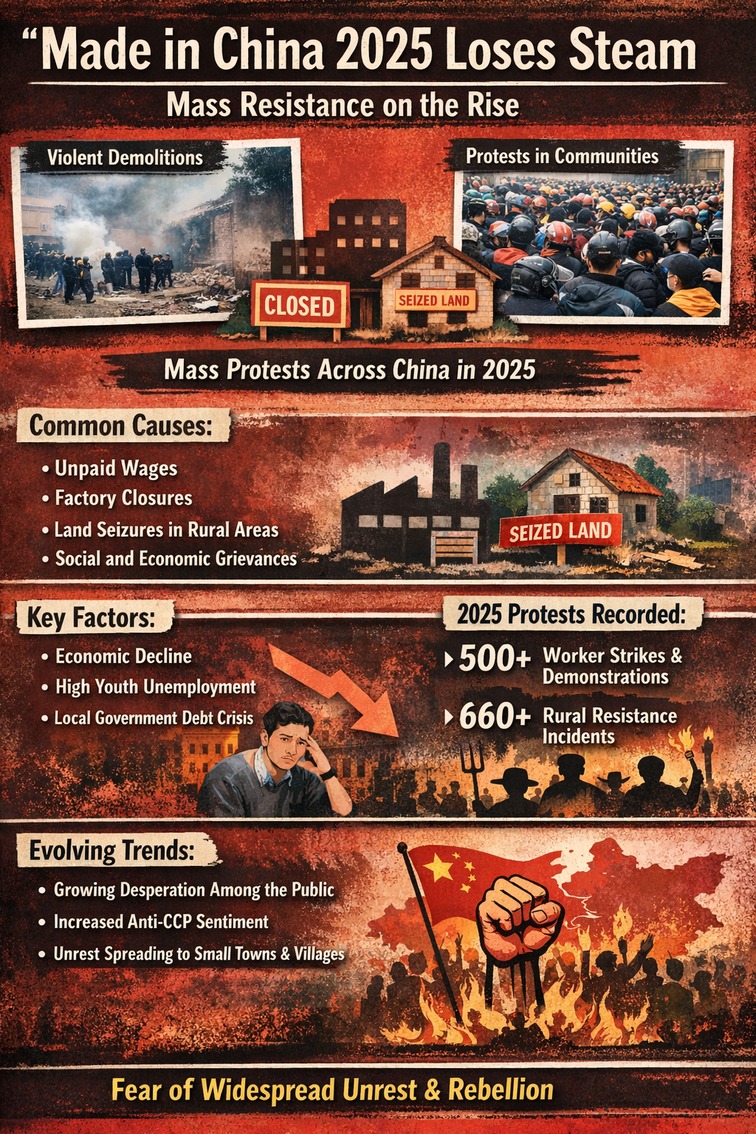
“Made in China 2025” Loses Steam
[People News] On December 23, an incident of citizens resisting violent government demolition occurred in Zhongshan County, Hezhou City, Guangxi. The local government dispatched a forced-demolition team of more than one hundred people composed of police and others to forcibly demolish the Longfu Temple in the area. Villagers split into two groups: male villagers resisted the forced-demolition team outside the temple, while female villagers defended inside the temple, preventing the demolition team from entering. Police used an unidentified irritant gas to force entry and arrested at least four villagers; multiple villagers were knocked to the ground during the clashes.
And just the day before, on December 22, in the Henen Puli Residential Community in Changsha, Hunan, a property management company prohibited food delivery couriers from entering the compound, leading to a fierce dispute between the two sides, which then triggered the gathering of several hundred delivery workers to demonstrate and protest. Authorities dispatched a large number of special police to the scene to maintain stability and made every effort to block information, with multiple members of the public being arrested.
Human rights lawyers stated that the root cause of all social conflicts in China today is the evil system of the Chinese Communist Party. The end of the year should originally be a time for family reunions, reverence for heaven and earth, and festive joy, but in the Chinese Communist Party state, the economy has seriously declined, unemployment has surged, public grievances have erupted everywhere, tragedies are constantly being created, and mass resistance incidents keep occurring.
According to records by “Yesterday” (China Collective Resistance Incident Records Network), since December, there have been more than 30 mass resistance incidents across the Chinese Communist Party state involving “more than 500 participants and suppression by police.” According to incomplete statistics, more than 500 incidents of similar scale have been recorded on the site throughout the year. Many of these were collective wage-recovery, rights-defense, and resistance actions by workers in the manufacturing system.
“Yesterday” records show that by early December 2025, more than ten manufacturing worker rights-defense incidents had occurred nationwide. The main causes triggering resistance included: wage arrears, unpaid social insurance contributions, enterprise relocations without compensation, layoffs without compensation, and so on. Half of the collective resistance incidents occurred in Guangdong Province in southern China. For example: from December 4 to 11, 3,000 workers at Yilisheng Technology in Shenzhen, Guangdong, went on a large-scale strike; on December 10, workers at Shenzhen Xinhao Optoelectronics Technology Co., Ltd. staged a major protest; on the same day, workers at Taihe Maosheng Environmental Co., Ltd. in Ji’an, Jiangxi, went on a collective strike, and so forth.
There were even more incidents in November. In just four days from November 1 to November 4, a total of fourteen manufacturing worker strikes or collective wage-recovery incidents occurred nationwide, distributed across Guangdong, Zhejiang, Jiangxi, Hunan, Anhui, Hubei, and other regions.
“Made in China 2025” was the first ten-year program proposed by former Chinese Communist Party premier Li Keqiang to implement the strategy of “strengthening the manufacturing nation.” Its goals were for the Chinese Communist Party state to enter the ranks of manufacturing powerhouses from 2015 to 2025; to reach a medium level among the world’s manufacturing powers by 2035; and for its comprehensive strength to enter the forefront of global manufacturing powers by 2049. In previous years, “Made in China 2025” was a hugely popular buzzword, described by the Chinese Communist Party as “fighting a war that China must not lose in the next ten years.”
However, once 2025 arrived, this term became a term of defeat and embarrassment. Manufacturing activity in the Chinese Communist Party state has continued to shrink; factory closures, worker unemployment, bosses fleeing, and wage arrears have occurred repeatedly. The strategy of revitalizing the economy through manufacturing has become a joke.
Since the Chinese Communist Party completely lifted COVID-19 controls at the end of 2022, the much-anticipated economic recovery in the Chinese Communist Party state has not materialized as expected. Economic decline and persistently high youth unemployment, among other factors, have created an uncertain economic environment that has hindered consumption and spending. Foreign capital withdrawal and population decline have further worsened economic conditions. In particular, after Europe and the United States increased tariffs on trade with the Chinese Communist Party, industrial activity—mainly export-oriented—has also been significantly affected. Current manufacturing output in the Chinese Communist Party state far exceeds new orders, and reliance on exports is increasing. It can be anticipated that future conditions will be even less optimistic.
2025 is about to pass. The “Made in China 2025” strategy from ten years ago, which planned to invest 300 billion U.S. dollars and focus on fostering ten high-tech industries such as new energy, robotics, semiconductors, and nanotechnology, has instead resulted in mass resistance incidents erupting across manufacturing sectors nationwide, ending in a miserable defeat and creating international embarrassment. High-profile nationalist rhetoric such as “Amazing, my country,” “Seeing the motherland act like a rogue puts my mind at ease,” and the “new four great inventions” has ultimately proven to be nothing more than empty boasting.
In addition to manufacturing, protests in rural areas triggered by land expropriation and local fiscal issues have increased significantly. According to a December 19 report by Britain’s The Guardian, citing tracking data from “China Dissent Monitor,” a project under the Washington-based organization Freedom House, 661 rural resistance incidents were recorded in the first eleven months of this year, an increase of about 70 percent compared with all of last year—a 70 percent surge in rural resistance. In 2025, there were more than 200,000 instances of popular resistance of various sizes, with actual figures believed to be even higher.
Experts analyze that this year’s popular resistance exhibits three new characteristics, accumulating energy for the outbreak of large-scale popular uprisings.
The first is that both the number and the scope show an expanding trend. From cities to villages, from the internet to real life, from economic to social issues, “it can be said that winds and clouds are surging; this is one of the basic characteristics of the end-of-regime tendency of the Chinese Communist Party’s tyranny.”
The second is that popular resistance in 2025 has released greater despair among the populace. Not only unemployed migrant workers, but also college graduates who are unemployed upon graduation, demobilized soldiers for whom demobilization equals unemployment, independent intellectuals, and private entrepreneurs are all in a state of despair.
“The third characteristic is that popular resistance shows an increasingly strong political orientation, and is increasingly concentrated as hatred and anger toward the Chinese Communist Party.”
Lai Jung-wei, executive director of the Taiwan Inspiration Association (TIA), stated that contemporary protest incidents are not necessarily related to the economy and can involve all aspects of social life. The threshold for triggers has become very low; for example, the Jiangyou incident was triggered by a student bullying case. Furthermore, these incidents do not necessarily occur in large cities; they also occur in rural areas and small cities—“small flames in many places are slowly being ignited.”
He believes that the increasing frequency of such incidents has placed enormous pressure on all levels of the Chinese Communist Party’s governing apparatus from top to bottom. At a time of poor economic conditions and strained local finances, the pressure to maintain stability has multiplied.
The nationwide resistance situation in the Chinese Communist Party state has clearly made the Chinese Communist Party feel that its rule is under threat. In late November, the Chinese Communist Party unusually proposed strictly preventing large-scale return and prolonged stay of migrant workers in their hometowns, placing the whole country on alert, which was widely seen as an attempt to prevent the outbreak of popular uprisings. On December 22, the General Office of the Central Committee of the Chinese Communist Party issued a document related to the Lunar New Year, in which the sixth point explicitly emphasized the need to “make every effort to maintain overall social stability,” and to continue developing the “Fengqiao Experience,” namely the Chinese Communist Party’s long-used method of “using the masses to fight the masses,” with the purpose of maintaining the party’s stability. Simply put, these recent measures by the Chinese Communist Party all highlight one issue: the party believes the overall situation is unfavorable and unstable, and therefore has introduced various stability-maintenance measures to protect its regime and interests. △





News magazine bootstrap themes!
I like this themes, fast loading and look profesional
Thank you Carlos!
You're welcome!
Please support me with give positive rating!
Yes Sure!