
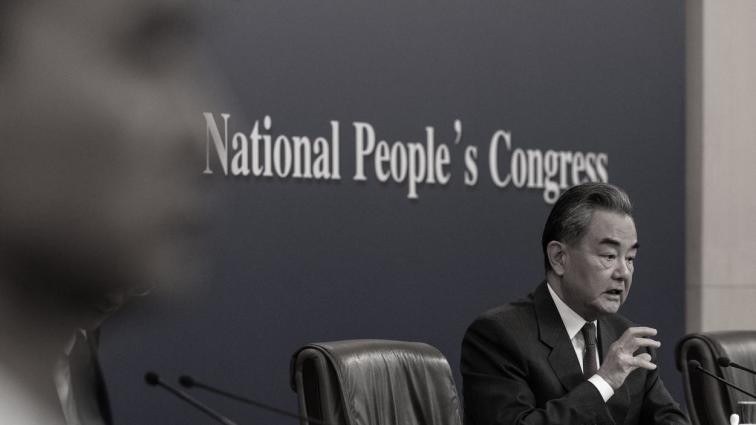
Image: Chinese Foreign Minister Wang Yi. (Photo by Kevin Frayer/Getty Images)
[People News] Following Japanese Prime Minister Kishi Sanae's statement on November 7 that "If there is an issue in Taiwan, there is an issue in Japan," the Chinese Communist authorities implemented a new wave of anti-Japan measures. These included extensive anti-Japan propaganda, attempts to belittle Kishi; diplomats displayed their 'wolf warrior' persona by repeatedly criticising Japan; Li Qiang declined to meet Kishi at the G20 summit and cancelled the China-Japan-Korea ministerial meeting; imports of Japanese seafood were suspended, and Chinese citizens were warned against travelling to Japan; military exercises were conducted, among other actions.
At first glance, this appears to be the 'wolf warrior' diplomacy that Xi once championed. However, regarding Sino-U.S. relations, the Chinese Communist Party has softened its stance, acknowledging the peace that former U.S. President Trump brought to the Middle East, not opposing Trump's proposed peace agreement for the Russia-Ukraine conflict, agreeing to purchase U.S. agricultural products, enhancing control over fentanyl, and consistently signalling a 'hope for win-win' relationship with Trump. They even proactively called Trump after instigating conflict with Japan. The intensity of their denunciations and accusations against U.S. sanctions has also diminished compared to previous years. This shift is clearly at odds with Xi's 'wolf warrior' diplomatic approach over the last few years.
The capitulation of Beijing's diplomacy towards the U.S. can be attributed in part to the tough pressure from the Trump administration. However, it also raises questions: in light of Xi Jinping's frequent power losses, who is actually leading the diplomatic efforts?
It is important to note that after Xi Jinping completed the consolidation of power at the 19th National Congress of the Communist Party of China, he began to offer guidance in the realm of foreign affairs and developed the 'Xi Jinping Thought on Diplomacy'. The core principle of this thought is to build a community with a shared future for mankind, which replaces the early Deng Xiaoping era's slogan of 'hiding one's capabilities and biding one's time' with the concept of 'great power diplomacy'. However, over the past year, the Communist Party's approach to foreign affairs has started to downplay the emphasis on 'great power diplomacy'. What is the reason for this shift? Recent news regarding Wang Yi, a member of the Political Bureau of the Central Committee of the Communist Party, Director of the Central Foreign Affairs Office, and Foreign Minister, provides some insight.
According to the Ministry of Foreign Affairs of the Communist Party, a national conference on local foreign affairs was held in Beijing from November 27 to 28, where Wang Yi attended and delivered a speech. He emphasised that local foreign affairs work should be guided by 'Xi Thought', particularly Xi's diplomatic thought, and should 'serve the overall diplomatic theme and high-quality development as determined by the Party Central Committee's foreign policy and country-specific policies'. He also stated that it is essential to 'implement the Party Central Committee's requirements... to ensure that official overseas trips and foreign forums and exhibitions are pragmatic and efficient'. Notably, Wang Yi did not include any expressions of loyalty in his remarks.
It is significant to observe Wang Yi's wording, indicating that 'Xi Thought' serves merely as a guiding principle, while the foreign policy and country-specific strategies must be executed in accordance with the directives of the 'Party Central Committee'. Here, the 'Party Central Committee' clearly does not equate to 'Xi Central'. The changes in the Communist Party's official media suggest that the current 'Party Central Committee' holds a different connotation compared to the 'Party Central Committee' during Xi's era of singular authority.
Since the incident involving Xi Jinping last July, the People's Liberation Army Daily and state media have consistently signalled a commitment to 'collective leadership'. For instance, on August 29, the Beijing Daily published an article titled 'Adhering to the Central Committee's Concentrated and Unified Leadership is the Highest Political Principle'. Senior officials of the Communist Party of China have echoed this sentiment, with some stating that during their study of the plenary session's spirit, they would 'unify thoughts and actions with the spirit of the plenary session' and 'align with the major decisions and deployments of the Party Central Committee'. Xi has also had to emphasise the importance of 'strengthening the Party Central Committee's concentrated and unified leadership' in several public appearances. Such statements from Xi are uncommon, particularly given his significant power. This is because, in the view of Xi and other senior officials, Xi, who is perceived as the sole authority, embodies the 'Central', thus negating the need for any concentrated and unified leadership.
Recently, on November 6, Xi Jinping mentioned the 'Party Central Committee' twice while receiving a report on the construction of the Hainan Free Trade Port in Sanya, Hainan Province. On November 8, during a meeting with senior officials in Guangdong Province in Guangzhou, he reiterated the need to 'effectively unify thoughts and actions with the decisions and deployments of the Party Central Committee'. This aligns with one of the core messages from the communiqué of the Fourth Plenary Session that concluded in October, which emphasises the necessity to 'uphold and strengthen the authority of the Party Central Committee and its concentrated and unified leadership' during the '14th Five-Year Plan' period.
Xi's remarks suggest that he now also needs to operate under the Central Committee and must adhere to directives from above. If even Xi is required to follow the collective decision-making of the 'Party Central Committee', can Wang Yi be an exception?
For readers who still have questions, it may be helpful to compare the content of Wang Yi's speech at the national local foreign affairs work conference held on April 10-11, 2024. During that speech, Wang Yi remarked that since the 18th National Congress of the Communist Party of China, 'local foreign affairs work has coordinated with China's characteristic major country diplomacy... achieving fruitful results... the most fundamental point is to always adhere to 'Xi Thought' as guidance.' He emphasised that in the future, local foreign affairs work must 'deeply understand the decisive significance of the 'two establishments' and resolutely achieve the 'two safeguards,' among other points.
Reflecting on Wang Yi's address at the national meeting of local foreign affairs office directors in December 2018, he provided a thorough explanation of 'further enhancing the new era of China's characteristic major country diplomacy,' clearly stating the need to 'earnestly implement Xi Jinping's diplomatic thought,' and also referenced 'four fours two,' among other topics.
Wang Yi's varying expressions, particularly his omission of 'major country diplomacy' and any loyalty phrases this year, along with the trend of many foreign diplomats from the Communist Party of China downplaying Xi in their speeches on the Ministry of Foreign Affairs' official website, all suggest that Xi has essentially lost his diplomatic leadership and discourse power.
In fact, signs of Xi's diminishing control over foreign affairs have been evident for some time. One notable instance occurred on April 10 of this year, when the Ministry of Foreign Affairs of the Communist Party of China held its routine work conference for foreign diplomats in Beijing. Xi Jinping, who has historically placed great importance on diplomacy, did not meet with as many attending foreign diplomats this time as he had in previous years. In earlier years, Xi not only met with them but sometimes also delivered speeches.
Another notable occurrence is that at the Central Peripheral Work Conference held on April 8-9 this year, 'Xi Jinping's Diplomatic Thought' was completely absent. Li Qiang, who chaired the meeting, emphasised the importance of earnestly implementing the spirit of Xi's speech after Xi had finished speaking, yet he did not mention Xi's diplomatic thought nor its implementation.' This stands in stark contrast to the Central Foreign Affairs Work Conference held at the end of 2023, where Li Qiang referenced Xi's diplomatic thought multiple times, stating, 'We must use Xi Jinping's diplomatic thought as guidance to effectively carry out foreign affairs in this new journey.'
The fact that Xi has lost his leadership role in foreign policy does not imply that he cannot meet with foreign dignitaries or go on official visits as chairman. Before the Communist Party of China officially discloses the truth, Xi and many senior officials still need to fulfil their roles effectively, and observers should not be misled by this situation. △





News magazine bootstrap themes!
I like this themes, fast loading and look profesional
Thank you Carlos!
You're welcome!
Please support me with give positive rating!
Yes Sure!