
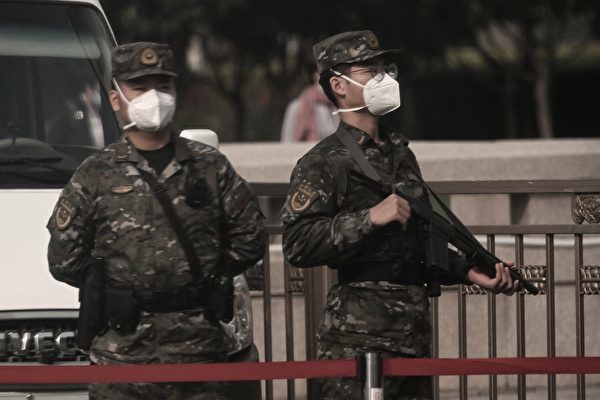
Caption: On October 13, 2022, ahead of the 20th National Congress of the Chinese Communist Party, security personnel were stationed along the road leading to Tiananmen Square. (NOEL CELIS/AFP via Getty Images)
[People News] In late November 2025, a video that had been hidden for 36 years suddenly went viral online: a complete recording of the trial of Xu Qinxian, commander of the 38th Group Army, from June 1989. In the footage, this general, dressed in military uniform and with greying hair, appears composed, his voice steady yet impactful as he delivers a statement that left everyone present in shock:
"I can lose my hat, I can go to prison, I can be executed, but the 38th Army cannot open fire on unarmed students and citizens."
Within just a few days, this video was shared millions of times on overseas platforms. Although it was swiftly blocked within China, it continued to circulate extensively through encrypted channels and private groups. Almost everyone who viewed it was moved by Xu Qinxian's distinctive military integrity on camera: he did not cry or deliver a passionate speech, but instead displayed a nearly brutal calmness, like a blade that has been unsheathed for 36 years yet still shines with a chilling light.
Less than ten days later, the Central Military Commission took action.
On November 28, 2025, the Central Military Commission issued a newly revised supplementary regulation to the "Disciplinary Regulations of the People's Liberation Army (Trial Implementation)," which will come into effect on January 1, 2026. The core of this regulation is alarming:
"Military personnel who refuse to execute orders from superiors, or who delay or alter execution for any reason, will be directly expelled from military service and referred to military prosecution for criminal responsibility, with a maximum penalty of life imprisonment."
The new regulations are more severe than the previous ones, as they for the first time categorise 'refusal to execute orders' as a standalone offence, distinct from the general 'crime of disobeying orders,' with punishments that are nearly equivalent to those for 'insubordination during wartime.' Additionally, the accompanying explanatory guidelines specifically outline two 'typical circumstances':
1. Refusing to open fire or carry out clearance operations under the justification of 'humanitarian' or 'conscience' reasons while dealing with 'riots,' 'disturbances,' or 'serious political events';
2. During the execution of significant missions, making unauthorised statements that could undermine military morale or leaking the content of orders.
Those familiar with military regulations can easily recognise that these two points serve as 'negative examples' specifically targeting the actions of Xu Qinxian from years past.
Moreover, there is an additional, less noticeable yet more insidious provision in the same set of documents: if a soldier is suspected of the aforementioned behaviours, they will be suspended and isolated during the investigation, with their military rank and benefits temporarily withheld. Following a conviction, not only will the individual be expelled from military service, but their immediate family members will also be barred from applying to military academies or entering military civilian positions, effectively implicating three generations.
Upon the news breaking, a profound silence fell over the military. Some have privately dubbed this new regulation the 'Xu Qinxian Clause.'
However, this is merely the tip of the iceberg. The day after the video was revealed, on November 26, significant changes took place at the top of the National Confidentiality Bureau: both Director Li Zhaozong and Deputy Director Shi Yingli were dismissed simultaneously, with Song Gongde, a PhD in law from Peking University, appointed as the new director. The official announcement was vague, merely stating 'the appointment and dismissal of national staff,' but the public quickly connected it to the leak case — the source of Xu Qinxian's video remains unclear, yet it precisely documented the entire court proceedings, raising suspicions that it originated from military internal files. The Confidentiality Bureau serves as the 'firewall' for Zhongnanhai, tasked with safeguarding state secrets, and this personnel change seems too coincidental: the former director, Li Zhaozong, had previously been the deputy director of the General Office's Secret Bureau, a seasoned expert in intelligence management, yet he resigned immediately after the video 'leaked.' Analysts have pointed out that this is not a mere coincidence, but rather a 'surgical operation' on the intelligence system by the higher-ups — the concern is not just about one video, but the potential vulnerabilities within the entire confidentiality chain. Who can assure us that the next 'Xu Qinxian' won't resurface through similar channels?
Simultaneously, a wave of online cleansing has emerged. Following the exposure of the video, major domestic platforms swiftly entered a 'zero tolerance' mode: keywords like 'Xu Qinxian', '38th Army', and 'Rebellious General' were immediately blacklisted, leading to the mass banning of related accounts and even the removal of historical documentary clips. The algorithms of WeChat, Weibo, and Douyin have been upgraded, with AI reviews transitioning from 'passive deletion' to 'active hunting'. According to overseas monitoring, from November 25 to 30, over 100,000 posts were deleted in China, and more than 5,000 accounts were banned. This is not merely about 'maintaining stability'; it represents a thorough 'memory cleansing' across the internet. The video is regarded as a 'historical virus' that, if it spreads, could influence the younger generation within the military. Particularly in the context of the current economic slump and rising unemployment, young people's admiration for 'conscientious soldiers' fills the gap left by their disillusionment with the system. The authorities are evidently alarmed; the scale of the cleansing evokes memories of the 'internet iron fist' during the peak of the anti-corruption campaign in 2019, but this time it is even more severe—tracking of VPNs has been intensified, and it is suspected that following personnel changes in the Confidential Bureau, the new team has directly connected with the Cyberspace Administration to establish a 'double insurance'.
Military regulations, the Security Bureau, and online purges—these three measures deployed together are still only “emergency resuscitation.” The real climax is Xi Jinping’s “personally written” article, “To Advance the Party’s Self-Revolution, We Must Achieve ‘Five Further Attainments’,” published in Qiushi on December 1. This speech was originally delivered during the Politburo’s collective study session in June 2025, yet it was deliberately republished at this politically sensitive moment. The “Five Further Attainments” in the title strike directly at the sore spots: the understanding of the Party’s self-revolution must be further in place; the determination to advance self-revolution must be further in place; the strength to resolve prominent intra-Party problems must be further in place; the measures for self-purification and self-improvement must be further in place; and the effectiveness of self-revolution must be further in place. In the article, Xi Jinping repeatedly stresses “firm ideals and convictions, forging unshakable loyalty to the Party, deeply cultivating a mindset of serving the people, possessing upright moral character, and maintaining integrity and honesty,” and he explicitly calls for “resolutely eliminating all factors that undermine the Party’s advanced nature and purity.” This is hardly a routine “Party lecture”—it is clearly an upgraded “Party-purification campaign”: from the military to the Party-state apparatus, from the grassroots to the top leadership, a comprehensive “physical examination.”
Outside observers note that the timing of this article is striking: just as the video controversy exploded, he suppressed the uproar with the banner of “self-revolution,” which is tantamount to warning the entire Party and military that “Xu Qinxian-style conscience” is not heroic, but a cancerous tumour “damaging purity.” Purification is not empty rhetoric; the article’s conclusion bluntly states, “We must strengthen theoretical armament and uphold the spiritual pursuit of Communists.” In the current context, this is equivalent to placing an ideological tightening-curse on anyone who might waver.
Some say Xi Jinping has been frightened.
Indeed, Xu Qinxian's video appears at a particularly inopportune moment: the situation in the Taiwan Strait is at an unprecedented level of tension, with the US, Japan, Australia, and the Philippines continuously conducting military exercises, and incidents of aircraft collisions and interceptions occurring frequently in the South China Sea. Meanwhile, the domestic economy is in decline, local debts are collapsing, unemployed youth are taking to the streets, and the term 'run' is nearly classified as a sensitive word online. At this critical juncture, a military commander who refused to fire on the people 36 years ago has suddenly made a striking return, effectively challenging the long-held principle that 'the gun must always obey the party.' Even more concerning is that Xu Qinxian's statement in the video, 'If I don't go to hell, who will?' is spreading rapidly among young people, with some even creating memes featuring his image.
Xi Jinping cannot possibly be without fear.
(Author's X account)
△





News magazine bootstrap themes!
I like this themes, fast loading and look profesional
Thank you Carlos!
You're welcome!
Please support me with give positive rating!
Yes Sure!