

The "Hidden Word Stone" (also known as the "Stone of the CCP's Demise") discovered in Zhangbu Township, Pingtang County, Guizhou Province, along with an old version of the ticket for the tourist site, shows the character for "亡" (demise) clearly visible. (Minghui.org)
[People News] Several significant landslides have occurred in different parts of mainland China over the past two months, with alarming scenes and considerable casualties reported.
On September 16 at 8:40 AM, a massive landslide struck Shida Guan Village in Baxi Town, Mao County, Sichuan. The falling rocks and mud buried several buildings at the foot of the mountain, rapidly blocking the Min River and completely halting traffic on the national highway.
Reports indicate that since August, multiple landslides have occurred at the Zhenzi Dam in Shida Guan Village, Baxi Town, Mao County. The Chinese Communist Party (CCP) has claimed there were 'zero casualties,' but this assertion is met with scepticism by the public.
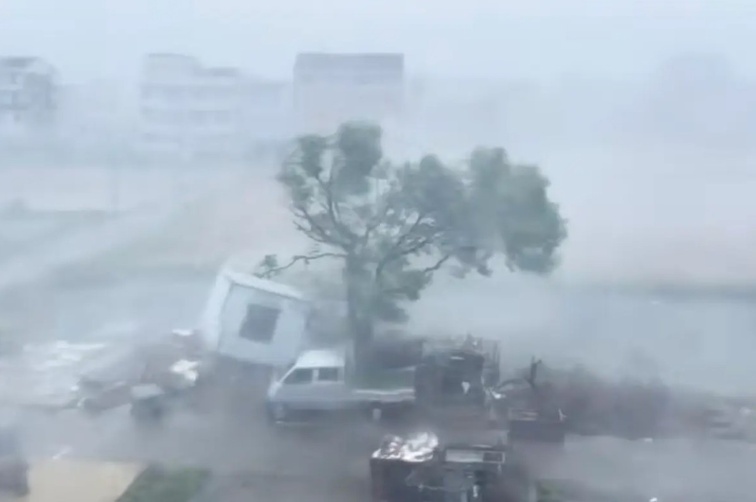
From September 11 to 15, Hainan Island experienced extremely heavy rainfall, which triggered mountain floods, resulting in landslides in Wuzhishan, road collapses, house collapses, and vehicles and individuals being swept away by the flood, leading to severe devastation.
On August 26, sudden floods and mudslides hit the border area between Nepal and Tibet, destroying numerous villages and causing significant damage to roads and infrastructure. The CCP's Jilong Port was quickly overwhelmed, and the disaster scene was shocking. Official data from Nepal indicates that there were 1,403 deaths and 6,150 people missing on the Nepal side, while data released by the CCP on September 18 reported 562 individuals dead or missing at Jilong Port.
On July 17 at 9:08 AM, a large-scale landslide occurred near the Wujang Sanqiao on National Highway 211 in Hanji Street, Pengshui Miao and Tujia Autonomous County, Chongqing. By July 30, the incident had resulted in 51 fatalities, 10 missing persons, and 10 injuries.
In ancient China, a landslide was viewed as a dire omen signaling the imminent end of a regime.
According to the "Zuo Zhuan," "A country must depend on its mountains and rivers; when the mountains collapse and the rivers dry up, it is a sign of its demise. In no more than ten years, the fate of the regime will conclude." This suggests that effective governance and the maintenance of power rely on the stability of the natural landscape; thus, a landslide and a river drying up are indicators of a regime's downfall. Within a decade, the regime's fate will be sealed, paving the way for a new authority.
The "Book of Han: Treatise on the Five Elements" notes: "Mountains symbolize the ruler. The mountain ridge represents the laws and regulations of the state; when it cracks, the laws and regulations are divided, leading to discord between the upper and lower classes." This implies that high mountains are emblematic of the monarch, with the mountain ridge symbolizing the state's legal framework. A crack in the ridge signifies the disintegration of these laws and the estrangement of the ruling and common classes.
In the Tang Dynasty's "Kaiyuan Divination Classics," the "Yun Dou Shu" states: "When the mountains collapse, it signifies that ministers are usurping the ruler's power, resulting in the loss of the foundation of governance." In the context of Yin-Yang and the Five Elements, the ruler and the Son of Heaven are associated with 'Yang.'
Dong Zhongshu's "On Disasters and Anomalies" explains: "Mountains belong to the Yin category; a collapse signifies the departure of loyal ministers, while treacherous officials obscure the ruler's virtues, blocking the flow of benevolence, creating anger and resentment, and leading to the scattering of the populace." This indicates that a landslide symbolizes the departure of loyal officials, while deceitful ministers mislead the ruler, severing communication between officials and the people, resulting in public discontent and fragmentation.
The "Mirror of the Earth" states: "A landslide indicates the ruler's power is waning and governance is becoming tyrannical; within three years, a military coup will occur." This suggests that a landslide foreshadows a decline in the ruler's authority, the rise of oppressive governance, and the likelihood of a military uprising within three years.
The "Di Jing" further states: "When the mountains collapse in spring, the country will experience city demolitions; when they collapse in summer, there will be floods across the land, and the ruler will perish; when they collapse in autumn, there will be great armies; and when they collapse in winter, there will be widespread famine in the middle of the year." This does not require further explanation, and this year's mountain collapses have indeed occurred in both summer and autumn, with floods already manifesting across the land. The questions remain: when will the ruler perish and when will the great armies appear?
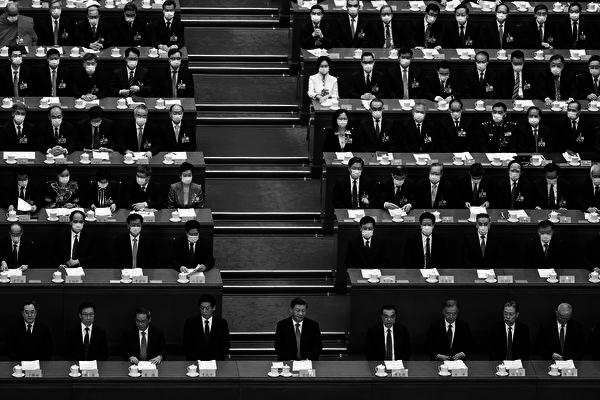
In summary, from the perspective of ancient people, mountain collapses signify the weakening of the ruler's power, ministers betraying their lord, seizing power, and the regime heading towards collapse. This observation holds true when we compare it to the current situation of the Chinese Communist Party (CCP). On one hand, while various news about CCP leader Xi Jinping continues to dominate the headlines, there are numerous signs indicating that Xi's power is being weakened. For example, although Xi has made important video speeches at global service trade summits in the past, he has been absent this year; the military's "Illustrated Report" has removed Xi from the cover for four consecutive months; the phrase "resolutely and effectively implement the major decisions and deployments of the Party Central Committee and the Central Military Commission" in military statements has omitted the reference to "Chairman Xi"; and the Minister of National Defense, Dong Jun, emphasized in his "August 1" speech the importance of "listening to the Party and following the Party". Xi has also stressed the Party's leadership in several speeches, among other things.
On the other hand, high-ranking officials like Li Qiang have been unusually vocal in their expressions of loyalty to Xi; several high-ranking officials have mentioned the spirit of Xi's directives alongside the "spirit of the Politburo" or the "decisions and deployments of the Party Central Committee"; officials affiliated with Li Qiang's faction and non-Xi faction officials have continuously risen to power; Xi's confidant Huang Kunming has not shown support for Xi; Xi's Director and Deputy Director of the General Office have taken on new roles, and members of the "Fujian Gang" such as trusted aide Chen Xi have been removed from their positions…
The subtle shifts in the political landscape of the Chinese Communist Party (CCP) described above seem to resonate with ancient proverbs regarding the signs of an impending collapse. Furthermore, a growing number of celestial phenomena suggest that the CCP is now in a countdown to disintegration.
(First published by the People News)△





News magazine bootstrap themes!
I like this themes, fast loading and look profesional
Thank you Carlos!
You're welcome!
Please support me with give positive rating!
Yes Sure!