

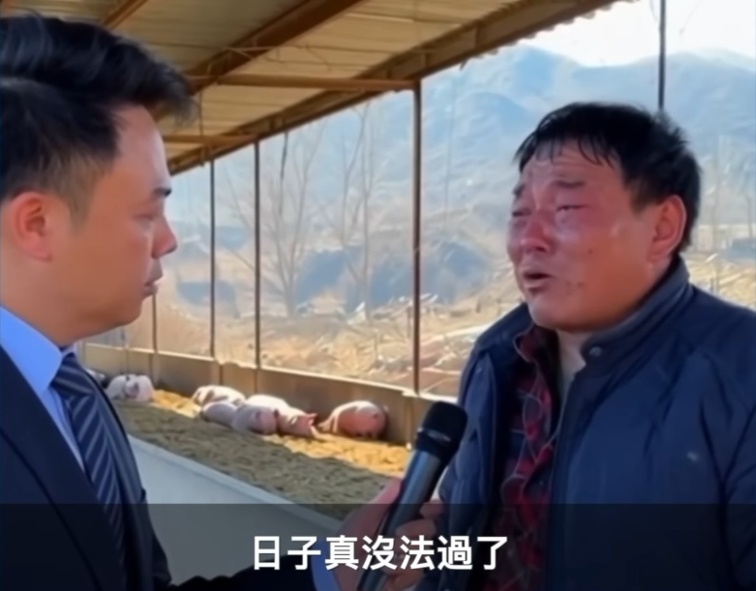
Oxidised food and products are everywhere in China and are impossible to guard against. (Video screenshot)
[People News] Recently, it was reported that a cabbage buyer in Kangbao County, Hebei Province, used a formaldehyde solution to treat cabbage before loading it onto trucks, raising serious concerns about food safety.
According to Radio Free Asia, the Kangbao County government announced on August 22 that local departments, including agriculture, rural affairs, market regulation, and public security, have initiated an investigation. Preliminary checks confirmed that the situation depicted in the circulated video is accurate, revealing that the buyer engaged in illegal practices to preserve the freshness of vegetables during transportation.
Agricultural product markets in East China, including Nanjing and Wuxi in Jiangsu Province, have subsequently announced a complete ban on the entry of cabbage from Kangbao County.
Experts: Natural Presence Does Not Justify Artificial Addition
Roger Clemens, a food safety and toxicology expert at the University of Southern California, stated in a written response to our station that while formaldehyde may naturally occur in some fruits, vegetables, and fish, this is fundamentally different from the intentional addition of formaldehyde to food.
Clemens stressed that a "zero tolerance" policy should be adopted regarding the deliberate use of formaldehyde in food. For food that has already been contaminated, simply washing it is not enough to mitigate the associated risks.
Similar Reports from 14 Years Ago
Our station reported in 2012 that some vegetable merchants in Qingzhou, Shandong, had been soaking cabbage in formaldehyde solution to keep it fresh. Industry insiders at that time indicated that this practice had been ongoing for three to four years and was considered a "hidden rule" within the local industry.
Now, fourteen years later, similar issues have emerged once again.
Huang Yanzhong, a senior researcher on global health at the Council on Foreign Relations, stated in an interview with our station that this may not be an isolated incident, but rather a manifestation of recurring structural problems.
Huang Yanzhong argues that the high liquidity of vegetable procurement and long-distance transportation nodes, combined with their scattered locations, makes it challenging for regulatory authorities to achieve comprehensive oversight. Additionally, the costs associated with formal cold chain transportation may lead some purchasers to resort to illegal methods to minimize losses.
"The cost of counterfeiting is very low, and the chances of being caught are also minimal, which results in high profits from such activities," he explained.
Huang Yanzhong believes that addressing these issues requires more than just concentrated investigations following incidents; it is essential to lower the compliance costs for operators and to establish a risk-oriented regulatory framework that targets high-risk categories, seasons, and production areas.
"Relying solely on strict enforcement is unlikely to solve the problem, as the profit margins simply do not justify it," he noted.
Food safety incidents continue to undermine public trust.
This incident first came to public attention through online videos, which subsequently led to official investigations and targeted inspections in various regions.
Huang Yanzhong believes that the repercussions of such incidents extend beyond potential health risks; they also gradually erode consumer confidence in the food safety system and result in collateral damage to law-abiding farmers and merchants.
"For consumers, the greatest harm is the collapse of trust," he stated. "With repeated incidents like this, over time, public confidence in the food safety system is slowly diminished."
He advocates for a shift in food safety regulation from reactive emergency responses to ongoing supervision that encompasses the entire supply chain.
The essential point is to transition regulation from reactive measures to proactive oversight throughout the entire process, ensuring there is monitoring, technical inspections, and data that can provide early warnings, rather than waiting for public outcry to respond.
Huang Yanzhong also stressed that food safety issues are not exclusive to China.
"No country has perfect food safety; every nation faces food-related challenges," he stated. "What can truly be compared is whether issues can be identified quickly enough, communicated clearly enough, and addressed thoroughly enough." △







News magazine bootstrap themes!
I like this themes, fast loading and look profesional
Thank you Carlos!
You're welcome!
Please support me with give positive rating!
Yes Sure!