
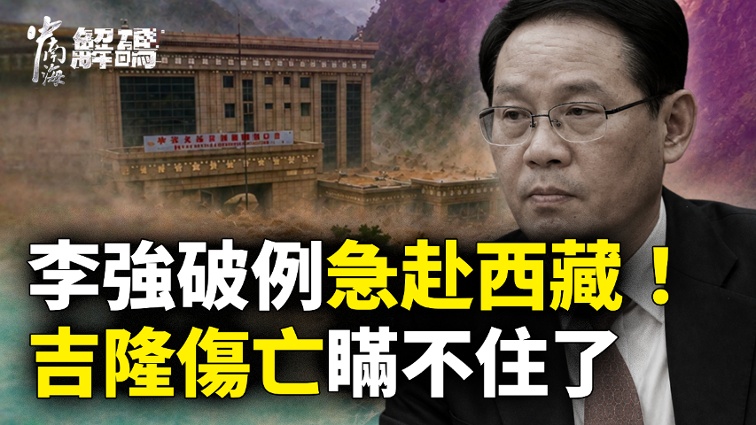
Li Qiang has made an unprecedented visit to Tibet! The casualties in Jilong can no longer be hidden!
[People News] On August 26, a mudslide disaster struck the Shigatse region along the China-Nepal border, causing significant damage to the Jilong Port in Tibet. In an unusual move, General Secretary of the Communist Party Xi Jinping tasked Premier Li Qiang with visiting the disaster area the following afternoon.
However, two days later, the Communist Party has not provided a complete and accurate account of the disaster situation. As of the afternoon of the 28th, Nepalese police reported that the local death toll had risen to 469, with 977 people still missing, while the information released by the Communist Party remained unchanged since 8 PM on the 26th: 3 confirmed dead and 558 missing.
Recent reports indicate that many families of missing persons have arrived in Jilong Town but are still unable to access the port. The Chinese Communist Party (CCP) has imposed strict controls on media coverage, prohibiting the 'malicious' dissemination of related images and texts. They emphasize that the disaster originated on the Nepal side, downplaying the casualties on the Tibet side.
Ms. Qin, who works in the joint inspection building at the Jilong port, revealed that it is reported that at least a thousand people have been buried alive. The port office houses over 200 civil servants, most of whom are party members. Currently, she can only anxiously await news in a hotel.
Some analysts suggest that Xi Jinping's decision to send Li Qiang to the disaster area does not reflect a sudden concern from the CCP for the public's plight; rather, it indicates the severity of the situation. Many of the missing individuals are officials, civil servants, and party members from the port, as well as numerous foreigners from various countries. If the CCP fails to respond appropriately, it risks inciting dissatisfaction among domestic civil servants and facing international condemnation.
Naturally, the CCP's focus on the source of the disaster while neglecting to address the situation itself and failing to issue timely warnings to Nepal has already provoked public outrage.
Some netizens have suggested that the Chinese Communist Party (CCP) is concerned about facing 'heavenly punishment,' which has led to social skepticism. This prompted the issuance of a secret directive requiring domestic media to only reprint unified reports from party media. They highlight that a landslide occurred in Nepal, resulting in significant casualties on the Chinese side, effectively shifting the blame onto Nepal. Meanwhile, the CCP is vigorously promoting its 'active rescue' efforts... Regarding early warnings to Nepal, it is worth noting that the CCP has a history of building dams and diverting rivers in other countries, as well as contaminating their waters, which poses risks to their safety. Even if communication lines remain intact, it is uncertain whether the CCP would provide advance notice.
Furthermore, some netizens have pointed out that the sudden burial of party members and officials evokes memories of the SARS and COVID-19 outbreaks, during which some severely ill party members were reportedly thrown into incinerators while still alive. Despite claims of being long-time party members, they could not escape the grim fate of being pushed into the furnace by cremation workers.
It is important to note that the disaster at 'Zhilong Port,' which was instantaneously 'cleared' by a landslide, occurred just before the CCP's regulations took effect, granting customs the authority to intercept Chinese citizens suspected of having ill intentions for traveling abroad.
The CCP has mandated that starting September 15, ports and borders have the right to deny passage to Chinese citizens suspected of having bad motives for going abroad. In fact, many customs had already begun enforcing this regulation in August. The port being swept away by the landslide is unprecedented in the CCP's history. This may also explain why, two days after Li Qiang's visit to the disaster area, the CCP is still struggling to publicly disclose specific details about the disaster.
We are deeply saddened by the officials, party members, and ordinary citizens who lost their lives in an instant; their fame, wealth, and very lives have turned to dust in the blink of an eye, marking a profound tragedy. Perhaps they had many regrets that they did not have the chance to address, and maybe just last week they watched heartbreaking videos of victims who lost their lives in the typhoon and flood disaster...
Regrettably, the Chinese Communist Party (CCP) does not provide its party members and officials with the opportunity to learn from these experiences. Those party officials who continue to order or carry out the CCP's concealment of disaster information should consider that natural disasters may one day affect them as well. If one does not value others today, tomorrow they too may be treated as mere dust. In the choice between the CCP and their own lives, it should be evident which holds greater importance.
(First published in People News) △







News magazine bootstrap themes!
I like this themes, fast loading and look profesional
Thank you Carlos!
You're welcome!
Please support me with give positive rating!
Yes Sure!