
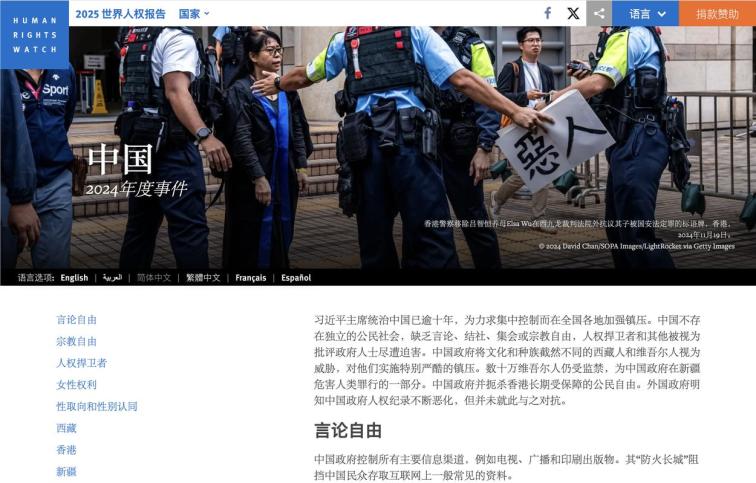
2025 World Report on Human Rights, China Section Cover Screenshot (Screenshot from Human Rights Watch official website)
[People News] On June 16, 2026, the human rights organisation Protectors of the Guard published a report titled "Behind Iron Bars: Investigation into the Conditions of Chinese Detention Centres." The report reveals serious issues within these facilities, including obstacles to lawyer visits, violence, bullying by prison guards, inadequate medical care, lack of outdoor activities, and overcrowding. It argues that the Chinese detention centre system has long been devoid of external oversight, raising concerns about the basic rights of pre-trial detainees.
As reported by Radio Free Asia, a questionnaire survey commissioned by Protectors of the Guard interviewed 84 individuals who had previously been detained in Chinese detention centres. The survey addressed issues such as violence, lawyer access, medical care, outdoor activities, and overcrowding. Respondents were drawn from 19 provinces and municipalities across China, covering at least 58 different detention facilities. Protectors of the Guard noted that there are over 2,600 detention centres nationwide, making it challenging for outsiders to gain a comprehensive understanding of the internal conditions within these facilities.
The report presents alarming data, indicating that 73% of respondents reported being blocked from meeting with a lawyer, and many were unable to hire a lawyer independently; 76% stated they had experienced violence from police, guards, or other detainees; and 76% reported the presence of a 'prison head' in their cells, where certain detainees were either authorized or took it upon themselves to exert control over the cell, bullying and managing their fellow inmates.
Obstacles to Lawyer Visits Impact Legal Cases
In response to numerous interviewees claiming they were barred from meeting with lawyers while in detention, lawyer Zhuang from Hunan told Radio Free Asia that under conditions of detention and oppression, lawyers serve as a crucial 'lifeline' for detainees. Prolonged absence from legal counsel can lead to a mental breakdown for these individuals, which in turn affects their statements, confessions, and the overall trajectory of their cases.
He remarked, 'This will undoubtedly have an impact. Particularly in oppressive conditions, lawyers are almost like a lifeline for them. If they are unable to access this so-called lifeline for an extended period, they are likely to experience significant mental distress. Many aspects of their psychology will be affected, including their expressions and what they refer to as confessions, all of which will be influenced.'
The report further reveals that 64% of respondents reported being unable to obtain timely medical care; 24% stated they had never been permitted outdoor activities, or had outdoor activities less than once a month; and 60% indicated that the per capita space in their detention cells was less than 2 square meters, roughly the size of an elevator. Guards noted that these conditions demonstrate that violations of international law and Chinese regulations within detention centres are not isolated incidents.
Issues of violence and misconduct among prison officials are prevalent.
Lawyer Zhang (Zhang Lushi) from Jiangxi informed Radio Free Asia that violence in detention centres is quite prevalent, and this violence may not only originate from guards or police but can also arise from the tolerated presence of 'prison heads.' He remarked, 'This situation is certainly more common. Not all incidents involve guards; the prison heads inside can also take action. These prison heads are typically tolerated by the detention centre, effectively helping to maintain order. If the police find someone objectionable and wish to deal with them, they are increasingly less likely to act directly; they usually instruct the prison heads to apply pressure within the cell and continue to exert pressure even after the individual is released.'
Zhang also noted that, compared to previous years, some detention centres have seen improvements in living and eating conditions, but the underlying issues persist. He provided an example from around 2014, when he interacted with a detainee who reported that the detention centre served mouldy rice. After this issue was made public, the detention centre temporarily changed the rice, but eventually reverted to the original situation.
The Protectors report highlighted that Chinese detention centres serve as pre-trial detention facilities, where detainees have not yet been convicted by a court. The report states that at this stage, rights such as meetings with lawyers, evidence review, medical care, and protection against abuse should be guaranteed; however, the actual conditions described by interviewees often diverge from legal standards.
Insufficient Protection of Pre-Trial Detention Rights
The Chinese Communist Party (CCP) typically defines detention centers as facilities for the lawful detention of criminal suspects and defendants. Chinese law also stipulates that criminal suspects have the right to appoint lawyers, and detention facilities are required to ensure basic living and medical conditions for detainees. The Protectors report indicates that testimonies from interviewees reveal that these regulations are frequently undermined in practice.
Chen Yanting, a researcher at Protection International, told Radio Free Asia that "After the Iron Bars" is part of his research on China's detention system. A related report on China's prison system is expected to be released later this summer. He stated, "We hope this investigative report will help the international community gain a better understanding of some issues within China's detention system, where human rights violations are widespread. We urge governments and parliaments, especially in democratic nations, to pressure the Chinese Communist Party to improve detention conditions and respect the basic rights of detainees."
Protection International noted that given the ongoing reduction of information transparency in China and the risks faced by former detainees when they testify publicly, such investigations can provide valuable insights for the international community regarding China's pre-trial detention system.
Lisbon Event Faces Pressure from Chinese Embassy
Protection International also mentioned that this report is being released in conjunction with an event co-hosted by Protection International and the American Club in Lisbon on June 16. During this event, Protection International leader Peter Dahlin and British human rights activist Han Feilong (Peter Humphrey) will share their experiences of imprisonment in China and discuss the country's improper detention practices. Protection International reported that the Chinese Embassy in Portugal sent a letter to the event organisers on June 5 to apply pressure; on June 12, an X account impersonating Protection International disseminated a manipulated promotional poster for the event, containing incorrect details about the date, time, and location, with the intent to mislead potential attendees.
△








News magazine bootstrap themes!
I like this themes, fast loading and look profesional
Thank you Carlos!
You're welcome!
Please support me with give positive rating!
Yes Sure!