

This year, an increasing number of young people have been seen rummaging through trash bins. (Video screenshot)
[People News] On June 15, a topic titled 'The Life of Ordinary People: Cattle and Horses in Prosperity, Cannon Fodder in Chaos' surged to the top of Weibo's trending searches, resonating deeply with many netizens who expressed their concerns over social stratification and the difficulties of life. This phenomenon of 'loss quotes' did not arise spontaneously; it is rooted in a specific historical context and prevailing social sentiments. Its widespread sharing reflects underlying issues such as economic pressure, class anxiety, scepticism towards authority and warfare, and a pervasive pessimism regarding the destinies of ordinary individuals.
On June 15, the topic 'The Life of Ordinary People' unexpectedly became a trending subject on Chinese social media, with numerous netizens sharing a short poem that reads: 'The life of ordinary people, cattle and horses in times of prosperity, cannon fodder in times of chaos, peacefully extracting their strength, sacrificing their lives in war. Do not speak of the matter of sealing marquises, for one general's success means the decay of ten thousand bones. Peace was originally created by heroes, yet heroes are not seen enjoying peace.' Notably, the line 'Do not speak of the matter of sealing marquises, for one general's success means the decay of ten thousand bones' is borrowed from a poem by Cao Song from the Tang Dynasty, reinforcing the sense of powerlessness experienced by individuals within grand narratives.
For decades, the Chinese Communist Party has promoted a narrative centred around 'My country is amazing' and 'The prosperous era of national rejuvenation.' However, the reality for the 600 million people at the bottom of the income scale, who earn less than 1,000 yuan per month, is one of 'personal life pressure' and 'despair for the future.' Many Chinese netizens have endured an intensely competitive education system from a young age, where countless students struggle to gain admission to universities, only to face a harsh 'graduation equals unemployment' reality afterwards. Even graduates from prestigious institutions, including those with master's and doctoral degrees, often find themselves in the grim situation of delivering takeout or working as security guards. Even if they are lucky enough to secure a job, they are subjected to the gruelling demands of 996 and 007 work schedules, low pay, anxiety over potential layoffs, and the fear of taking sick leave... This paints a bleak picture for them, leading many to realise that ordinary people in Communist China are merely the 'bones' and 'cannon fodder' that support the so-called 'prosperous era.'
When there is a stark contrast between grand narratives and everyday experiences, sentiments like 'prosperous era cattle and horses, chaotic era cannon fodder' easily gain traction.
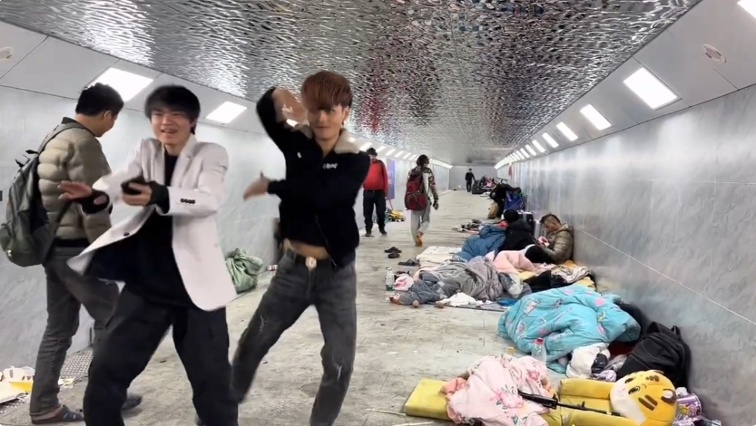
Underground tunnels have become the 'homes' for unemployed young people. (Video screenshot)
In response, many netizens have commented: 'With a monthly salary of three thousand, I remember my country’s grievances; with an annual salary of one million, I travel to the United States; wealth and nobility do not fall upon the common people; the battlefield is filled with the souls of the common folk. If there is a path to fame and fortune in the fields, why should the shepherd boy study hard? In this society, when the country is in trouble, every citizen has a responsibility; when the common people are in trouble, they take matters into their own hands.'
In today's world, there exists a significant divide between the wealthy and ordinary people. The lives of ordinary individuals are characterised by early mornings and late nights spent tightening screws, while also caring for both the elderly and children, all for a meagre salary. If you are wealthy, would you choose to befriend such individuals?
Those who find themselves at the very bottom of society lack the time and energy to learn, think, or plan for the future. Their available resources are extremely limited, and their social networks are narrow. They are already worn out from dealing with the harsh realities of life, making any discussion of social mobility seem utterly impossible.
Compounding this issue, platforms like Douyin, Kuaishou, Toutiao, and Xiaohongshu have emerged as addictive distractions, consuming the majority of people's leisure time and leaving them with even less opportunity to reflect on their lives, change their circumstances, or consider their futures.
Consequently, the current state of affairs is that most individuals are trapped within a specific social stratum, confined to a limited circle...
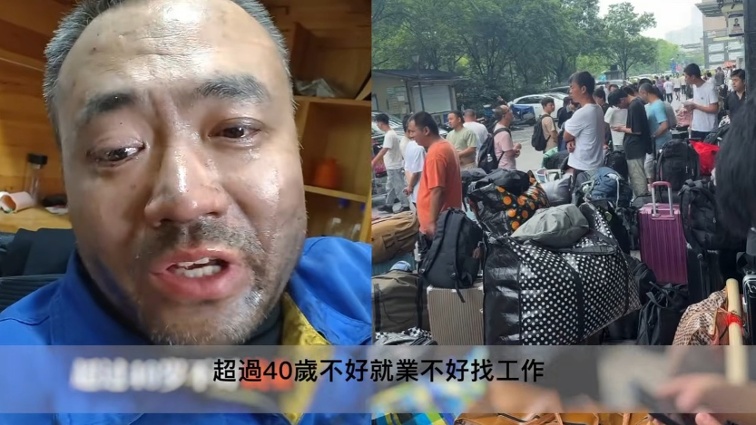
Many factories are hiring, but they do not consider applicants over the age of 35. (Video screenshot)
The vibrancy of youth has been dimmed.
In the online landscape of China, individuals under 40 still constitute the majority. In a normal society and a healthy era, the term 'youth' inherently shines with promise. Even when faced with adversity, they firmly believe that these challenges are temporary, as they are still young, filled with the boldness and passion of 'long live youth,' and confident in their ability to change their destinies through hard work. They possess the resilience to start anew even after making mistakes, which fuels their dreams for the future. Each of us, when we look back on our youthful days, no matter how inexperienced or challenging they were, can still draw energy from that fervent spirit of 'long live youth' to combat the passage of time.
However, the most heartbreaking aspect is that today's young people in China begin their 'youth memories' in a grey tone. Their self-descriptive terms such as 'cannon fodder, cattle and horses, leeks, human resources, consumables, the youth of four no's, the youth of ten no's, tail payment individuals, caretakers of four-legged gold-swallowing beasts, social scraps, and useless people...' illustrate a collective darkening of their perception of fate. They have come to realize that under the CCP system, they are no longer even considered living beings, but have been reduced to cold minerals and components.
When a young person realises that they cannot afford a house in a major city even after working tirelessly for a hundred years without eating or drinking, and that even dating, marriage, and having children have become luxuries, the significance of their struggle vanishes.
This is not merely the despair of individual young people; it represents a 'chronic haemorrhage' of a society that has entirely lost its creativity and hope for the future.
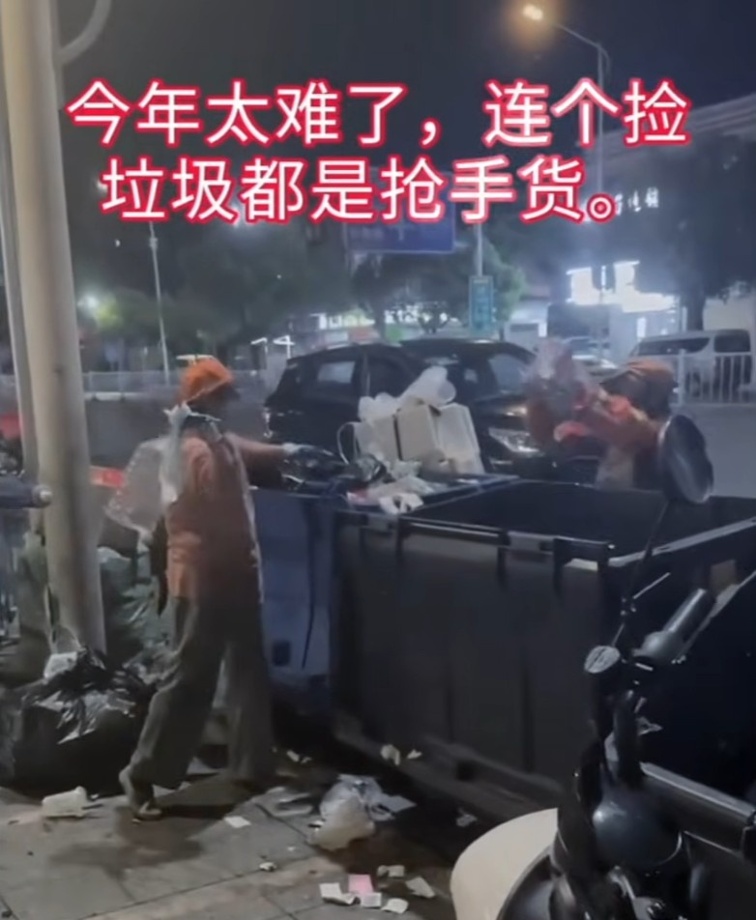
Life is incredibly challenging; this year, even scavenging through trash cans has turned into a competition. (Video screenshot)
When young people attempt to voice their opinions or express dissatisfaction, they encounter relentless scrutiny, account bans, and censorship online. Independent thought is often branded as 'destabilising' or linked to 'foreign forces,' and even the basic right to express pain is taken away. With no outlet for their frustrations, they are forced to suppress their feelings. This excessive repression and forced endurance can lead to explosive outbursts, manifesting in acts of 'loyalty' that retaliate against society.
In this context, as young people lose hope for the future, their 'vitality' fades, giving way to a 'twilight state.' This represents a rational self-protection mechanism—when the prospects ahead are bleak, rather than continue to expend their lives like mere labourers, it is wiser to adopt a defensive mindset of 'heart like dead ashes' in advance.
This is not a choice of weakness, but rather the most silent and resolute form of resistance they can muster when they feel powerless to change their circumstances. They make a statement to the system that seeks to exploit them with their 'four noes' stance: 'no marriage, no children, no home purchase, no struggle.' They declare, 'If you only see us as the labourers of a prosperous age, then our generation is the last fuel on this assembly line.'
When the belief that 'if you are willing to fight, you can change your fate' is extinguished, they calmly respond to the Chinese Communist authorities: 'This is our last generation, thank you!'
(First published by the People News)
△





News magazine bootstrap themes!
I like this themes, fast loading and look profesional
Thank you Carlos!
You're welcome!
Please support me with give positive rating!
Yes Sure!