

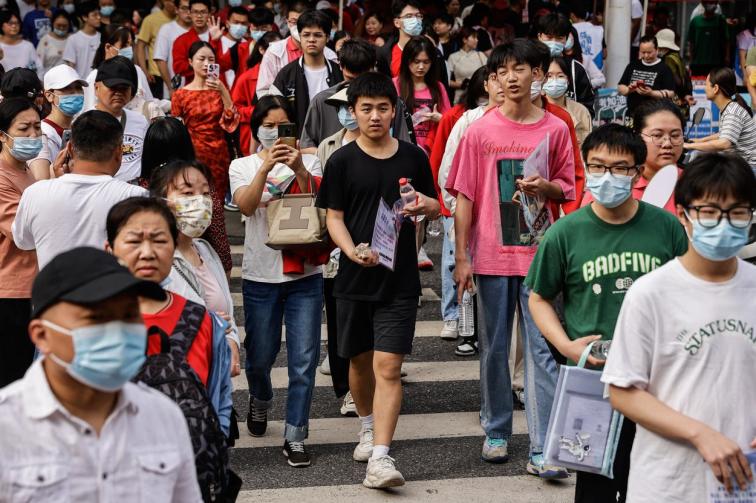
Parents outside the Gaokao venue in Shanghai. (Video screenshot)
[People News] The 2026 Chinese Gaokao is currently taking place, and discussions surrounding the exam questions have gone viral online. Many examinees are expressing their frustrations, claiming that the questions are "too difficult," making it the most talked-about topic on the Chinese internet in recent days.
In the past two days, the main topics of discussion and public sentiment among Chinese netizens have centred on three key aspects:
1. Essay Topic: Embracing "Grand Narratives" and "Technological Anxiety"
Each year, the Chinese essay topic in the Gaokao garners significant attention, and both netizens and education experts generally agree that this year's topic features more characteristics of "anti-routine" and abstract reasoning.
The National I and II papers primarily focus on the themes of "grandeur and difficulties." The National I paper poses the question "The Change in Understanding of the Same Word," which explores the evolution of the times and the imprint left on youth.
The National II paper references an ancient text: "The sun and moon do not lose their form, hence they are obscured and then bright again; the Yangtze and Han rivers do not lose their source, hence they are blocked and then flow again," prompting examinees to discuss how to navigate challenges and turbulent times in personal or civilizational development. This quote is from the Eastern Han scholar Ying Shao's work, "Customs and Usages: On Blockages and Flow." It conveys the idea that the sun and moon maintain their natural order, so even when obscured by clouds, they will eventually shine again; similarly, the Yangtze and Han rivers retain their sources, so despite encountering obstacles, they will ultimately reach the vast expanse. This statement illustrates the life philosophy of "responding to all changes with invariance."
Netizens widely interpret that this exam question serves as a strong indicator of policy direction, with the official design of the question being quite clear: the authorities are trying to suggest to students how to maintain confidence and 'strategic stability' amid the current challenges of economic recession, high unemployment, and difficult living conditions. What should they maintain confidence in? The Chinese Communist Party (CCP) is clearly relying on candidates to continue believing in its governance, indicating that the CCP has recognised that the economic difficulties have eroded public confidence and patience.
The exam question essentially acknowledges that the country and economy are currently in a 'headwind period,' facing challenges such as insufficient domestic demand and obstacles in foreign trade, which are akin to 'turbulent waves.' Since the onset of the COVID-19 pandemic, the economy has been in a continuous decline for several years, and the savings of the populace are nearly depleted, yet there are no signs of economic recovery. In this context, the authorities are urging society as a whole to 'not panic and trust the fundamentals' during this economic downturn.
The Shanghai exam and the Beijing exam (AI anxiety): The Shanghai exam directly addresses reality, requiring an exploration of 'how technology is transforming the world while also reshaping our imagination'; the Beijing exam's micro-writing also touches on 'artificial intelligence (AI) and a happy old age.' Netizens humorously self-deprecate, noting that students in the exam room are anxiously contemplating whether they will be replaced by AI while simultaneously writing with a fountain pen about their thoughts on AI. Some media outlets even used AI models like DeepSeek and ChatGPT to 'answer the same question' in a competition on the same day, drawing a large audience.
2. 'Breaking Free' Historical Exam Questions
History is defined as the record of events that have occurred in the past, without the addition of any associations or speculations; it is a subject where rote memorisation from textbooks can easily yield high scores. However, this year has brought a change.
As reported by the Yangcheng Evening News, on June 8, outside the Zhixin examination centre in Guangzhou, several candidates remarked that this year's history exam included a significant number of questions that extended beyond textbook knowledge, placing greater emphasis on students' comprehensive thinking skills.
In regions such as Henan, history exam questions presented candidates with a mind map filled with historical inaccuracies, asking them to 'identify at least four errors and provide suggestions for corrections along with their reasoning.'
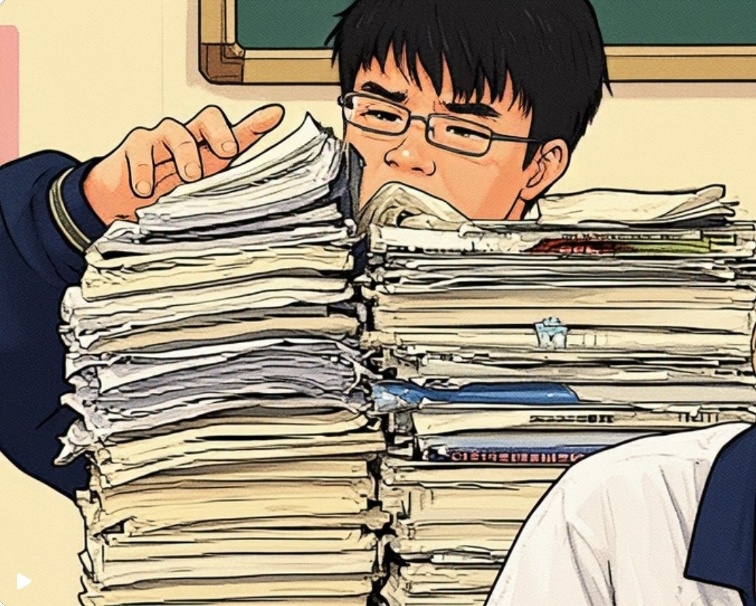
Many candidates expressed online that they felt 'blown away' (indicating they were overwhelmed by the questions and mentally affected), as the templates they had practised for three years proved to be of no use.
Netizens voiced their frustrations: 'I don’t even know what’s right or wrong myself, and you expect me to correct someone else’s mistakes?' Such questions compel candidates to analyse materials like history professors, leaving students who depend on rote memorisation at a complete loss.
Moreover, the inclusion of classical Chinese texts has increased: a substantial amount of classical Chinese material appeared in the history multiple-choice questions, requiring candidates to first engage in 'classical Chinese reading comprehension' before addressing the history exam, resulting in widespread lamentation in discussion forums.
3. The Pressure of Employment Prospects
Official data indicates that this year, 12.9 million college entrance examination candidates entered the exam halls with dreams in their hearts. Meanwhile, there are 12.7 million fresh graduates about to leave school, and public sentiment has been confused about their employment prospects for several months. However, the China New Employment Form Research Centre recently published the "2025 China Blue-Collar Employment Research Report," revealing shocking figures: the number of flexible workers is expected to reach 320 million this year.
These three sets of data together dismantle the last remnants of the illusion that "a diploma equates to a respectable middle class." This situation signifies not only the collapse of the diploma bubble but also a silent and profound crisis during China's macroeconomic structural transformation.
As a result, unlike previous years when discussions online revolved around "which majors are profitable, listening to Zhang Xuefeng for application advice," this year has seen a decline in optimistic discussions about specific major prospects. It seems that many have come to realise that regardless of the major chosen, graduation will be met with intense competition. There is a widespread sentiment of lamenting that "in an era where thousands of troops and horses cross a single-log bridge, even the bridge's value is diminishing."
Inside the exam halls, parents continue to hope for their children to achieve "top marks" under the blazing sun; however, outside the halls, the 320 million gig workers and the saturated ride-hailing market starkly illustrate the harsh reality. This significant divide between lofty expectations and the cold reality represents the most pressing and distressing structural challenge currently facing the Chinese economy. △



News magazine bootstrap themes!
I like this themes, fast loading and look profesional
Thank you Carlos!
You're welcome!
Please support me with give positive rating!
Yes Sure!