
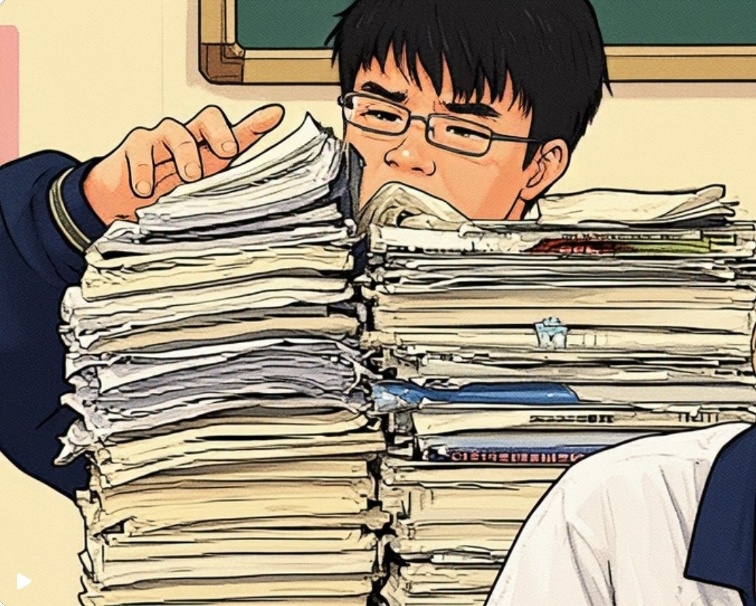
The rote learning education model keeps students under constant high pressure. (AI-generated image)
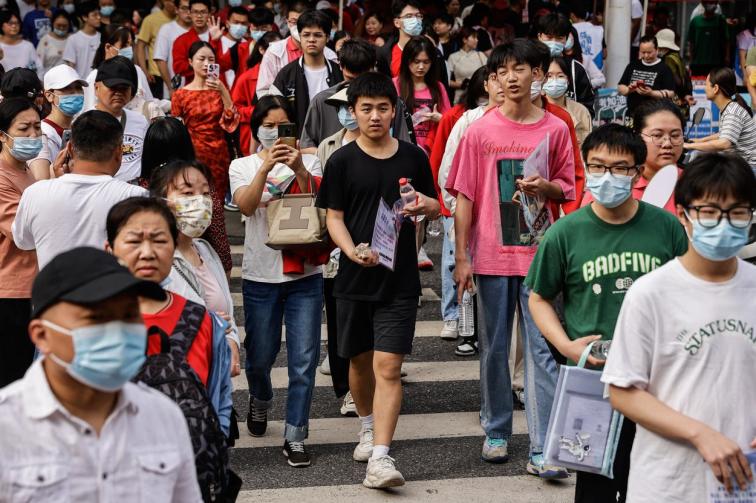
[People News] With only a few days remaining until the Chinese Gaokao, one of the trending topics among netizens is the "pre-exam oxygen inhalation craze." Many parents, observing their children showing signs of fatigue, insomnia, and memory decline before the exam, are taking them to hospitals for hyperbaric oxygen therapy. They hope that "supplementing oxygen" will enhance memory, concentration, and sleep quality, allowing their children to score a few more points in the final stretch.
Exhausted Gaokao Students
Recently, social media platforms in mainland China have been flooded with promotional posts about "pre-exam oxygen inhalation for revitalisation, hyperbaric oxygen as a brain power charger," quietly igniting a consumer trend.
According to reports from The Dajiyuan, numerous posts on China's short video platforms emphasise the benefits of oxygen inhalation: a single session can alleviate brain fatigue, improve attention span, and boost memory; continuous oxygen inhalation for several days before the exam can double review efficiency... These claims have led to hyperbaric oxygen being dubbed a "brain power charger."
A verified Weibo user, "Give Me a Steel Ring," pointed out that with less than a week to go before the 2026 Gaokao, the newly installed hyperbaric oxygen chamber at the People's Hospital of Yongfeng County in Ji'an, Jiangxi, has unexpectedly become a "popular check-in spot." Originally intended for patients, this equipment has served over 30 middle and high school students in just 10 days, charging 96 yuan for a single 90-minute session.
A report from 'Minsheng Weekly' highlights that during the final preparation phase for exams, many students have adopted a routine of staying up late to study, leading to mental stress, insomnia, and anxiety. In various regions, there has been a sharp increase in bookings for hyperbaric oxygen chambers at rehabilitation centres and private health institutions, primarily among senior high school students. Many training centres and wellness shops have capitalised on this trend by offering brain-boosting packages before exams, with prices for a single hyperbaric oxygen session ranging from hundreds to several hundred yuan.
At the hyperbaric oxygen treatment centre of the People's Hospital of Yongfeng County in Ji'an, Jiangxi, a parent named Wang shared that her child is facing significant academic pressure and has noticed a slight decline in memory. She brought him in to try the hyperbaric oxygen chamber, hoping it would enhance his memory and relieve some of his study stress.
A student named Xiao Yang reported feeling extremely fatigued lately and sometimes having trouble sleeping at night. He described the hyperbaric oxygen experience as very quiet and comfortable, and after the session, he felt completely relaxed. He hopes that this treatment will help him get a better night's sleep.
However, the medical community generally cautions that hyperbaric oxygen is not a 'magic solution' for improving exam scores. For healthy students, the key factors that truly influence exam performance are sleep, emotional stability, and consistent study habits.
Originally designed as medical equipment, hyperbaric oxygen chambers are primarily used for the clinical treatment of conditions such as carbon monoxide poisoning, brain injuries, and hypoxic brain disease, and are not intended for use as health devices for healthy individuals. The trend of healthy students flocking to use these oxygen chambers contradicts their original medical purpose.
Some doctors have pointed out that hyperbaric oxygen therapy is not a "cure-all for brain enhancement." For students who are energetic and sleep well, the best ways to relieve stress are to maintain a regular routine, breathe fresh air, and engage in appropriate exercise. Hyperbaric oxygen therapy should only be considered after a professional evaluation when children show clear signs of fatigue, dizziness, and difficulty concentrating due to excessive mental strain. Before undergoing treatment, patients must cooperate with doctors to complete several examinations, and in some cases, its use is strictly prohibited.
However, the question remains: Are the sleep problems, anxiety, and declining attention of many students really just due to lack of sleep and "hypoxia"?
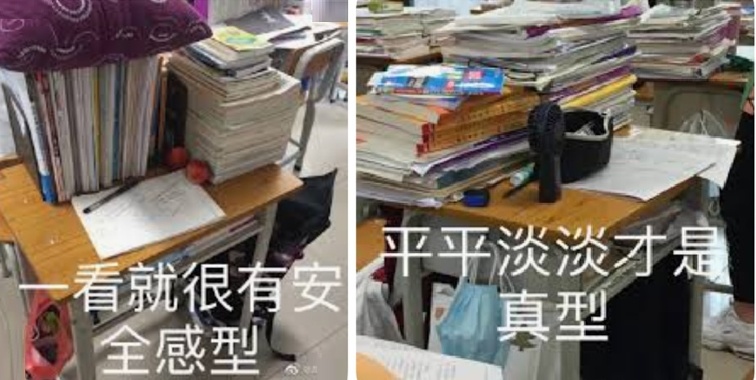
Chinese high school students' desks are cluttered with reference materials. (Image from the internet)
The high-pressure educational environment
For many Chinese students, the core issue may stem from the long-term high-pressure educational environment created by "cramming-style education."
For years, the education system under the Chinese Communist Party has faced criticism for its widespread use of "cramming-style education." From elementary school onward, students are subjected to intensive curricula, frequent testing, competitive rankings, and tutoring pressures. Particularly in middle and high school, students' daily lives are often overwhelmed with excessive homework, mock exams, and remedial classes.
Many students wake up early for school and stay up late doing homework, making chronic sleep deprivation a common experience. Some parents describe their children as being "trapped in an endless exam machine," with weekends and school breaks also consumed by tutoring and homework.
Psychology experts indicate that prolonged sleep deprivation and high-stress conditions have a direct impact on teenagers' concentration, memory, and emotional stability. When the body remains in a state of stress for an extended period, symptoms such as anxiety, insomnia, irritability, fatigue, and emotional fluctuations may increase, which can subsequently undermine learning effectiveness.
Many teachers and parents have observed a paradox: as students invest more time in their studies, their learning efficiency does not necessarily improve. Some students, exhausted, stay up late to complete their homework, appearing to be 'working hard,' but they may actually be trapped in a cycle of low efficiency—poor sleep, diminished mental state, difficulty retaining information, and fluctuating grades, which forces them to spend even more time on their studies.
Commentators suggest that when educational objectives overly emphasise exam scores, students' mental health and personal development often take a backseat. Consequently, anxiety becomes commonplace, rest is viewed as a luxury, and even adequate sleep is regarded as a 'waste of time.'
In recent years, although the Chinese Communist Party has publicly advocated for the 'Double Reduction Policy,' many students and parents report that the actual competitive pressure has not significantly diminished. Instead, the competition for higher education and employment has intensified, perpetuating educational anxiety.
Over 30 years ago, the phrase 'a thousand troops and ten thousand horses crowding a single-log bridge' was used to illustrate the immense pressure faced by students preparing for the college entrance examination. It seems that all children are being directed towards the same goal: achieving high scores, gaining admission to prestigious universities, competing for rankings, and securing good jobs after graduating from reputable institutions. However, in recent years, China's economy has been in a prolonged downturn, leading to a very low employment rate for university graduates, with even those holding PhDs and master's degrees resorting to jobs as delivery drivers. Confronted with this grim reality, students nationwide are feeling disheartened and confused; they have begun to understand that their hard work may not guarantee a secure future, which in turn breeds anxiety. This sense of anxiety and uncertainty about the future cannot simply be resolved by taking a deep breath.
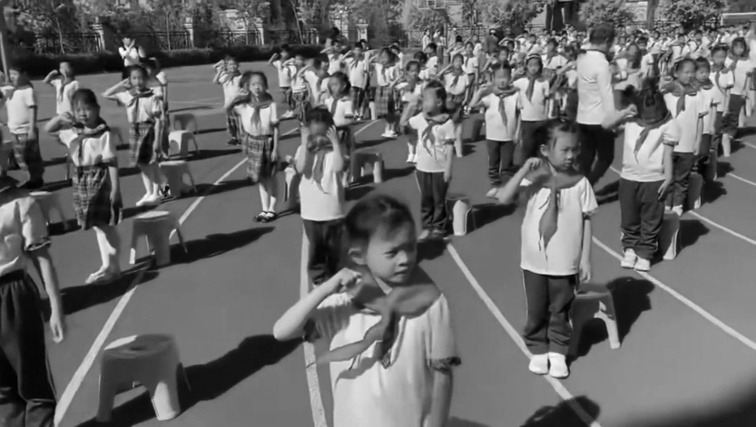
Elementary school students are taken by their teachers to pledge their lives to the Communist Party of China. (Video screenshot)
Brainwashing is not genuine education.
The education system of the Communist Party of China has been consistently criticised by the international community and independent scholars as a form of 'systematic brainwashing education.' Its primary aim is not to foster individual free will and creativity, but rather to uphold the absolute control of the Chinese Communist Party and ensure the stability of its regime. This system seeks to mould young people who lack traditional Chinese moral values, possess no independent judgment, are imbued with atheistic and evolutionary ideologies, and are obedient to the Communist Party, ready to 'contribute their lives' at any moment as compliant 'communist successors.' The 'cramming education' model is employed by the Communist Party to implement this brainwashing education for students.
The term 'fill-duck education' refers to an educational model that forcibly imparts a vast amount of knowledge and officially sanctioned concepts to students. In this system, exam answers must align with those prescribed by the authorities, leaving no room for deviation or personal expression. This method of teaching, which emphasises rote memorisation without comprehension, is a form of brainwashing. It not only severely suppresses students' independent thinking and creativity but also tends to induce psychological stress, anxiety, and a dislike for learning, ultimately leading to significant negative effects on both physical and mental health over time. This explains the immense pressure and anxiety felt by students preparing for the college entrance examination.
In his work 'On Education,' Xi Jinping highlighted that the education and talent development initiatives of the Communist Party of China (CPC) are fundamentally aimed at 'nurturing individuals for the Party and cultivating talent for the nation,' while also stressing the 'political nature' of education.
In March 2026, the Ministry of Education of the CPC released the 'Negative List for Basic Education Standard Management (2026 Edition),' which explicitly outlined 20 stringent prohibitions. The primary objective of this list is to enforce ideological control, strictly banning any actions or statements deemed 'anti-Party and anti-socialist,' as well as those that tarnish the Party's image or disparage its leaders.
The authorities mandate that schools must not encroach upon the time designated for 'ideological and political' courses, aiming to ensure that there is ample time for brainwashing and Party indoctrination after establishing ideological boundaries.
The Chinese Communist Party's "brainwashing education" represents a systematic political initiative that spans from kindergarten through to doctoral studies, encompassing a range of subjects including politics, history, and language. At its core, this education instils ideas such as "without the Communist Party, there is no New China" from an early age, while mandating the study of Xi Jinping Thought. This approach forcibly links love for the nation with love for the Party and its leader, leading students to confuse the Party with the country. They are misled into believing that "loving the Party" is synonymous with "loving the country," and that "opposing the Party" equates to "betraying the country." Furthermore, the education system promotes narrow nationalism, hate education, and a distorted historical perspective, excessively highlighting external invasions, threats, and historical animosities to incite hostile feelings among students, fostering a binary view of "friend or foe." Concepts like "independence" and "democracy" are treated as "viruses" or "poisons," resulting in students only trusting the Communist Party and losing their ability to make independent judgments or embrace diverse values. This ultimately reinforces their blind loyalty to the Party, transforming them into instruments for maintaining social stability.
Critics argue that the Communist Party's brainwashing education constitutes a form of "systematic ideological control," with its most insidious aspect being the prioritisation of political loyalty over scientific education, thereby producing individuals who willingly serve as cannon fodder for the Party.
Within the Communist Party's educational framework, students are compelled to wear the red scarf and are pressured to sing revolutionary songs from a young age, pledging to be "always ready" to sacrifice their lives for the Party's cause. This pledge acts as a curse, binding their personal destinies to the Communist Party, with their lives and deaths subject to the Party's control. Given this early indoctrination, how can Chinese students, who have been ensnared by this curse since childhood, ever experience genuine relaxation and joy in their hearts, bodies, and souls?
To free oneself from the toxic influence, the most effective approach is to declare a withdrawal from the Party, the Youth League, and the Young Pioneers. Announcing the 'Three Withdrawals' signifies the cancellation of these toxic influences, enabling individuals to liberate themselves from the constraints of totalitarian rule in their bodies, spirits, and thoughts, thus achieving genuine freedom. Only by escaping the tragic fate of becoming cannon fodder for the Chinese Communist Party can one gain the confidence and ability to shape their own future and take control of their own destiny.
(Originally published by the People News)
△





News magazine bootstrap themes!
I like this themes, fast loading and look profesional
Thank you Carlos!
You're welcome!
Please support me with give positive rating!
Yes Sure!