

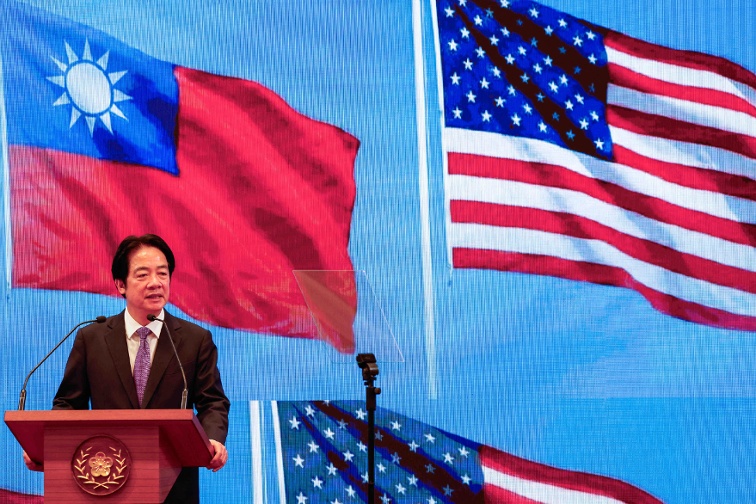
On September 19, 2025, during a phone call between Trump and Xi, Trump came away with a double win, while the CCP’s wolf warrior diplomacy was left deflated. (Image by People News)
[People News] On May 11, the same day that Trump’s visit to China was officially announced, the Chinese Ministry of Foreign Affairs unexpectedly launched a bilingual short video titled "Peaceful Coexistence." The video repeatedly stresses that "China and the U.S. cannot change each other, but can change the way they interact" and that "the Earth is too small to accommodate the turmoil and confrontation between China and the U.S." It presents a unilateral standard answer for "peaceful coexistence" in a self-questioning format. This urgent and conciliatory propaganda move marks a rare instance of the Chinese Communist Party's diplomacy showing a softer approach. Almost simultaneously, He Lifeng, a member of the Political Bureau of the Central Committee and Vice Premier of the State Council, led a delegation to South Korea for the final round of economic and trade consultations ahead of the summit with U.S. Treasury Secretary Janet Yellen. These two developments resonate with each other, clearly highlighting Beijing's passivity and anxiety in the new round of competition with the U.S.
The Ministry of Foreign Affairs' rapid transformation from wolf warrior to conciliatory
The timing of the short video "Peaceful Coexistence" released by the Ministry of Foreign Affairs is particularly significant. On the morning of May 11, it was announced that Trump would visit China from the 13th to the 15th, and by the afternoon, the video was online. The content reflects on historical events such as Nixon's visit to China and ping-pong diplomacy, emphasising that the "two largest economies" should "treat each other with sincerity and interact with trust," deliberately elevating the theme of peace, which strongly suggests a white flag of submission.
In recent years, the assertive 'wolf warrior' diplomacy of the Chinese Communist Party (CCP) has taken the world by surprise. Terms like 'the East rises while the West declines', 'a great change unseen in a century', 'a community with a shared future for mankind', and 'we will accompany you to the end' have become common phrases among CCP diplomats, who often accuse the United States of 'hegemonism' and 'Cold War mentality'. However, as Donald Trump prepares to visit Beijing, the CCP has suddenly begun to advocate for peaceful coexistence, stressing that 'the Earth cannot accommodate confrontation'. This dramatic shift reveals the CCP's facade of strength while hiding its internal weaknesses.
The CCP is currently grappling with multiple crises. Firstly, Xi Jinping faces a significant power crisis, with unrest within the CCP's military ranks. Recently, defence ministers Li Shangfu and Wei Fenghe were given death sentences with a reprieve. While this serves as a deterrent, the situation surrounding Zhang Youxia remains unresolved. Xi Jinping had previously leaked information about the CCP's nuclear capabilities to the United States via the Wall Street Journal, hoping to achieve two objectives: to undermine the U.S. and to solidify accusations against Zhang Youxia for foreign collusion. However, military leaders across various regions have not accepted this narrative. Consequently, the CCP is left with no choice but to hold Zhang Youxia accountable for corruption, temporarily lowering its anti-U.S. rhetoric, which adds a touch of irony to the upcoming Xi-Trump meeting.
Secondly, the CCP's economic situation is dire. The domestic real estate market remains depressed, consumer spending is weak, youth unemployment is a growing concern, and local debts are soaring. The 5% GDP growth rate in the first quarter has become a source of ridicule.
Thirdly, on the international front, the CCP faces a multi-faceted encirclement from the European Union, India, and Southeast Asia. The U.S. continues to tighten high-tech export controls, and efforts to de-risk supply chains are accelerating. Additionally, the U.S.-Iran conflict has introduced further uncertainties into energy import channels.
In this context, stabilising Sino-U.S. relations has become a crucial lifeline for the Xi Jinping administration, allowing it to showcase political stability and sustain economic growth. The Chinese Ministry of Foreign Affairs has carefully considered Xi Jinping's intentions, quickly producing short videos with conciliatory messages in an effort to soften Trump's negotiating position. At the same time, they are packaging this as a diplomatic victory for domestic audiences to uphold the regime's legitimacy.
He Lifeng, a close ally of Xi Jinping, made an urgent trip to South Korea, adopting a low-profile approach to seek peace ahead of the summit.
From May 12 to 13, He Lifeng held economic and trade consultations with U.S. Treasury Secretary Steven Mnuchin in South Korea. The choice of location is noteworthy—why not hold the talks in Beijing or Washington, but instead in a third country, South Korea? The urgency, coming right before Trump's visit to China, points to the anxiety within the Chinese Communist Party and the existing differences between China and the U.S. Previous rounds of consultations had not yielded satisfactory results for Xi Jinping, prompting hopes to secure as many technical concessions from the U.S. as possible before the leaders' meeting, thereby avoiding Xi facing difficult issues directly and risking embarrassment during the summit.
As Xi Jinping's economic confidant, He Lifeng has frequently led Sino-U.S. economic and trade engagements. This trip to South Korea focused on key issues such as tariff stability, procurement of agricultural products and energy, rare earth exports, high-tech regulations, and fentanyl management. The U.S. side seized this opportunity to strengthen the U.S.-Japan-South Korea alliance, first meeting with Japanese Prime Minister Suga Yoshihide in Tokyo before moving on to discussions with China in Seoul. This strategy serves as a form of pressure on Beijing, reinforcing alliances and establishing a containment strategy right at the doorstep of the Chinese Communist Party, highlighting an imbalance in power dynamics and strategic positioning.
The Chinese Communist Party (CCP) appears to be keen to convey through He Lifeng its intention to procure large orders of American soybeans, Boeing aeroplanes, and other goods, in return for tariff reductions and the easing of sanctions. Following Trump's first visit to China in 2017, the US-China trade war erupted in the subsequent year, during which the CCP proposed a first-phase agreement, trading short-term purchases for temporary relief. However, in practice, Beijing has been known to employ delaying tactics. This time, the US is likely to be more sceptical of the CCP's intentions. The Bessenet team is expected to remain firm on the CCP's demands for structural economic reforms, including supply chain security, intellectual property rights, and market access.
US Sanctions, Iranian Factors, and Concessions from Beijing
On the eve of the summit, the US imposed sanctions on several Chinese entities linked to Iran, including companies that provide satellite imagery support for Iranian activities and Hong Kong and UAE entities involved in transporting Iranian oil to China. This serves as a direct punishment for the CCP's covert support of Iran and adds leverage to the upcoming Trump-Xi meeting.
The CCP finds itself in a difficult position regarding Iran; it must balance the need to maintain energy imports from the Middle East and its geopolitical influence while avoiding a complete fallout with the US. The Trump administration is urging China to reduce its oil purchases from Iran and to apply pressure on Tehran to facilitate a ceasefire in the region. This reflects another layer of the CCP's strategic motive behind its recent video calling for peace, as it seeks to portray itself as a 'responsible major power' while making soft concessions in negotiations to gain US leniency on issues related to Taiwan and tariffs.
However, the U.S. is unlikely to make concessions easily. The sanctions imposed on three Chinese satellite companies and other measures indicate that Washington is ready to negotiate while continuing its confrontations. If the Chinese Communist Party (CCP) engages in significant purchases of U.S. energy, agricultural products, and Boeing aircraft, it would effectively be paying tribute to Trump, which could be interpreted by the international community as a sign of capitulation.
The Taiwan issue: The CCP may be miscalculating.
Taiwan remains a contentious topic that cannot be overlooked in the Trump-Xi (Xi Jinping) meetings. The Chinese side hopes that the U.S. will reduce arms sales and limit support for Taiwan independence; however, Trump may take a flexible approach regarding Taiwan, discussing one thing while acting differently. While negotiations may allow for some leniency, Trump is unlikely to compromise on Taiwan's strategic significance to the U.S., which would undermine the CCP's ability to stir up anti-American sentiment concerning Taiwan.
Amid economic downturn pressures, the CCP is even less inclined to see an escalation of conflict in the Taiwan Strait, as this would completely undermine foreign investment confidence and economic growth. However, if substantial concessions are made at the summit, such as tacitly permitting continued U.S. arms sales, it could provoke a nationalist backlash domestically, leading to a dual dilemma of external strategy and internal governance. This dilemma represents the structural vulnerability behind the CCP's apparent softening.
Tariffs remain a looming threat.
While the U.S.-China tariff truce may be extended, it is likely to be a temporary ceasefire. The core issue lies in the CCP's illegal practices, including technology theft, intellectual property violations, market rule breaches, and state subsidies, which pose a national security threat to the U.S. and infringe upon free trade. The U.S. has identified China as a systemic strategic competitor, and whether under Biden or Trump, the anti-communist stance has become firmly entrenched.
If He Lifeng's negotiation outcomes are confined to procurement commitments without any substantial market openings or reforms of state-owned enterprises, it will be challenging to alter the U.S. approach of technology decoupling and economic sanctions.
China is facing an intensifying economic crisis in real estate, an ageing population, local government debts, and innovation bottlenecks, which makes it hard for domestic circulation to sustain the overall economy, as it still heavily depends on external markets, technology, and capital. The CCP's softening stance is deeply rooted in the pragmatic need to seek political legitimacy through economic means. In the short term, the upcoming Xi-Trump meeting may yield several agreements, leading to a temporary boost in market sentiment. However, in the long run, the irreconcilable confrontation between the U.S. and China is an unavoidable trend.
As the Xi-Trump meeting draws near, the CCP's Ministry of Foreign Affairs has attempted to soften its stance through a short video, and He Lifeng's urgent trip to South Korea for preliminary discussions reflects a passive compromise under the political and economic pressures facing the CCP. Trump will arrive in Beijing with an 'America First' agenda, and if the CCP continues to approach structural competition with a zero-sum mentality, it will ultimately harm itself. Following the Xi-Trump meeting, U.S.-China relations may see a brief period of stability, but the trajectory of the CCP's decline is increasingly difficult to reverse.
(First published by the People News) △








News magazine bootstrap themes!
I like this themes, fast loading and look profesional
Thank you Carlos!
You're welcome!
Please support me with give positive rating!
Yes Sure!