
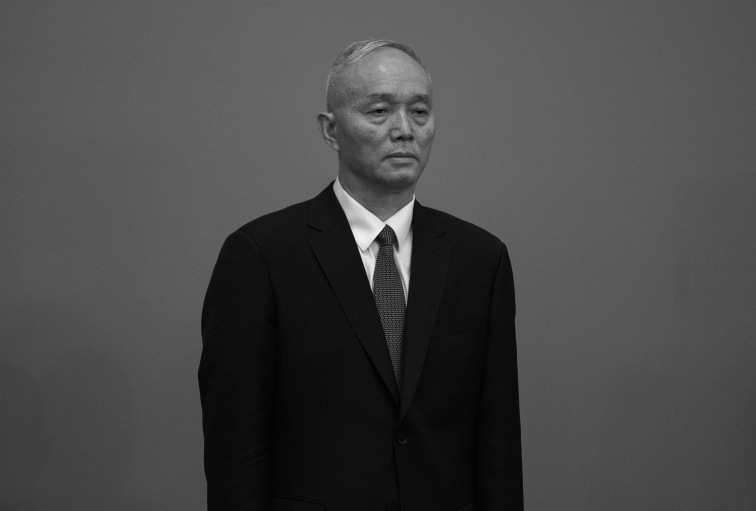
File photo: On October 23, 2022, Politburo Standing Committee member Cai Qi attends a press conference at the Great Hall of the People with other newly appointed Standing Committee members and both domestic and international journalists. (Photo by Kevin Frayer/Getty Images)
[People News] A recent article by The Economist indicates that while Cai Qi is nominally ranked fifth among the seven members of the Standing Committee, he has effectively risen to second place. This is due to his role overseeing the General Office, where he is responsible for dispatching the Central Guard Bureau to ensure Xi Jinping's personal safety. Additionally, Cai Qi serves as the Secretary of the Central Secretariat, tasked with implementing leadership decisions and managing the Party's daily operations. He has also taken on the role of China's internet surveillance czar and has even extended his influence to the military. His extensive sphere of power has made him a potentially dangerous figure within Zhongnanhai.
This assessment aligns with rumours circulating abroad regarding Cai Qi's discord with Xi Jinping, creating political ripples ahead of the Fifth Plenary Session of the Communist Party.
With just over a year remaining until the 21st National Congress of the Communist Party, the atmosphere within Beijing's power centre has subtly shifted. The 20th Congress established a structure where one leader holds supreme authority while many others pay homage. Will the political logic of prioritising the political security of the highest leader over national governance continue to be reinforced at the 21st Congress? This certainly leaves ample room for speculation from the international community.
Cai Qi's power significantly surpasses that of Wang Dongxing, akin to Khrushchev sleeping next to Xi Jinping?
The Economist noted in its report, 'Cai Qi may be the second most powerful figure in China. As a trusted aide to Xi Jinping, he has access to nearly all policy areas and holds many secrets of the Communist Party, whether viewed through the lens of his actual functions or seating arrangements.'
The article highlights that Cai Qi's extensive responsibilities are exceptionally rare in the history of the Communist Party. It cites former Central Intelligence Agency analyst Jonathan Qin, who stated, "When people ask me who would succeed Xi Jinping if he were to suddenly pass away without a succession plan, Cai Qi seems to be the most obvious choice." He added, "The second-in-command is always the most likely to challenge the highest leader."
Furthermore, the article notes that Cai Qi's role in diplomacy appears to be more active than that of any previous director of the Central Office. Besides sitting next to Xi Jinping during meetings with foreign leaders, Cai Qi also holds individual meetings with foreign visitors, including leaders from India, Egypt, and Turkey.
The author points out that Cai Qi's political influence and active engagement have attracted considerable attention from U.S. officials and many other foreign governments. During Trump's second term, he specifically sought a meeting with Cai Qi, which ultimately did not happen. Senior British security officials have hinted that Cai Qi may have been involved in a suspected espionage case.
Historically, only Wang Dongxing has held both the positions of Standing Committee member and director of the Central Office. Wang Dongxing ultimately betrayed Mao Zedong and became a key figure in the arrest of Jiang Qing. Cai Qi's power significantly surpasses that of Wang Dongxing, and whether he can maintain Xi Jinping's trust over the long term is a politically sensitive issue that warrants attention from the outside world. Based on historical patterns and the brutal nature of internal struggles within the CCP, conflicts and contradictions between Cai Qi and Xi Jinping are inevitable; it is simply a matter of time before they emerge.
Xi Jinping's criteria for the red lines between political adversaries and trusted allies are often highly uncertain. While it is evident that excessive power constitutes one such line, the exact threshold for crossing it remains unknown. This uncertainty represents the greatest risk for Cai Qi in his current position.
On March 26, reports surfaced online that Xia Linmao, the Executive Vice Mayor of Beijing, had been taken away for questioning, although it was later said that he returned safely. Xia Linmao is regarded as a capable official and a close confidant of Cai Qi. This incident seems to convey an unspeakably sensitive message to the outside world. Whether it indicates Xi Jinping's tentative probing of Cai Qi or a miscalculation by the Discipline Inspection Commission remains unclear to outsiders.
On April 30, Xi Jinping made an unexpected visit to Shanghai, accompanied by Cai Qi, Ding Xuexiang, and Shi Taifeng. That morning, Xi attended a symposium on strengthening basic research in Shanghai and delivered a speech. Cai Qi and several high-ranking officials seated on stage, along with local officials in the audience, were all focused on taking notes, not daring to look up. Cai Qi adopted a subservient posture, appearing loyal with his tail between his legs. Can this demeanour serve as a guarantee of his power? A glance at Wang Qishan's fate provides insight. During Xi Jinping's first term, the Xi-Wang system dominated the political landscape, but Xi dismantled the very support that had helped him, turning around to deal with Wang Qishan, leaving him in disgrace. Although Cai Qi has closely followed Xi Jinping like a subordinate and lacks the pedigree of the red second generation, he does not pose a threat to Xi Jinping in terms of his background. However, the party affairs operations, ideological dissemination, and core coordination powers that Cai Qi currently wields far exceed the typical responsibilities of standing committee members, potentially posing a threat to Xi Jinping.
Cai Qi began his career in Fujian and Zhejiang, where he developed a long-standing close relationship with the top leadership. After joining the Standing Committee, he assumed a crucial role in party affairs, influencing the political vetting of cadres, the flow of information, and loyalty assessments. In a highly centralised system, a close aide wielding such extensive covert power inherently poses a risk. Should Xi Jinping grow wary of Cai Qi's considerable influence, he could find himself in a precarious position. By the time of the 21st National Congress, Cai Qi's age would no longer be an advantage, and his sensitive role in party affairs means that if he is evaluated as 'loyalty and risk coexist,' his political future could take a dramatic turn for the worse.
In contrast to Wang Dongxing during the Mao Zedong era, the nature of Cai Qi's power has fundamentally changed. Wang primarily relied on central security systems, such as the Central Guard, to exert influence at specific historical moments. In contrast, Cai Qi achieves extensive infiltration through daily party networks, encompassing organisational personnel, high-level stability maintenance, ideological control, and even the management of political elders across various domains. This structural influence significantly elevates his risk level compared to historical precedents. The Economist suggests that in today's environment, which lacks effective checks and balances, roles similar to those of close aides are more likely to become unstable variables within the power dynamics.
There are rumours that Zhang Youxia is intensifying fractures within the power structure.
On April 30, the 22nd meeting of the Standing Committee of the National People's Congress concluded, confirming that the qualifications of Zhang Youxia and Liu Zhenli as members remain legally valid. Reports circulating online suggest that among the seven members of the Standing Committee, there are three differing opinions on how to address the situation with Zhang Youxia. This indicates that Xi Jinping's attempts to enforce a crackdown within the military have become a contentious issue. Military power, which should serve as the ultimate safeguard for the Communist Party of China (CPC), has proven difficult to control, remaining outside of Xi Jinping's direct influence. As a result, he has refrained from leaving Beijing for four consecutive months, fearing potential sabotage.
This power struggle has directly impacted the Standing Committee of the CPC. Signs of factional divisions among members are emerging, with some advocating for a hardline purge, others calling for a cautious transition, and some possibly looking to leverage the situation to expand their influence. These underlying disagreements indicate a weakening of the cohesion within Xi Jinping's power base. Cai Qi, as a pivotal figure in party affairs, is inevitably involved in this dynamic. He may need to coordinate assessments of military and political personnel, filter relevant information, and navigate the power struggles within the Standing Committee. This delicate balancing act could pose additional political risks; mismanagement could lead to accountability, while excessive manoeuvring might be perceived as a threat.
Observations from the 21st National Congress: Is Xi Jinping's personal power nearing its end or becoming more entrenched?
The 21st National Congress was expected to consolidate power, but current signals suggest that the future is fraught with uncertainties. If issues involving Zhang Youxia and others are not adequately addressed, the internal tensions within the Standing Committee and the military's opposition could escalate, impacting the overall personnel structure and political trajectory. Cai Qi's role is particularly pivotal; will he align closely with Xi Jinping and the court officials to the bitter end, or will he adopt a neutral stance or even switch sides? The article in The Economist carries significant implications, seemingly signalling a particular faction; in other words, the power struggles within Zhongnanhai have already spilt over, and leveraging foreign media to exert influence is a traditional tactic in Beijing's political strategy.
Xi Jinping's power model is currently facing serious challenges. When the military becomes a source of power struggles, when close aide Cai Qi is perceived as a threat, and when hidden factions start to emerge within the Standing Committee, the political stability of Zhongnanhai shows signs of cracking. In the asymmetrical power landscape of Zhongnanhai, Cai Qi's rise to prominence has become a critical point of observation.
(First published by People News)△






News magazine bootstrap themes!
I like this themes, fast loading and look profesional
Thank you Carlos!
You're welcome!
Please support me with give positive rating!
Yes Sure!