
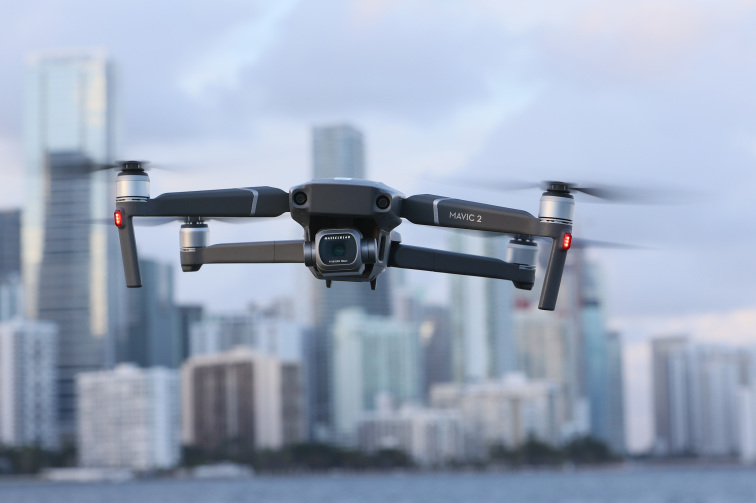
The U.S. government has suspended the import of certain DJI drones. Pictured is a DJI Mavic 2 Pro, manufactured by the Chinese drone maker, hovering in Miami, Florida, on December 15, 2021. (Joe Raedle/Getty Images)
[People News] On May 1, 2026, Beijing implemented the strictest drone policy in its history, resulting in a complete ban on drones in the capital.
The "Beijing Regulations on the Management of Unmanned Aerial Vehicles" took effect on May 1, designating the entire administrative area of Beijing as a controlled airspace, thereby prohibiting all outdoor drone flight activities. Additionally, the sale and rental of drones and their core components to the Beijing area is entirely banned, and the transportation and carrying of unregistered drones and components into Beijing is also prohibited. Existing equipment must be registered under real names and verified within a specified timeframe, or it will face strict restrictions. Stores of brands such as DJI in Beijing have begun removing products from their shelves, and e-commerce platforms are no longer accepting orders destined for Beijing.
The rationale behind this extreme policy reveals the core conflict within the current governance model of the Communist Party of China. As the top decision-maker, Xi Jinping's security concerns systematically establish political red lines and sensitive areas for economic development, making his presence the most significant obstacle to China's economic progress. This preventive governance approach, which operates on the principle of "better to mistakenly kill a thousand than let one escape," is accelerating the steep decline of the Chinese economy.
In the context of fears of decapitation, the technological zeroing has rendered drones, Hikvision, and Tesla as technological taboos.
The immediate impetus for Beijing's drone ban is closely tied to Xi Jinping's security anxiety regarding the risk of decapitation. The U.S. cases of decapitating leaders in Venezuela and Iran have left Xi restless at night, further exacerbated by intense political power struggles within Zhongnanhai, where internal dissent and external threats loom, resulting in a surge in Xi Jinping's security anxiety.
Consumer-grade drones are user-friendly and portable, and they are perceived as potential low, slow, and small threats in politically sensitive areas. This anxiety quickly escalated into global regulations and bans, forcing ordinary enthusiasts, aerial photographers, low-altitude logistics companies, and the entire industry to bear the consequences. The domestic drone leader, DJI (Dàjiāng), faced a severe setback in the Beijing market, which undoubtedly dealt a significant blow to the company, directly affecting its reputation and marketing environment. The Chinese Communist Party (CCP) is actively promoting the low-altitude economy, with official forecasts estimating a market size of 1.5 trillion yuan by 2025 and over 3.5 trillion yuan by 2035. However, the recent drone clearance initiative in Beijing has clearly delivered a harsh blow to the low-altitude economy. Xi Jinping has placed security above all else, completely overshadowing economic development, and this inherent contradiction has largely defined the economic governance style of the Xi Jinping era.
This fear has also spread into the surveillance sector. The Hikvision surveillance system sold by the CCP to Iran was found to have potential vulnerabilities, resulting in the collective downfall of high-ranking officials in the Mullah regime at the hands of the US and Israel. Reports circulated online that over 300 individuals, including senior executives and technical staff from Hikvision's headquarters and R&D departments in Xi'an, Shanghai, and Zhejiang, were taken away for investigation on Xi Jinping's orders. Although the official narrative has attempted to dispel these rumours, the incident has already caused significant disruptions within the CCP's security industry chain. Once a cornerstone of digital stability, the surveillance giant now faces political scrutiny, which is deeply ironic and illustrates the cyclical nature of fate, leaving one to ponder who will be spared by the heavens.
The electric vehicle industry has also seen extreme cases. During inspections by Xi Jinping, there have been several instances where Tesla vehicles faced strict restrictions. For example, during Xi's visit to Chengdu, Sichuan, in 2022, Tesla was instructed not to enter certain urban areas. Similar restrictions have been observed in locations like Beidaihe. Military facilities and government agencies had previously banned Tesla from entering, citing concerns that the vehicle's cameras and data uploads could lead to security leaks. Despite Tesla's establishment of factories in China, its contribution to employment, and its role in promoting new energy vehicles, it remains under tight control due to concerns over the leader's security.
Technology is inherently a double-edged sword; it can drive economic growth while also posing political security risks. This challenge is faced by countries worldwide, and the solutions extend beyond mere technological independence and rapid innovation. More crucially, they require an inclusive and open political system, improvements in the legal framework, and adherence to the values of freedom and democracy. The integration of institutional civilisation and cultural prosperity serves as the fundamental guarantee for national stability and public safety. In contrast, Xi Jinping and the Communist Party of China are pursuing a path of totalitarianism, relying on violence, deception, and fear to maintain their rule and diplomatic relations, which will ultimately lead to their own downfall.
Under the pretext of national security, there has been a blockade of information, criminalisation of VPNs, and an expansion of crackdowns on circumvention tools.
In recent years, the Communist Party of China has broadened its crackdown on VPNs from providers to ordinary users. National security agencies have frequently reported cases where individuals with access to sensitive information were held accountable for visiting foreign websites or mistakenly installing software. Ordinary internet users who circumvented restrictions to access foreign platforms have faced investigations and fines. This indiscriminate assault on the flow of information has created a pervasive chilling effect.
Researchers are unable to access cutting-edge international knowledge in a timely manner, making it difficult for entrepreneurs to keep up with global market dynamics, which has led to a significant rise in the cost of information related to innovation. Since the reform and opening up, one of the key drivers of China's economic growth has been the technological spillover resulting from limited information openness. However, the current North Korea-style trend of internal networking has severed this vital economic support channel. Much like the comprehensive drone regulation in Beijing, this approach does not represent precise governance; instead, it relies on instilling fear to maintain control, prioritising regime security over economic development.
In a similar vein, since Xi Jinping took office, the management of the economy by national security and public security has emerged as a significant feature of the new era, creating a unique economic suppression strategy for the Communist Party. Issues such as the movement of 500,000 people, a nationwide crackdown on spies, and the 'lying flat' phenomenon in response to foreign forces have not only become popular memes on the internet but have also discouraged billions in foreign investment, resulting in a frantic capital exodus. The actual use of foreign capital is projected to continue its downward trend in 2025, with the withdrawal or hesitation of foreign investors further undermining technological spillover and job absorption capacity.
The isolationism driven by the party's preservation mentality and the suppression of private enterprises has led to systematic destruction in the real estate and internet sectors.
Xi Jinping has stressed that 'the Party leads everything,' asserting that the economy must serve the goals of stability and power consolidation. This has manifested in the systematic suppression of private enterprises, leading to a series of ineffective policies. The real estate sector serves as a prime example. The policies of 'housing is for living, not for speculation' and the 'three red lines' are ostensibly aimed at risk control, but their implementation through a movement-style, one-size-fits-all approach reveals the true essence and original intent behind these measures.
In 2025, real estate development investment is expected to see a significant decline, with some months experiencing drops of over 17%, leading to a persistently sluggish year overall. The total sales of commercial housing are projected to fall to approximately 8.4 trillion yuan, which is less than half of the peak figure of 18.2 trillion yuan recorded in 2021. New home prices across the country have been declining year-on-year for more than thirty consecutive months. In March 2026, the new home prices in 70 large and medium-sized cities dropped by 3.4% year-on-year, marking the largest decline in nearly ten months. The unsold inventory remains high, with the area of commercial properties for sale reaching 766 million square meters, including a residential inventory of 402 million square meters, resulting in a prolonged de-stocking cycle. From January to February 2026, real estate development investment decreased by 11.1% year-on-year, while the sales area of new homes fell by 13.5%.
Real estate has historically accounted for about 70% of Chinese household wealth and nearly one-third of economic demand. Its ongoing sluggishness is directly dragging down consumption, employment, and local finances, leading to asset shrinkage for millions of families. Consumer confidence has remained low for an extended period, becoming the largest structural obstacle to domestic demand.
The internet economy has also been severely affected. The 'double reduction' policy has nearly decimated the education and training industry, resulting in millions of workers losing their jobs overnight. The platform economy is facing multiple rounds of regulatory scrutiny regarding antitrust issues and data security, leading to a significant evaporation of market value for major companies and widespread layoffs.
Private enterprises contribute over 60% of GDP, nearly 70% of tax revenue, and over 80% of urban employment. However, they are facing takeover by party organisations and political intervention due to labels such as 'disorderly capital expansion.' The retreat of state-owned enterprises at the expense of private ones has become a clarion call of the times. Entrepreneurs are either imprisoned or exploited, market confidence is undermined, and investment willingness is low.
In the nationwide leap forward under competition with the U.S., the chip, AI, and new energy vehicle industries are experiencing significant imbalances.
To address external pressures, the Xi Jinping administration has initiated multiple rounds of a nationwide leap forward. Substantial investments have been made in the chip industry, supported by the National Big Fund for key enterprises. However, both the self-sufficiency and yield rates remain low, advanced processes are significantly behind, and core equipment continues to depend on imports, intensifying the chokehold effect from sanctions.
The AI sector is excessively promoted, still relying on technology theft and public relations strategies. Consequently, the foundational ecosystem is limited by external constraints. While nationwide investments generate short-term enthusiasm, they struggle to fully replace open innovation. New energy vehicles have emerged as a source of pride for the Communist Party in recent years, with companies like BYD leading in production and sales while actively expanding internationally. However, the nationwide subsidies and capacity expansions have triggered international backlash, with the U.S. planning to raise tariffs on Chinese electric vehicles to 100%, and the EU has also launched anti-subsidy investigations and imposed tariffs. The West accuses the Communist Party of overcapacity and unfair competition. Domestically, there is an oversupply in low-end production and intense price wars, leading to extreme internal competition. The common flaw in these leap-forward initiatives is the forced construction of models through administrative orders and financial resources, suppressing the market and avoiding technological accumulation.
The political security anxiety stemming from great power competition has entrenched the weaknesses of the Communist Party's nationwide system.
The systemic consequences of Xi Jinping's economic regression
From the zero-COVID policy in Beijing drones to rumours of censorship at Hikvision, Tesla's avoidance of scrutiny, crackdowns on VPNs, suppression of private enterprises, the collapse of the real estate market, severe impacts on the internet sector, declining foreign investment, and the stalled leap forward in chips and new energy, a series of policies have created a negative feedback loop. Security concerns have led to preemptive zero-COVID measures and controls, further politicising economic activities and resulting in a dual blow to innovation vitality and market confidence, ultimately causing a decline in growth momentum.
Official data indicate that China's GDP growth is projected to be 5.0% in 2025; however, independent estimates suggest that the actual growth will only range between 2.5% and 3.0%, significantly lower than the official figures, with both investment and domestic demand showing signs of weakness. The national GDP growth target for 2026 has been set at 4.5% to 5%, marking one of the lowest levels in decades. International organisations, including the IMF, forecast that growth in 2026 will be just 4.4%. In March 2026, the urban survey unemployment rate increased to 5.4%; the youth unemployment rate (ages 16-24, excluding students) rose to 16.9%, up 0.8 percentage points from February, with some months nearing or exceeding 17%-20%, which is considerably higher than the overall urban survey unemployment rate. The average urban survey unemployment rate for the entire year of 2025 is expected to be 5.2%.
Xi Jinping is seen as the greatest hidden threat to China's economy. The drone zeroing incident in Beijing is not an isolated event; rather, it reflects a broader trend of security anxiety infiltrating society and various industries. Under the political logic that prioritises 'absolute safety for one individual' and 'a controllable regime', the aspirations of ordinary citizens have been stifled, and the future for everyone appears bleak. As the saying goes, 'if one person does not survive, many cannot escape'.
(First published by People News)△



News magazine bootstrap themes!
I like this themes, fast loading and look profesional
Thank you Carlos!
You're welcome!
Please support me with give positive rating!
Yes Sure!