
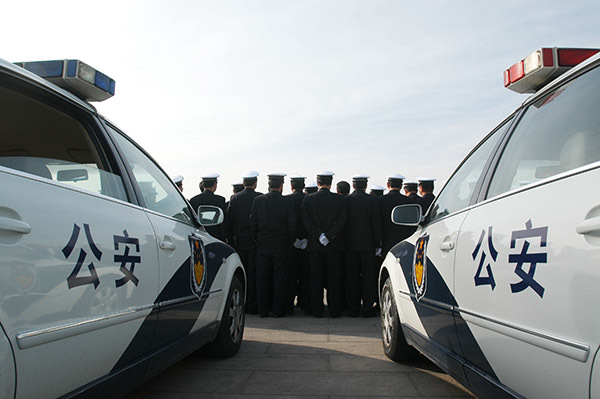
Illustration: CCP Police Vehicle (China Photos/Getty Images)
[People News] Recently, a controversial anti-smoking incident occurred in Shenzhen, a city recognised for having the strictest 'anti-smoking regulations' in China.
A 29-year-old woman named Wang was at a bus stop in the Guangming District, where she advised a man against smoking. After a conflict erupted between them, she called the police for assistance. The smoker was fined, but Wang, who sought help, was taken to a law enforcement centre for an extended 'personal safety inspection.' This inspection involved her being stripped of her clothing, having her underwear removed, and her high myopia glasses taken off. She even lost control of her bladder due to being unable to use the restroom for a prolonged period.
The exposure of this incident triggered a significant public outcry. The focus of public anger quickly shifted from 'Is smoking allowed at the bus stop?' to Why has the person advising against smoking become the one who is humiliated?'
A Drink Sparks an Anti-Smoking Conflict
On April 24, around 5 PM, at a bus stop on Tongren Road in Guangming District, Shenzhen, about ten people were waiting for the bus under a sunshade to avoid the rain. A man, Mr Chen, was smoking at the bus stop when a woman, Ms Wang, and her two friends approached him to advise against it. Mr Chen refused to extinguish his cigarette. After unsuccessful negotiations, Ms Wang poured her drink over Mr Chen's cigarette. The drink cup fell to the ground, and Mr Chen immediately picked it up and threw it at Ms Wang and her friends, resulting in a physical altercation, after which Ms Wang called the police.
When the police arrived, they took both individuals to the public security law enforcement centre. The police informed Ms Wang that public transport platforms are considered outdoor areas and 'do not fall within the non-smoking range.' They also stated that her act of pouring the drink on the cigarette was suspected of 'insulting others,' and she could face administrative detention for five days.
However, according to the "Shenzhen Special Economic Zone Smoking Control Regulations" that have been in effect since 2014, areas outside the entrances and exits of public transportation stations, outdoor platforms of public transport vehicles, and areas where waiting lines form are designated as non-smoking zones. The police's account regarding Ms Wang is clearly at odds with these regulations.
Chen (Chen Mou) was ultimately fined fifty yuan by the transportation enforcement department. However, the subsequent ordeal faced by the complainant, Ms Wang, shocked everyone.
As revealed by Ms. Wang on her Weibo account (@来杯姬尾酒), she was subjected to a "personal safety inspection" in a confined area, which involved stripping naked, bending over against the wall, removing her underwear, and even taking off her glasses for severe myopia (she was also prohibited from wearing contact lenses during the inspection, resulting in significant visual impairment). Despite her repeated requests to use the restroom, she did not receive a timely response and ended up urinating on the sleeve of her one-piece sweater. Other women in the same room, including a 65-year-old woman with allergic urticaria and a patient with depression, also endured similar humiliating inspections, with their pleas being ignored for an extended period.
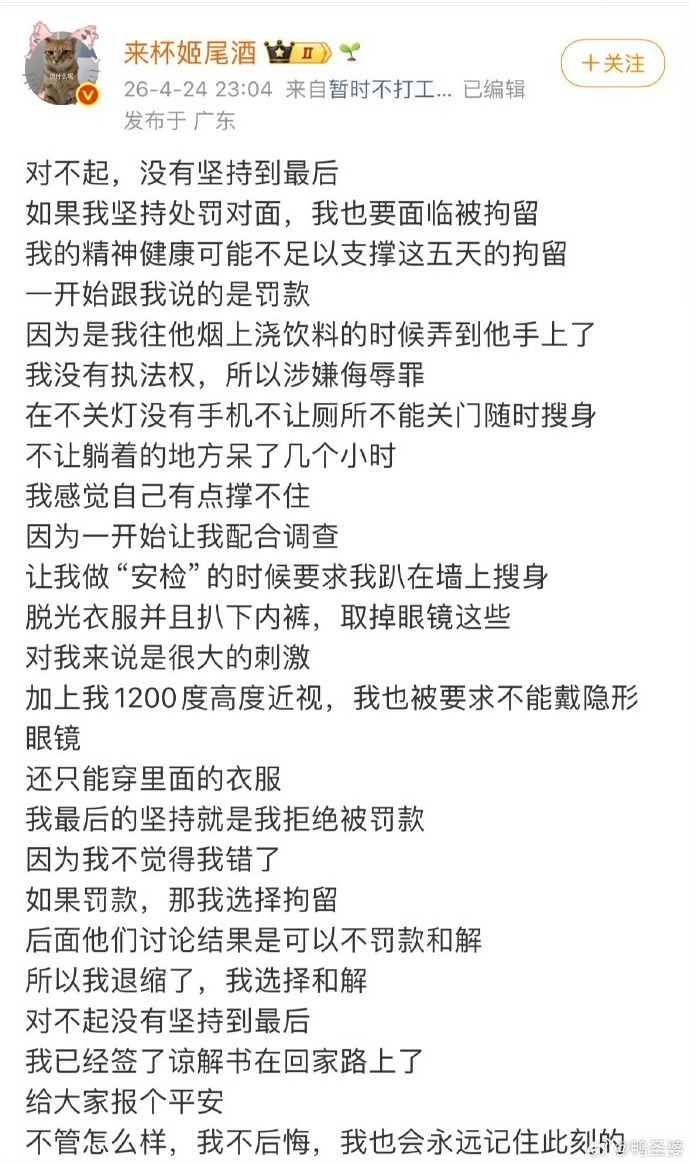
(Image source: Weibo @来杯姬尾酒)
The police described this as a "public security summons for cooperation in investigation," rather than formal detention. However, the entire process lasted several hours, leading to Ms Wang experiencing a mental breakdown. Eventually, under pressure, she settled with Chen and signed a people's mediation agreement, relinquishing any claims against him.
This incident quickly became a trending topic on Weibo, igniting discussions about smoking bans in public spaces, the limits of law enforcement, and issues of gender violence.
Following the surge of public opinion online, a joint investigation team was established on April 25 in the Guangming District of Shenzhen, comprising departments such as health, public security, transportation, and local street offices. That evening, the investigation report was released, stating: "Both parties were brought to the centre for a security check due to a dispute. Ms Wang's examination was conducted by female staff in a closed area; Chen's smoking behaviour violated the 'Shenzhen Special Economic Zone Smoking Control Regulations', and he has been fined administratively by the transportation enforcement department and ordered to rectify his behaviour." The report emphasised that these checks were conducted in accordance with regulations, and ultimately both parties voluntarily mediated and did not pursue accountability against each other.
After the incident, Ms Wang took to Weibo to express: "I do not regret advising against smoking, but I am utterly devastated by the treatment from the police." Public sentiment among netizens quickly turned to question the boundaries of law enforcement, asking, "Why was the complainant subjected to a strip search?" and "Did the police show favouritism towards the smoker?"
The necessity of 'strip searches' in law enforcement has sparked public scepticism.
According to reports from Feng Media, the term 'strip search' does not exist in current Chinese law; it only defines 'personal searches,' which are categorised into ordinary body surface checks and checks of private areas (commonly referred to as 'strip searches'). According to the 'Procedures for Public Security Organs Handling Administrative Cases' in China, public security organs are permitted to conduct searches on individuals related to violations of public order management, and searches of women’s bodies must be performed by female staff, aimed at preventing accidents, collecting evidence, or checking for injuries, contraband, etc.
However, the details recounted by Ms Wang—including the removal of her underwear, the taking off of her high myopia glasses, and the prolonged restriction on restroom access—have raised significant public scepticism about whether these actions align with the enforcement boundaries of 'preventing accidents, collecting evidence, or checking for injuries, contraband, etc.' The Southern Metropolis Daily, a mainland media outlet, cited several lawyers who stated: 'The use of personal search rights should be strictly limited. If the actions taken during the search result in the victim experiencing psychological trauma that far exceeds the legal classification of the case itself, this represents a classic case of 'imbalance between administrative purpose and means,' which is a form of excessive law enforcement.'
Some legal experts in mainland China also argue that in cases of ordinary public security disputes, where the complainant is not a major suspect, there should be clearer criteria and oversight mechanisms to determine the necessity of conducting highly private inspections.
Analysts suggest that the 'strip search' conducted on individuals involved in non-violent, minor public security disputes has fundamentally strayed from its intended purpose of ensuring personal safety, evolving instead into a humiliating law enforcement tactic. The aim is to coerce individuals into compliance under the weight of severe psychological trauma, compelling them to relinquish their legitimate rights in exchange for the chance to escape a degrading situation. When law enforcement no longer serves as a protector of justice but instead becomes a mechanism for humiliating those who defend their rights, public spaces risk becoming havens for wrongdoers to perpetrate their misdeeds.
△



News magazine bootstrap themes!
I like this themes, fast loading and look profesional
Thank you Carlos!
You're welcome!
Please support me with give positive rating!
Yes Sure!