
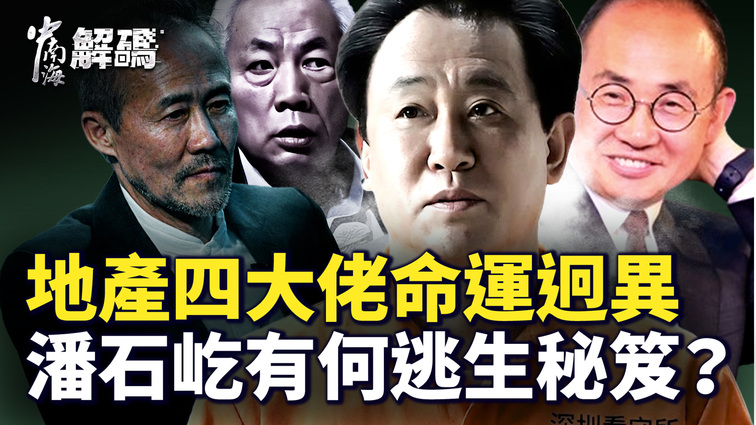
The Four Real Estate Tycoons Have Very Different Fates — What Is Pan Shiyi’s Secret to Making a Safe Exit? (People News)
[People News] On April 13th and 14th, the once untouchable Chinese real estate tycoon Xu Jiayin found himself in the defendant's seat at a Shenzhen court. Confronted with a staggering debt of 330 billion dollars, a sum that could devastate countless families, Xu Jiayin ultimately bowed his head and pleaded guilty. Just 48 hours after the conclusion of Xu Jiayin's trial, on April 16th, former Chinese real estate mogul Pan Shiyi, who was in the United States, suddenly broke his long silence by publishing a lengthy article titled 'My Reflection.' In this piece, he expressed to the world that he had discerned the rules of this game, enabling him to leisurely take photographs and learn programming in the early morning in New York while sitting on billions in assets. This article provoked the ire of the Beijing authorities and was swiftly deleted shortly after its release.
Perhaps he should consider himself fortunate: had he been a bit slower back in the day, would he also be facing trial today for that astronomical figure? Xu Jiayin pleads guilty while Pan Shiyi escapes; this contrasting fate brings to mind two other prominent figures in Chinese real estate: Ren Zhiqiang and Wang Shi.
Why is it that, despite all having emerged from that tumultuous era, some ended up as prisoners, some as survivors grappling with the aftermath, while only Pan Shiyi became the calm observer capable of penning 'My Reflection'?
The Disappearing Long Article and the Ponzi Scheme
Pan Shiyi's lengthy article titled 'My Reflection' unsurprisingly went viral online but was erased at lightning speed in less than 24 hours, leaving behind only a cold '404.'
This article serves not so much as a reflection but rather as a declassified document concerning the 'collective frenzy' that has persisted for over 30 years. Pan Shiyi no longer makes light of the situation; instead, he adopts a cold and incisive tone to strip away the last remnants of shame from China's real estate industry. He reveals how, over the past three decades, this sector has gradually evolved into a colossal 'Ponzi scheme' driven by policy incentives and financial collusion.
To begin with, Pan Shiyi uncovers the fundamental logic behind this game: it is not merely developers constructing buildings, but rather a 'collective conspiracy' where all parties seek their own benefits.
Local governments depend on 'selling land' to sustain city operations and fiscal expenditures, while developers serve as the conduits for capital, acquiring land through substantial bank loans. The most crucial final link in this scheme is the multitude of homebuyers who cling to their dreams of the future. Everyone is betting that housing prices will perpetually rise, wagering that the funds from new entrants can cover the debts incurred by earlier investors.
Pan Shiyi bluntly states in the article that real estate is a financial game of 'borrowing new debts to repay old ones'; they are not building houses, but rather generating debt. If new capital ceases to flow, the government cuts off funding, or the public refuses to step in, and if housing prices stagnate, this entire scheme will collapse instantly.
Pan Shiyi's decision to speak out only after Xu Jiayin's trial stems from his desire to finalise the separation: he seeks to demonstrate that Xu Jiayin's downfall is not merely a case of personal greed, but rather that the intertwined system of 'land, money, and housing' has reached its conclusion.
The deletion of this lengthy article can be attributed to its candid nature, as it not only conveyed the truth but also highlighted a critical point: if this situation involves everyone, with the central government being the ultimate authority, why is it that only Xu Jiayin is currently imprisoned?
One of the most pressing questions on everyone's mind is why Pan Shiyi has managed to evade similar consequences.
To grasp why Pan Shiyi has escaped scrutiny, it is essential to look beyond his wealth and consider his life experiences and interpersonal strategies.
So, why has Pan Shiyi been able to avoid trouble?
Pan Shiyi's personal WeChat public account has remained inactive for three years. Prior to releasing his lengthy article titled "My Thoughts," he quietly published another piece on April 6, titled "My Fate is Determined by Me, and Also by Heaven." In this article, he reflects on his life journey and shares his insights on life, work, and social interactions.
He remarked, "Stability is something that seems unimportant when everything is fine; it is only when problems arise that we recognise its true value." When he spoke of "Heaven," he described it as a higher existence and wisdom, stating, "Heaven is greater than I am," emphasising that no matter how hard one tries, there are limits to what can be achieved. He urged people to maintain a sense of gratitude, warning that if one believes everything is solely earned through personal effort, it can lead to a hardened heart.
In conclusion, Pan Shiyi stated, "When the heart is calm, one can gradually gain clarity. When it is time to exert effort, one should do so without forcing outcomes, and also know when to let go. This is not about conceding defeat, but rather recognising that Heaven is greater than I am."
According to public records, Pan Shiyi was born in 1963 in Panji Zhai Village, Tianshui City, Gansu Province. In 1995, he and his wife Zhang Xin co-founded SOHO China Limited. On October 8, 2007, SOHO China successfully went public on the Hong Kong Stock Exchange.
In 2005, Pan Shiyi and Zhang Xin co-founded the SOHO China Foundation, with the goal of transforming the lives of students and families in impoverished regions through educational funding. However, the foundation's $15 million donation to Harvard University in 2014 ignited considerable controversy, resulting in attacks on Pan Shiyi by the online forces of the Chinese Communist Party.
Since 2014, Pan Shiyi has been gradually divesting his assets. In June 2021, Blackstone Group announced its intention to acquire SOHO China for $3 billion, a move that industry insiders interpreted as a strategy to 'cash out'.
Nevertheless, the deal faced obstruction from the Chinese Communist authorities. In August 2021, they launched an investigation under the Anti-Monopoly Law. Following this, SOHO China announced the termination of its agreement with Blackstone Group.
On September 7, 2022, SOHO China released an announcement on the Hong Kong Stock Exchange stating that Pan Shiyi had resigned as chairman of the board, and Zhang Xin had stepped down as CEO. The announcement indicated that after their resignations, the couple would concentrate on supporting arts and charitable initiatives. Subsequently, reports emerged that Pan Shiyi and his wife had settled in New York, USA.
Pan Shiyi's life story reveals that his modest background has given him a natural sense of 'survivor's anxiety'. Unlike Xu Jiayin, who harbours an expansionist desire to reclaim everything, Pan Shiyi's sense of crisis is marked by a constant readiness to withdraw, accompanied by an intrinsic scepticism towards the current state of prosperity.
For Pan Shiyi, SOHO China is merely a commodity; if the price is right and the circumstances are unfavourable, he can easily discard it. This attitude of 'not being attached, not being obsessive' enabled him to calmly cash out and exit in 2014, even as others were frantically competing for prime land deals.
Moreover, Pan Shiyi understands the essence of 'decluttering' better than anyone else. In the Chinese business landscape, many entrepreneurs find themselves constrained by labels such as 'patriotic entrepreneur' or 'industry leader,' often choosing to stubbornly hold on to their positions to save face.
While the internet was mocking him as 'Pan Pao Pao,' he retreated to the United States to learn programming and photography, minimising his public presence. This kind of 'flexibility' in his character helped him avoid the tragic confrontations that Ren Zhiqiang experienced.
Pan Shiyi once shared a story about the differing approaches he and Ren Zhiqiang took when dealing with officials, which may explain their ultimately divergent fates.
He recalled an incident when he and Ren Zhiqiang were summoned by a minister for criticism. Pan Shiyi's approach was to 'nod and admit fault.' He believed there was no need to create conflict; by simply nodding, the minister would eventually run out of criticisms.
In contrast, Ren Zhiqiang opted to 'stand firm.' When the minister criticised him, Ren Zhiqiang would respond in kind, resulting in a standoff that lasted three hours, with both men sweating from the intensity of the exchange.
Amid the extremely tense atmosphere at the scene, Pan Shiyi left the venue several times under the pretext of needing to go to the restroom to avoid conflict, circling outside the office before returning. This incident was later ridiculed by Ren Zhiqiang, who remarked that Pan Shiyi was so frightened by the minister that he kept running to the restroom. However, Pan Shiyi clarified that he simply believed that dialogue should occur in a calm environment and that there was no need to intentionally create a tense atmosphere.
Pan Shiyi also noted that he never gets angry when confronted with criticism or rumours. For example, when a newspaper accused him of fraud in an online auction, he found it amusing after reading the article and even shared it on Weibo, explaining the fair process of the auction.
In a similar vein, both seeing the truth and speaking candidly, Pan Shiyi opted to express his views overseas. Ren Zhiqiang, known as 'Ren Da Pao' for his confrontational style, chose to speak out domestically. Currently, he has spent several years in prison, facing an 18-year sentence.
On the other hand, Xu Jiayin represents the extreme outcome of the real estate boom. His failure stems from his inability to differentiate between 'his own capabilities' and 'the dividends of the era.' He believed he was a leader, but in reality, he was merely a pawn.
While Xu Jiayin was still extravagantly spending money at banquets and passionately discussing the dreams of Evergrande Auto and Evergrande Spring, the astute Pan Shiyi was already busy selling, selling, selling. At that time, he faced widespread criticism online for allegedly fleeing the scene and being unpatriotic. However, a decade later, Xu Jiayin appears grey-haired in court, while Pan Shiyi reflects on his life after the storm in a lengthy article from New York. What does this reveal? In a frenzied era, survival does not necessarily belong to the strongest, but rather to those most attuned to danger. Pan Shiyi's success stems from his belief that games rarely end well.
Then there is Wang Shi, the patriarch of Vanke, who has consistently sought dignity and a professional managerial system. Even after years of retirement and attempts to maintain a professional distance from power, the ongoing aftershocks of the Vanke crisis have led to rampant rumours about Wang Shi's troubles. Despite his repeated clarifications, he has not been able to achieve the same level of nonchalance as Pan Shiyi, who has embraced a 'zero assets, personal freedom' lifestyle.
Wang Shi and the aftershocks he cannot escape
If Pan Shiyi embodies 'calm realism,' then Wang Shi's character is marked by a pronounced 'elitist arrogance.'
Although Wang Shi has not been the chairman of Vanke's board since June 2017 and no longer engages in daily decision-making, the deepening real estate crisis leading into 2026 seems to be gradually consuming this once-elegant patriarch amid the era's aftershocks.
Recently, rumours surrounding Wang Shi (Wáng Shí) have been swirling. On April 12, prominent Weibo user Qin Feng posted that 'Wang Shi has been arrested,' and this news quickly gained traction online. However, this post is no longer visible on Qin Feng's Weibo account. Qin Feng, a former political reporter for Phoenix Television, is related by marriage to Li Zhaoxing, a former Minister of Foreign Affairs of the Communist Party of China. As a result, many believe that the rumours may have some basis.
That evening, Wang Shi took to Weibo to say, 'It seems that everyone is more concerned about my situation than I am. Everything is fine, and I will leave the rumour-mongers to the law.' His wife, Tian Pujun, also posted three messages on Weibo that evening to refute the rumours and denounce those spreading them. On the 14th, Tian Pujun's office issued a lawyer's letter, explicitly stating that the claim of Wang Shi's arrest is a malicious fabrication.
While Wang Shi and the relevant parties have tried to adopt a 'calm and collected' approach to dispel the rumours, the frequency of their clarifications reveals an unprecedented level of anxiety.
Firstly, a defining trait of Wang Shi's character is his almost obsessive pursuit of 'status' and 'dignity.' Unlike Pan Shiyi, who can endure criticism, Wang Shi is deeply concerned about his social reputation. This 'scholar' persona has brought him numerous accolades during prosperous times, but in challenging times, it has become a significant burden.
Secondly, Wang Shi's crisis stems from his misjudgment regarding the 'professional boundary.' He has consistently believed that as long as Vanke's system is robust and its equity structure is decentralised, it can remain unbeatable in China's business landscape. However, he has overlooked the fact that in the real estate sector, which is deeply intertwined with local finances and bank credit, true independence is unattainable. As the spiritual leader of Vanke, Wang Shi cannot exit as effortlessly as Pan Shiyi.
Thus, when we compare Wang Shi with Pan Shiyi, we uncover a brutally harsh reality: Pan Shiyi's 'escape' is rooted in his disbelief in this system, while Wang Shi's 'entrapment' arises from his excessive faith in its rules.
In fact, the recent rumours surrounding Wang Shi's disappearance and his difficulties in leaving, regardless of their truth, reflect a subconscious sentiment among the public: in the face of a collective reckoning of the times, no one can fully withdraw simply by being 'elegant.'
Who is the true originator of the Ponzi scheme?
These four prominent figures have all experienced thirty years of real estate frenzy and have witnessed the pyramid constructed by the government, banks, developers, and homebuyers. Yet, they have ultimately arrived at starkly different conclusions.
However, we must not forget the decision-makers in this Ponzi scheme who continuously inflated land prices for real estate financing, the financiers who permitted leverage for interest, and the ordinary investors who have drained six wallets, taken on thirty years of mortgage debt, and now find themselves staring at unfinished buildings or devalued properties, wanting to cry but unable to.
Therefore, as we observe Xu Jiayin sitting in the defendant's chair during his trial, we must ask ourselves: are there still many empty seats in this courtroom?
What has become of the officials who once recklessly drove up land prices for the sake of political gain? What about the bank presidents who approved those loan applications? And what of the 'high-level rent-seekers' who enjoyed the most substantial profits during the real estate boom, only to escape unscathed when the crisis struck? While Xu Jiayin is not blameless, his trial serves merely as a 'sacrificial pawn to protect the king's performance. As long as this system persists, the true masterminds will never find themselves in the defendant's chair.
(Originally published by People News)
△





News magazine bootstrap themes!
I like this themes, fast loading and look profesional
Thank you Carlos!
You're welcome!
Please support me with give positive rating!
Yes Sure!