
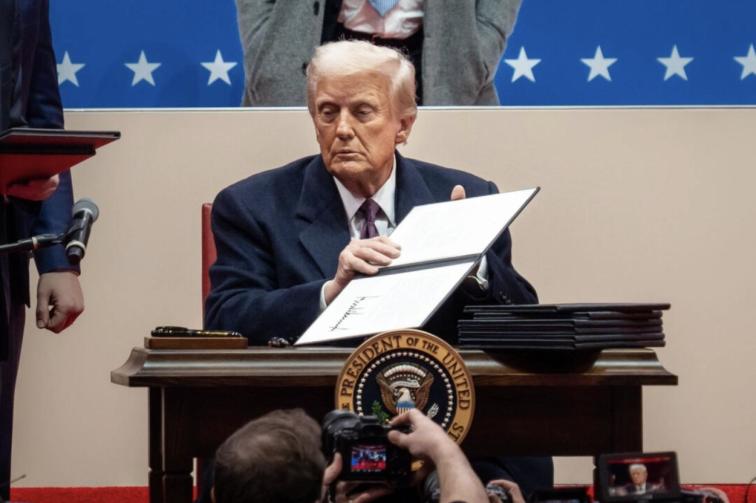
File photo: U.S. President Donald Trump signing an executive order at the Capital One Arena in Washington on January 20, 2025. (Madalina Vasiliu/Dajiyuan)
[People News] Australian law professor Yuan Hongbing has cited information from conscientious individuals within the CCP, disclosing the party's extensive support for Iran during the US-Iran conflict. As a result, the United States must navigate a region filled with deception, requiring both overt and covert strategies to achieve peace.
In an interview with 'China Insight', Yuan Hongbing further quoted these conscientious insiders, stating, 'The CCP is actually providing all-weather strategic partnership support to the Iranian regime. While publicly calling for a ceasefire, it has been secretly backing Iran's comprehensive development in international politics, economics, science and technology, particularly in the military sector. The CCP's infiltration into various levels of Iranian officials far surpasses the international community's understanding. According to reports from these conscientious insiders, the CCP has long established a shadow cabinet for Iran, which includes weapons and equipment, military supplies, and counterfeit US dollars produced by North Korea. Numerous shoulder-fired missile launchers and other military and dual-use materials, along with counterfeit US dollars, have been directly transported into Iran via the China-Iran railway, serving as military pay for the soldiers of Iran's Islamic Revolutionary Guard Corps.
Yuan Hongbing has disclosed that the Chinese Communist Party's (CCP) Ministry of State Security has secretly formed a psychological research institution aimed at U.S. President Trump. This covert research body consists of personnel from various CCP departments, including military intelligence, public security, foreign affairs, and the International Liaison Department of the Central Committee. The team is made up of numerous psychological experts who focus on analyzing the psychology of the U.S. President. Following the Trump 2.0 era, this team has significantly ramped up its psychological studies on President Trump.
The CCP believes that to undermine the United States' national will and weaken the country for its own advantage, it must first comprehend and target the individual who embodies that will—the U.S. President. They assert that by understanding the President's psychology and developing appropriate psychological warfare strategies, they can effectively attack the U.S. national will and ultimately defeat the United States. This mindset also influenced the negotiation tactics employed by Iran's representatives during the recent U.S.-Iran talks, which were crafted and provided by the Xi Jinping administration.
In the context of the Iran conflict, the CCP's regime established two primary objectives. The foremost goal was to transform Iran into another 'Afghanistan' for the United States, thereby distracting U.S. resources and creating conditions for the CCP to initiate a conflict in the Taiwan Strait, marking a pivotal step in the global expansion of communist totalitarianism. The secondary goal was to ensure that Iran's political structure would not collapse, allowing the CCP to maintain control over Iran and manipulate global terrorist organisations to disrupt international stability.
Why did Israel launch a raid before April 7 that destroyed a section of the China-Iran railway within Iran? This railway was once a source of pride for the Chinese Communist Party as part of its Belt and Road Initiative. Remarkably, it was repaired within two days of the bombing, which shocked and surprised the international community. How did Iran manage to achieve such impressive repair capabilities? Yuan Hongbing disclosed, 'The engineering troops that repaired this railway came from the Chinese Communist Party. In a significant sense, the Chinese Communist Party has effectively become a participant in this war in Iran.'
Consequently, the Chinese Communist Party has been eager to understand Trump's mindset regarding the Middle East conflict. Trump frequently shifts between expressing a desire to negotiate and declaring intentions to reduce Iran to the Stone Age. He also discusses imposing a 50% tariff on military aid to Iran, while simultaneously mentioning strengthening economic and trade cooperation. One moment he criticises NATO, and the next he calls for NATO to take action... The policies are highly inconsistent, with even different statements made within a single day, making it exceedingly difficult for the Chinese Communist Party to decipher its intentions.
Thus, when Trump visits Beijing in May, will he only discuss agricultural trade? That seems unlikely; he likely has numerous issues on his agenda and may even change his mind at the last moment.
In line with the Chinese Communist Party's (CCP) typical approach, high-level verbal confrontations require extensive advance preparation, and discussions must be conducted with meticulous attention to detail, strictly following the established script. In preparation for the upcoming meeting between Trump and Xi in mid-May, the CCP has been working for over a month. Since it was previously announced that the talks would take place at the end of March, the CCP likely began preparations in February, potentially producing a comprehensive set of documents and rehearsing various scenarios. Last time, at the end of March, Trump unexpectedly declared he would not attend, citing the ongoing Middle Eastern conflict, which rendered all of the CCP's preparations futile and necessitated changes. With the Middle Eastern war still unresolved and the CCP's military support for Iran being exposed, along with Xi Jinping's blatant deception of Trump, could the U.S. not again respond with, 'the war is still ongoing, so we cannot proceed'?
Examining Trump's psychology, research has been ongoing since the start of his first term, nearly a decade now, yet there are frequent instances of last-minute changes that lead to awkward situations. Initially, it was thought that Trump, as a businessman, could be enticed into compliance through financial incentives, prompting the CCP to attempt to infiltrate American values through business. However, Trump has been actively dismantling the hegemonic mindset of autocracy and tyranny on a global scale, leading to repeated embarrassments for the CCP, which has failed to achieve its objectives and instead faced setbacks. The research team is filled with inept individuals, raising concerns that in a moment of frustration, Xi might decide to make a few of them scapegoats.
Last Friday, the United States unexpectedly announced sanctions against Chinese companies that purchase oil from Iran, including Hengli Petrochemical and Shandong Shengxing Chemical Co., Ltd., which had already been sanctioned. In total, at least five Chinese companies have recently faced U.S. sanctions, along with approximately 40 other shipping companies and vessels associated with a shadow fleet. This news was sudden and difficult to predict.
So, how should Xi Jinping respond to Trump's visit to Beijing? The leverage lies with the other party, leaving him without any strong bargaining chips.
The ongoing conflict in the Middle East has effectively paused navigation through the Strait of Hormuz.
Xi Jinping has stated the need to ensure freedom of navigation in the Strait of Hormuz. While this statement seems correct at first glance, the Chinese Communist Party (CCP) opposes U.S. control of the strait and participation in maritime mine clearance. This implies that the CCP is aligning with Iran against the U.S. in the Strait. What room is there for negotiation? The CCP fails to understand Trump and cannot grasp his mindset; continuing discussions could lead to Trump walking away from the negotiations. The CCP risks harming itself in the process.
In reality, the U.S. is aware that controlling the strait also means holding the CCP's Achilles' heel. More than 40% of the CCP's oil imports transit through the Strait of Hormuz, making its energy security heavily reliant on the Middle East. Any instability in energy supply could jeopardise the CCP's export-driven manufacturing and industrial system, making it particularly vulnerable. Thus, after the U.S. military blocks the Strait of Hormuz, it is the CCP that faces the greatest pressure.
For the United States, controlling energy routes, limiting the profit margins and competitiveness of the Chinese Communist Party (CCP) manufacturing sector, and targeting the CCP's export-driven economy ultimately serve to strengthen the dollar system. This strategy aims to redirect capital back to dollar assets, reinforce U.S. financial dominance, and regain control over global supply chains and financial systems, effectively delivering a downward blow and overwhelming pressure on the CCP.
The Strait of Hormuz is simply a tool, marking the endpoint of Trump's blockade, which disrupts years of meticulous planning by the CCP, reshapes the global power structure, and contains the CCP's influence.
These developments were completely unforeseen by the CCP; the situation has arisen suddenly and is now unmanageable. For Xi Jinping (Xi Jinping) and the CCP, Trump's erratic strategies and tactics have left their secret teams struggling to comprehend the situation. Despite their extensive research and calculations, their cleverness has ironically put their own positions at risk.
(First published by People News)
△






News magazine bootstrap themes!
I like this themes, fast loading and look profesional
Thank you Carlos!
You're welcome!
Please support me with give positive rating!
Yes Sure!