
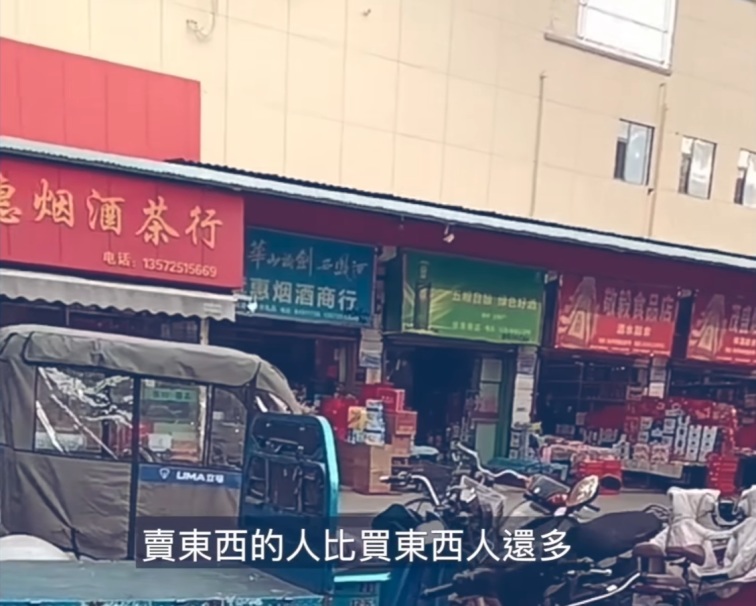
Caption: A visual representation of China's economic downturn. Across both first-tier cities and remote towns, shopping malls and markets face waves of closures, with vendors often outnumbering customers. (Video screenshot)
[People News] What a blunder! It's a disaster! The omnipotent netizens have forced the Chinese Communist Party to perform a new version of 'self-contradiction.' The National Bureau of Statistics, which claims to have unbeatable data, has been reported by netizens to the National Anti-Fraud Centre, known for its keen eye for fraud.
On April 16, the National Bureau of Statistics released the national economic data for the first quarter of 2026. Deputy Director Mao Shengyong stated that the GDP for the first quarter reached 33.4193 trillion yuan, showing a year-on-year growth of 5.0% at constant prices, which is an acceleration of 0.5 percentage points compared to the fourth quarter of the previous year, marking a good start.
While the head of the National Bureau of Statistics was excitedly boasting about the achievements of the great nation, he did not expect that the comment section of the video would turn into chaos. A total of 40,000 comments from netizens all tagged the 'National Anti-Fraud Centre,' demonstrating unprecedented unity and a common goal among the netizens. They were even more coordinated than when reporting the Cambodian telecom fraud centres.
Netizens could no longer tolerate the situation. Under the guidance of Xi Jinping's economic thought, the National Bureau of Statistics has degenerated from a serious data measurement department into a centre of data fabrication, filled with lies, only singing praises for the emperor and failing to speak for the common people, truly a fraud centre.
To understand how dire the situation is for the grassroots population across the country, one only needs to look at the harsh reality:
The employment and income crisis is widespread. How many people are unemployed or underemployed across the country? Each year, over 12 million college graduates face the pressure of unemployment. The so-called 'flexible employment' has effectively turned into a form of invisible unemployment for a significant portion of the population, with its scale rapidly increasing from approximately 120 million in 2015 to between 240 million and 280 million by 2025. The ride-hailing industry, which once served as a safety net for employment, is now saturated, with workers earning only 15 yuan for a 9-kilometre ride, and competition has reached extreme levels.
The living conditions of low-level workers are even more alarming. On April 14, a teenager working in Guangdong collapsed after a gruelling 16-hour shift due to exhaustion. On April 16, a sanitation worker in Zhaotong, Yunnan, reported a monthly salary of just 1,680 yuan, working 8-10 hours a day without any holidays throughout the year. In Guizhou, internet cafes charging 0.6 yuan are overcrowded with individuals who have been homeless for years. In Beijing, 5 yuan lunch boxes have sparked a frenzy among workers. Young people are living in the underpasses of Shenzhen. The price of live pigs has plummeted to 3 yuan per jin. Half of the actors in Hengdian are now unemployed.
The industry reshuffle is intensifying, and an economic downturn is looming. The catering industry has become a disaster zone, with approximately 9,000 restaurants closing each day in 2025, leading to a total of about 3 million closures for the year. The number of individuals subject to enforcement for dishonesty nationwide stands at around 8.5 million, highlighting the struggles of many businesses and individuals ensnared in debt and operational failures.
The decline in consumption and the eruption of social contradictions are evident. Major commercial buildings and supermarkets across the country are nearly empty, and the streets of first-tier cities are hauntingly quiet. The only place bustling with activity is the entrance of the National Letters and Visits Bureau in Beijing, where individuals facing forced evictions, judicial injustices, unpaid wages, and campus bullying line up day and night to seek redress for their grievances. Unfortunately, they often face interception, kidnapping, and even black jail tactics. The oppressive nature of the system has not only crushed social justice but also trampled on the basic tenets of humanity, leading to a series of tragic loyalty incidents. In Fangshan, Beijing, a wronged individual drove a bulldozer through a market, making it difficult to count the casualties.
The plight of the lower class has spread across the nation, affecting everyone from college students to workers, ride-hailing drivers to sanitation workers, and restaurant owners to young people struggling at the bottom of the social hierarchy. The statistics are stark, and the reality is even harsher—people cannot afford basic consumption, job security is precarious, avenues for protecting rights are nonexistent, and loyalty incidents are widespread. The economic downturn has inflicted significant trauma on society, and the systemic issues are rapidly undermining the basic means of survival.
Despite the grim realities and heart-wrenching suffering, the statistics bureau and party media choose to ignore these issues, instead promoting a narrative of economic optimism. On Douyin, some netizens have taken to storming the tower in the middle of the night. In a video showcasing a street filled with food stalls, the blogger wrote, 'Sinners! The destruction caused by one person takes generations to repair.' The most liked comment read, 'Our grandparents made the wrong choices; we must correct them to spare future generations from such hardship.'
While officials are exuberantly optimistic, the public feels a chilling reality; what lies behind this stark contrast? Let’s delve into the statistics bureau's claim of a 5% 'good start' to uncover the truth.
Firstly, the most striking contradiction lies in the core imbalance where production significantly outstrips demand. According to official data, the industrial added value for enterprises above a designated size increased by 6.1% year-on-year, which is an acceleration of 1.1 percentage points compared to the fourth quarter, with March alone achieving a growth rate of 5.7%. The equipment manufacturing sector grew by 8.9%, while high-tech manufacturing saw an impressive surge of 12.5%. At first glance, it appears that new productive forces are gaining traction, and the supply side is flourishing.
In stark contrast, the demand side shows a different picture. The total retail sales of consumer goods only rose by 2.4%, which is a 0.7 percentage point increase from the fourth quarter, but in March, it fell to just 1.7%. This phenomenon of 'strong supply and weak demand' is no longer a secret, and it became even more pronounced in the first quarter of 2026: while industrial capacity is operating at full speed, inventories are quietly accumulating, leading to pressure on corporate profits and stagnant prices. Although the Producer Price Index (PPI) has barely turned positive, it does little to conceal the reality of sluggish downstream demand.
Furthermore, the Chinese Communist Party has inflated demand figures by including online retail service consumption. If this new addition is excluded, the year-on-year and month-on-month growth of physical consumption is likely to show negative growth or be even weaker. The incorporation of online data into GDP calculations has made the figures look better, but it has obscured the downturn in offline physical stores. Additionally, since the Spring Festival occurred in February this year, it inadvertently extended the period for purchasing New Year goods, which stimulated consumption; otherwise, the data would have been even less favourable.
Secondly, state-owned enterprises continue to take the lead and make significant progress, creating a stark contrast with the retreat of private enterprises.
In the first quarter, investments from state-owned and state-controlled enterprises increased by 7.1% year-on-year, while private investments saw a decline of 2.2%. What underpins national investment? The reliance on special bonds, local government financing platforms, and policy bank loans essentially amounts to front-loading debt. Infrastructure investment rose by 8.9%, and manufacturing investment increased by 4.1%. While it appears that total investment has stabilised and grown, the early depletion of fiscal space translates to an increase in debt, suggesting that tax hikes are on the horizon, with the scythe poised over the agricultural sector.
Private enterprises are struggling with a lack of confidence, financing challenges, and the burden of the real estate sector, resulting in a continued low willingness to invest. Xi Jinping's approach to strengthening state-owned enterprises through the 'state advance, private retreat' strategy is becoming increasingly evident in the data. The state sector is fully occupying and replenishing its position, while the private sector is retreating and contracting. This is not a result of market optimisation; rather, it represents a reinforced version of Keynesian and Soviet economic principles. How long can debt-driven investment sustain itself? As the peak of debt repayment approaches, the financial gap will only widen.
Lastly, the growth of residents' income creates a strong perception of hindering GDP growth. The actual growth rate of per capita disposable income for residents is approximately 4.0%, with urban areas seeing only 3.2%, which is significantly lower than the GDP growth rate of 5%. The median income, which more accurately reflects income levels, is below the average, serving as a facade and amplifier for the party-state's livelihood income. A closer look at the data reveals that income growth primarily benefits the export and high-tech sectors, leaving billions of ordinary families feeling the chill.
The long-term sluggishness of consumption can be attributed to the low proportion of residents' income in GDP and the uneven distribution of wealth. High savings among residents are primarily precautionary; people are hesitant to consume or take out loans. This creates a negative feedback loop where unfair distribution hampers basic consumption, leading to product sales backlogs, worsening overcapacity, and a significant decline in economic efficiency. Economically, this situation is referred to as a 'demand-constrained growth trap.' Unfortunately, this is a deadlock that the Chinese Communist Party (CCP) cannot resolve, as its governance has historically relied on seizing private wealth and enriching itself at the expense of the populace.
The ultimate aim of economic development should be to enhance the quality of life for citizens. However, under the CCP system, wealth is concentrated in the hands of the government, state-owned enterprises, and a few monopolistic interest groups, leaving ordinary citizens with an inadequate share of resources. The long-standing low proportion of residents' income in GDP, combined with insufficient labour compensation in the primary distribution, is further squeezed by stability maintenance and infrastructure investments in the secondary distribution. Consequently, people are reluctant to spend, businesses face internal competition, corporate profits decline, employment conditions worsen, and income expectations diminish, creating a vicious cycle. Even if the macro GDP appears impressive at 5%, it is merely an illusion of prosperity for the average person.
Behind the 5% 'good start' lies the systemic limitations and persistent issues of the CCP's economic growth model. This model, which presents 'attractive data but a cold reality,' has long drained public confidence. No one is willing to support a GDP that only benefits the Zhao family.
(First published in People News) △








News magazine bootstrap themes!
I like this themes, fast loading and look profesional
Thank you Carlos!
You're welcome!
Please support me with give positive rating!
Yes Sure!