

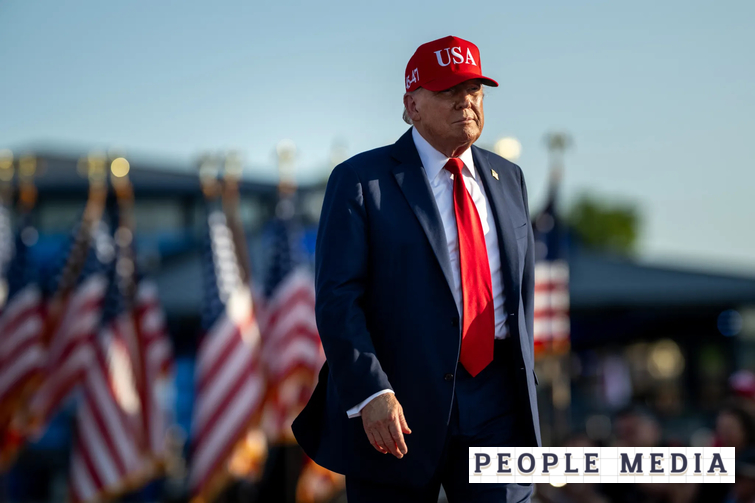
In the early morning of October 6, 2024, Trump delivered his victory speech. (Photo by Chip Somodevilla/Getty Images)
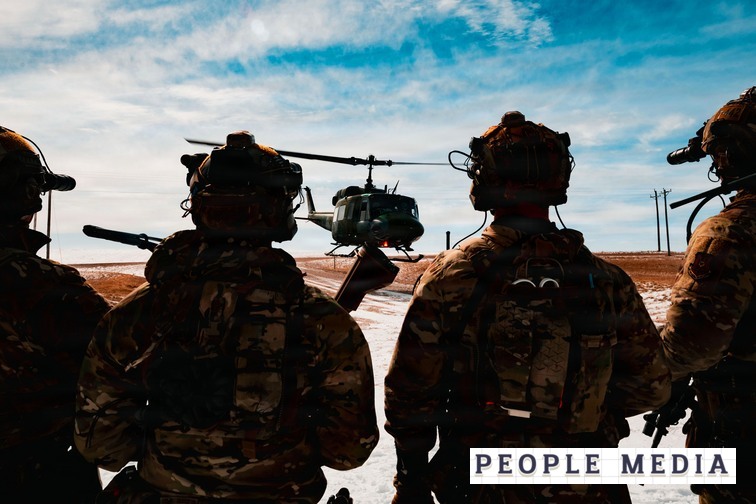
[People News] On April 5, after the successful rescue of the second trapped U.S. military pilot from Iran, President Trump enthusiastically informed Americans via his social media, "He is now safe!" He added, "He was never alone, as his Commander-in-Chief, Secretary of Defence, Chairman of the Joint Chiefs of Staff, and comrades were monitoring his location 24/7 and actively planning his rescue." Trump emphasised, "This marks the first time in military history that two American pilots have been rescued deep within enemy territory; we will never leave our warriors behind." He further stated, "We managed to execute these two operations without a single American casualty, not even one serious injury. This once again demonstrates our overwhelming air superiority over Iran," and declared, "We truly possess the best, most professional, and most lethal military in world history."
Indeed, there are very few militaries in the world capable of successfully completing "one of the most challenging and complex missions in U.S. special operations history." The information and videos released by the U.S. depict the entire rescue operation as akin to a Hollywood blockbuster—exciting, thrilling, and heart-stopping. Perhaps a Hollywood director could use this story as inspiration for a major film, which would undoubtedly be a hit in America.
In the eyes of Trump and genuinely patriotic Americans, despite the rescue operation costing hundreds of millions of dollars, nothing is more important than the success of the rescue, as human life surpasses all else. An Iranian on the X platform expressed such sentiments:
As an Iranian, watching this rescue mission unfold, I found myself praying for the American pilot's safe return—not just for his sake, but also to prevent the Islamic Republic government from using him as a bargaining chip or claiming some twisted 'victory'.
At the same time, I felt a profound sense of envy: your government deployed elite special forces and expensive aircraft, moving heaven and earth to bring an American back home. There was no hesitation, no excuses. In contrast, during the Iran-Iraq War, Iranian authorities employed human shields and recruited child soldiers to clear minefields, treating their own citizens like disposable tools. As we speak, they are still recruiting child soldiers.
The Islamic Republic shows no regard for human life. This is the stark and cruel distinction: one side risks everything to save its citizens, while the other sacrifices its own people to cling to power. Living under these two realities is a heavy burden.
This Iranian perspective resonates with the genuine feelings of many Chinese people. For those living in a country that either respects human dignity or does not, the choice is clear. This American operation not only sent shockwaves through the military world but also reaffirmed to the globe: the truly strong America has returned!
As Israeli Prime Minister Netanyahu expressed in his congratulatory message to Trump: 'This operation reinforces a sacred principle: no one is left behind,' and 'Your leadership has once again brought great victory to America.'
While watching reports on the U.S. military rescue operation, I noticed a particular detail: after all U.S. personnel had evacuated, the U.S. military carried out precision bombing on two C-130 transport aircraft that were initially used to evacuate the assault team and pilots, ensuring their complete destruction to prevent them from falling into Iranian hands. This action was likely pre-planned before the conflict began.
From my perspective, it is clear that the Chinese Communist Party (CCP) is the primary supporter of Iran, and the Trump administration was acutely aware of the CCP's efforts to steal high technology from the United States. Thus, this move is fundamentally aimed at countering the CCP, which has a history of reverse engineering U.S. military aircraft to acquire advanced technology.
For example, during the 1999 NATO bombing campaign against the Federal Republic of Yugoslavia, the U.S. used precision-guided missiles to strike the Chinese embassy in Belgrade. The Chinese government issued a 'stern protest,' while the U.S. admitted it was a 'mistaken bombing' and provided compensation for the damages incurred.
However, the reality behind the scenes is more complex. In fact, prior to the U.S. bombing, the CCP had received a warning from the U.S., but they chose to remain silent due to undisclosed motives. The actual target of the U.S. bombing was over a dozen Chinese military personnel who were hiding in the embassy. Their involvement in assisting Serbia and Montenegro in constructing a radar system, which enabled the Yugoslav army to successfully shoot down the then most advanced U.S. F-117 stealth fighter and collect the wreckage for analysis by Chinese experts, was what ultimately provoked the U.S.
Another significant incident occurred on April 1, 2001, when a U.S.-China military aircraft collision took place over the South China Sea. At that time, a U.S. Navy EP-3 reconnaissance aircraft was on a reconnaissance mission in the area, while the Chinese Navy dispatched two J-8II fighter jets to monitor and intercept it. One of the Chinese jets collided with the reconnaissance aircraft, which had suddenly turned, leading to the crash of the Chinese fighter. The pilot, Wang Wei, ejected but went missing and was later confirmed dead by the Chinese government. The U.S. reconnaissance aircraft was forced to land at Lingshui Airport on Hainan Island.
The two sides were at an impasse regarding responsibility for the incident, which escalated into a diplomatic crisis. After negotiations, the situation concluded with the U.S. expressing regret, the Chinese side releasing personnel, and the return of the aircraft. However, revelations from former CIA employee Edward Snowden indicated that the U.S. military suffered significant intelligence losses, which were quite alarming.
Snowden noted that the pilot of the U.S. EP-3 reconnaissance aircraft made several errors during the incident. One critical mistake was that after the collision, the pilot had approximately 40 minutes to destroy classified materials before being forced to land at Lingshui Airport. Due to inadequate training, not all materials were destroyed in time, allowing the Chinese side to acquire a substantial amount of military confidential information. U.S. officials believe that after the EP-3's forced landing, the documents and equipment on board were in chaos, making it extremely difficult to estimate how many items fell into Chinese hands.
Americans, who have repeatedly faced setbacks due to the Chinese Communist Party, should have learned valuable lessons and enhanced their training to ensure that American military equipment and information never fall into enemy hands. During this rescue operation, when the commander realised that the aircraft could not take off, he decisively ordered its complete destruction, leaving only scraps of useless metal for Iran and the Chinese Communist Party to salvage.
I wonder what the reaction of the Chinese Communist military personnel would be upon witnessing this impressive rescue and the bold actions of the U.S. military?
(First published by the People News)△





News magazine bootstrap themes!
I like this themes, fast loading and look profesional
Thank you Carlos!
You're welcome!
Please support me with give positive rating!
Yes Sure!